

There is a village in East Yorkshire where a stone has been standing for four thousand years.
It stands in a churchyard. Just around 24 feat of gritstone, 15 feet around, roughly forty tons, hauled from an outcrop about ten miles away by men who had no wheel. It leans slightly toward the north wall of the church, which is itself nine hundred years old and looks young beside it.
Around its base are headstones. Rows of them. Slate and limestone, weathered soft, the lettering gone shallow. Names, two dates, a line of scripture where the family could afford the extra cutting.
No one reads them.
They cut the grass and, I understand, the church is still open.
The fact is a headstone has a working life of about three generations, and after that it becomes landscape. Your great-grandchildren might find yours. Their children will walk past it on the way to something else.
The stone in the middle of that churchyard has outlived every grave around it by thousands of years.
Eighteenth-century excavation at its base suggested the stone runs as deep below ground as it stands above it.
Half of it is buried, and that is the half doing the work.
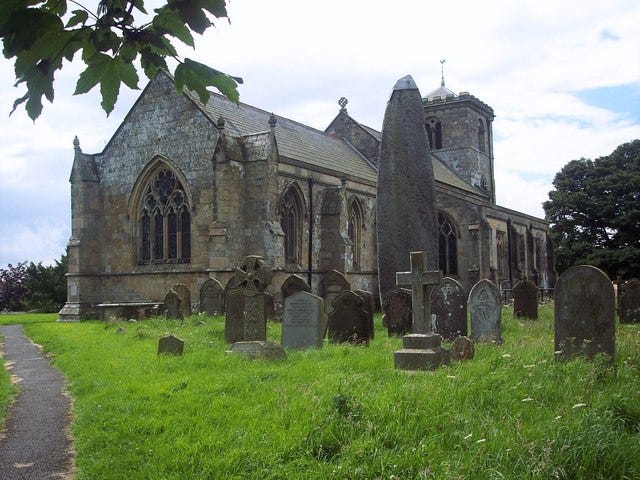
Fifty Thousand Stones
The stone at Rudston is not unusual except in size. Across Ireland, Britain, and Brittany there are roughly fifty thousand of these things. Set upright by human hands, deliberately, at enormous cost.
At Carnac in Brittany there are more than three thousand of them in one landscape, raised over something like two and a half thousand years. Twelve converging rows running better than three miles.
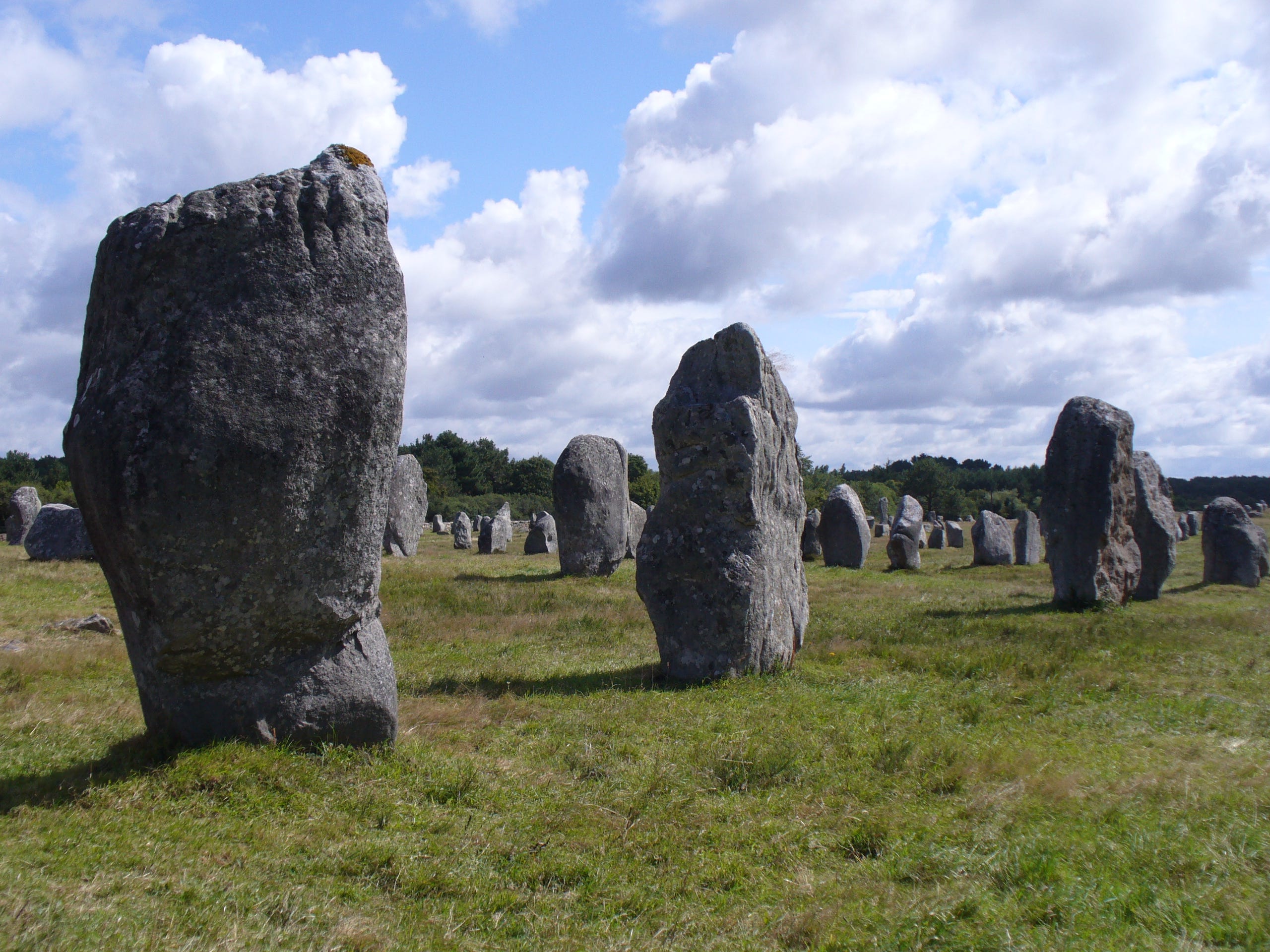
No one knows what they are for.
The people who put them up left no writing of which we know, and even their language is unknown.
The French monuments authority says that the Carnac stones have not yet given up the reason they exist. Every explanation is a guess: observatory, processional route, boundary marker, ancestor cult, calendar. Despite the countless analysis of men in lab coats, no one can read these stones.
Fifty thousand stones still standing.
Not one answer left alive.
If you are a man who has been telling himself that building something big will take care of the legacy, this is a hard lesson. Those men moved forty tons by hand. They out-built every one of us. And the meaning evaporated anyway, because a stone cannot say anything. It can only prompt someone to ask.
If no one is left who knows the answer, the stone becomes nothing but a forgotten decoration.
Four Languages
Four cultures looked at an upright stone, and each named a different part of it.
The Breton called it maen hir. Long stone. That is where our word menhir comes from, borrowed into English around 1834. The Breton named its shape, and nothing else.
The Latin called it monumentum, from monere, to remind and to warn. Literally, a thing that reminds you. The same root gives us monitor and admonish. The Latin named its function. Notice what that means. A monument is a reminder by definition. The only real question a monument raises is what it is reminding you of.
When we think of gravestones with think of a memorial, from the Latin root memoria. We name the content. Memory itself.
And the Hebrew called it massebah, from a root meaning *to set up. The Hebrew named the act. The verb. What a man does with his hands.
Shape, function, content, act. Four words, four languages, one rock.
Only in the Old Testament does anybody attach an instruction about where the thing has to point.
The Stones in Canaan
Before Israel came into the land, the land was already full of standing stones.
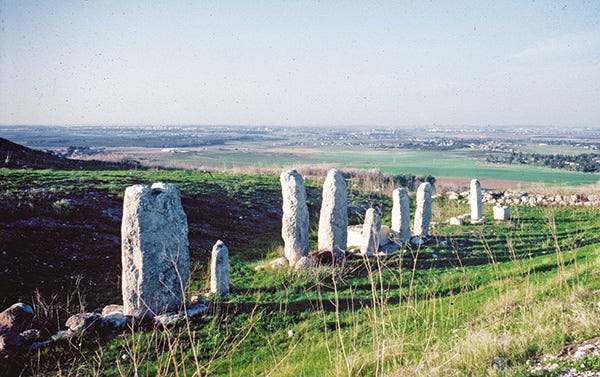
Archaeologists call them massebot, using the Hebrew word, and they turn up everywhere. At Gezer there is a row of ten of them, the tallest better than three meters, with a carved stone basin set in the middle of the line. Middle Bronze Age. Best guess is that they marked a covenant between towns.
At Hazor, the city Joshua would later burn, roughly thirty standing stones were set in four rows in the final phase of the temple. One of them is incised with a crescent moon and a pair of upraised hands.
Out in the desert, in the southern Negev and eastern Sinai, researchers have documented more than a hundred and forty separate massebot sites, and the count keeps climbing.
The practice spread far and fast. Basically, as Uzi Avner explains, any long stone could become one, if you set it on its narrow side.
The rock is ordinary.
The rock is lying in a field doing nothing.
Standing it up is the entire act.
At Tel ‘Eton, excavators found a standing stone inside a private house, set in the largest room, positioned so you would see it as you came through the door. The excavator’s read is that it served as that household’s religious center from the day the house was built until somebody took it down.
The building was destroyed around 701 BC.
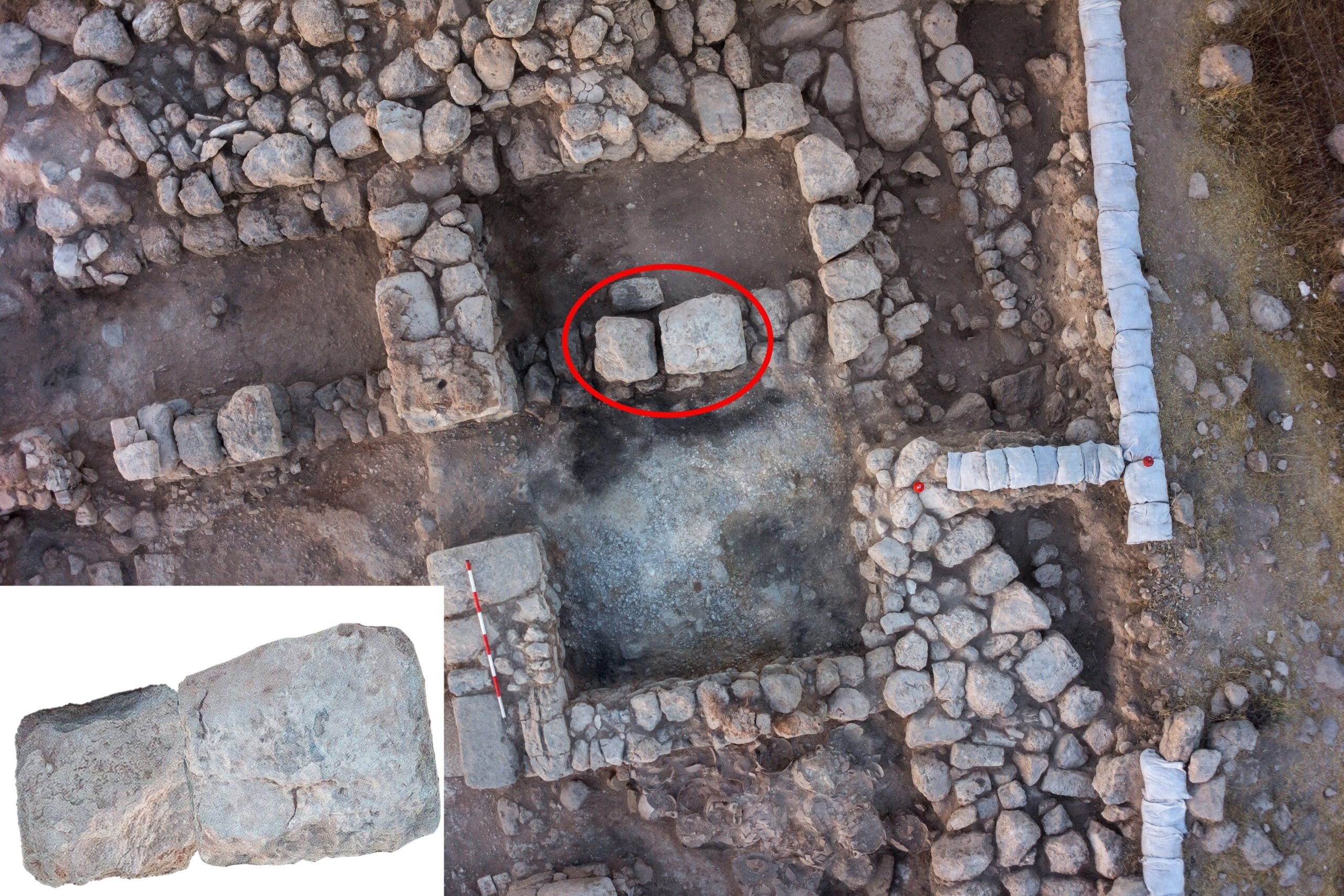
A man had a standing stone in his living room.
To date, no massebah has been dug up that matches a specific story in the Bible.
Jacob, Joshua, and Samuel all have written accounts of the practice and the particular stones are nowhere to be found.
Let us return to this in a moment.
Stones with Instructions
Joshua brings the people across the Jordan on dry ground, and the first thing God has him do on the other side is a construction project.
Twelve men. Twelve stones out of the middle of the riverbed. Carried up and stacked at Gilgal.
And then the reason, given in advance:
When your children ask their fathers in time to come, what do these stones mean, then you shall let your children know. - Joshua 4:6-7
This mechanism is not what most men assume. The stones exist to provoke a question, and a father exists to answer it.
This is the design. A boy walks past a pile of rocks that has no business being there. The strangeness makes him ask. His father tells him. Twenty years later, the boy is a man with sons of his own, walking past the same rocks, and his son asks, and he tells him, because his father told him.
The legacy is the answer, carried in the mouths of men who commanded to keep it.
You’ll read in many of my articles the phrase, build a legacy death cannot take. Stone erodes. Bronze corrodes. Money changes hands three times and forgets who passed it down. What actually survives is transmission running through people who can be read and who will answer when asked.
Which means a man has an obligation older than his mortgage. Be legible enough that your children have something to ask about, and be present enough to answer when they do.
Fail either half and your household becomes Carnac, Rudstone, or the countless other places with unreadable stones and forgotten stories. Something impressive standing in a field, and no one left who knows why.
The Other Pillar
Now, the hard one. Absalom, King David’s son, the beautiful one, the one who murdered his brother and stole his father’s kingdom, also set up a standing stone.
He put it in the King’s Valley, and he named it after himself. Samuel gives us his reasoning in his own words:
I have no son to keep my name in remembrance. - 2 Kingdoms 18:17-18
Same object. Same labor. Same technology as Joshua’s twelve. And the direction is exactly reversed.
Joshua’s stones stand because there will be children to ask.
Absalom’s pillar stands because there is no one to ask.
He looked down the years, saw no one coming who would carry his name, and did what a man does when he thinks the story is about himself. He builds the story a container and put his own name on the outside.
The scripture tells you how it ended. Joab’s men threw Absalom’s body into a pit in the forest and heaped a very great pile of stones on top of it.
Two stone structures for one man. One he set up for himself in the valley. One thrown on top of him in the woods.
Scripture is direct about standing stones. Some it commands and some it forbids, and the object never changes. Moses sets up twelve pillars at Sinai. Jacob sets one up at Bethel and pours oil on it. Joshua sets up a great stone at Shechem and calls it a witness. And the same Law that records all of that says the LORD hates the pillar, and orders Israel to smash the pagan ones already standing. Why?
The stone is neutral. The direction decides everything.
Empty Ground
Back to the thing the archaeologists cannot find.
No massebah in the dirt matches a biblical story.
Hezekiah broke them. Josiah tore them down and ground them to powder. The household stone at Tel ‘Eton, taken down sometime before 701 BC, may be a piece of physical evidence of a man obeying a reform.
The stones are missing because the witness moved.
It moved from stone into a scroll, which is the only monument you can carry into exile.
It moved from the scroll into a Person, whom the New Testament insists on calling the cornerstone, the stone the builders looked at and threw away.
And from Him it moved into men. Joshua setup twelve stones along the Jordan, prototypes of the 12 apostles, a reminder to the children of God, the Christ is coming to dwell with and in us.
Peter does not call us worshippers standing near a stone. He calls us living stones, built into a single house. One house, children of God, unified in and through His redeeming grace and kingdom.
Stone. Scroll. Son. Sons.
Every step of that moved the witness closer to something that could walk into a room, be looked at, and answer a question.
Which brings this into your kitchen.
The Rock Stack and the Cairn
Walk above the treeline on a hiking trail, and you will find cairns. Piles of rock, waist-high, spaced so that when the fog drops and the trail vanishes, you can find the next one and live.
You will never know who built them. Nobody signs a cairn. The man who stacked those stones took real trouble for a stranger he would never meet and got nothing for it, not even credit.
You will also find, at scenic overlooks in the country, the other thing. Little stacked rock towers built for a photograph. Land managers remove them, as they mislead hikers to follow a non-existent route and damage the ground from which they remove the rocks.
Same stones. Same stacking. One points at a route. One points at the person who stacked it.
That second kind is the whole religion of this age, and it has a name.
The cult of self. The modern lie that your life is your own.
The cult of self is tells you to build. It tells you to build loud. Stand out. Make it about you. Get seen. Put your name on the outside of the container, because the container is all there is.
Absalom would have understood the assignment immediately. He was early.
Here is the tell: The cult of self and Absalom arrive at the same place by the same road. A man who is building a monument to himself has usually already given up on there being anyone to ask. He does not really expect a son who wants the answer. So he skips the son and goes straight to the marble.
Most men drift into this. They spend thirty years becoming impressive, no years becoming legible, and then wonder why their children know their job title and not their God.
A Readable Life
Here is the key to what I’m trying to make clear. A man of God is called to be a standing stone.
A standing stone is a readable life. Present, consistent, and still.
Four words, each a physical property of an actual stone in an actual churchyard. Go to Rudston and check.
Readable. You can see the stone from across the field or along the trail and know something is there on purpose. A man’s life is readable when the people around him can tell what he stands for without having to interview him about it. Most men are hiding something. They are unreadable because they don’t speak; they don’t say what they believe, and when they do their actions don’t match their words.
Present. The stone remains where someone set it. Its entire usefulness depends on being in one location for a long time. Modern men focus on managing the next thing. They might physically be in the room and mentally at the job site or on their phone. There is no such thing as a standing stone that shows up occasionally. A man who is not there is not a marker of anything, however impressive he is elsewhere.
Consistent. It is the same stone all the way through. Cut it open and the core matches the face. Weather takes the surface down over centuries, and the material underneath is identical. A man is consistent when the version of him at the altar, in the meeting, and at eleven at night with his wife are recognizably one person. They can fake everything else on this list for about eighteen months. Consistency requires consistency; nothing else will suffice.
Still. And here is where modern man will read me wrong, because I have approached stillness wrong myself.
The modern mind hears stillness and thinks of quiet, slow, a mature man entering some gentle later season in life where he stops reaching for anything. This is what I thought, and I was wrong.
Still means planted deep enough to bear weight.
Today, we think of stillness as therapeutic “me time” or taking a rest.
Forty tons of gritstone, with half its length in the dirt, is under enormous, continuous load, and it is winning. It has been winning for four thousand years. This is an active stillness. A deeply anchored stillness.
A man remains still when he doesn't let the next opportunity, grievance, notification, or late-night idea that sounds like a calling sway him. You can lean on a still man. People can build things upon him.
Notice the order those four run in, because it is the order you actually meet a stone. You see it from a distance. You walk up to it. You put your hand on it and find it solid. And only if you dig do you find out how deep it goes.
Readable is what people get. Still is what makes it possible.
Standing on a Rock
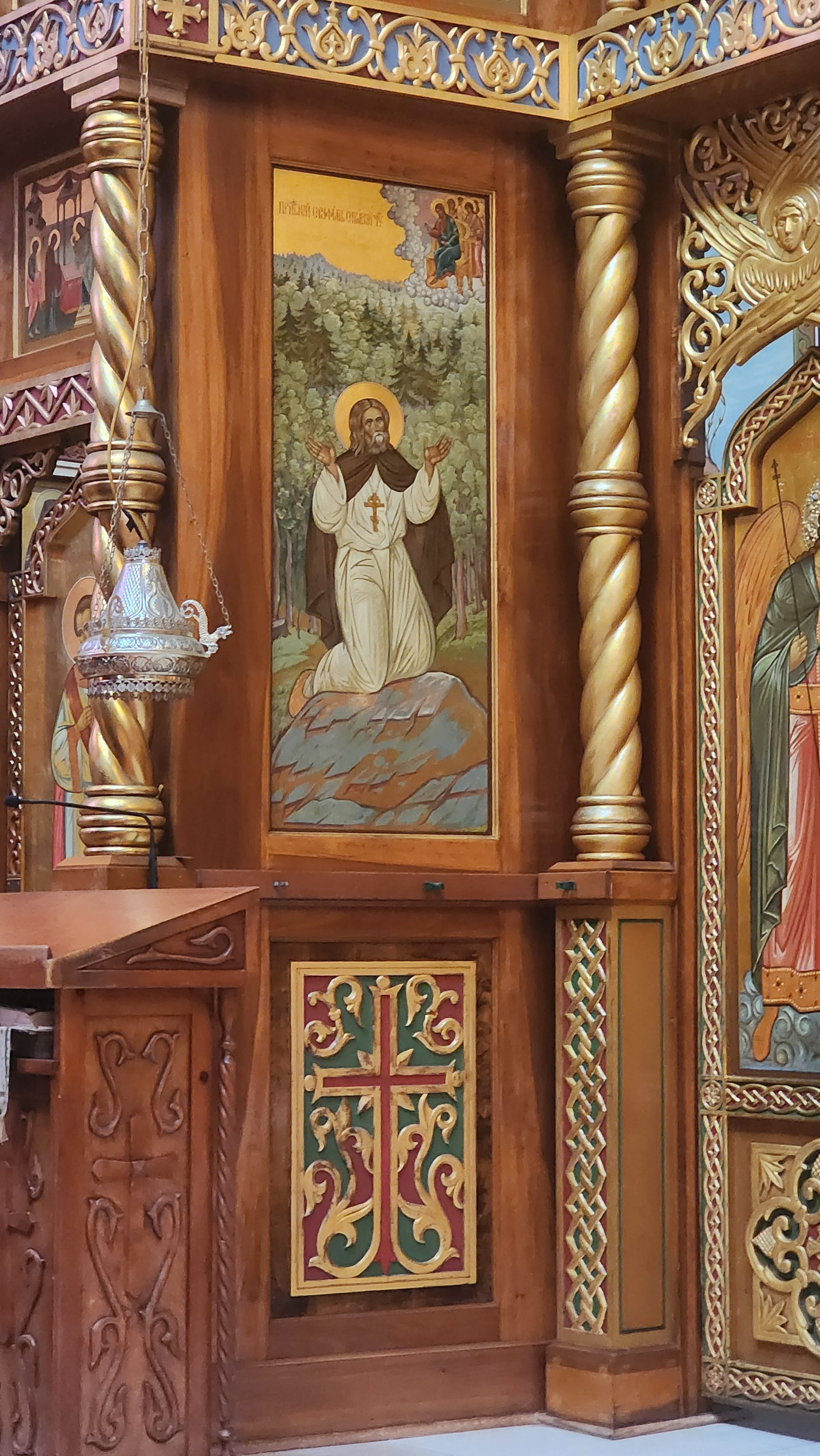
An icon of a man praying on a rock is in a cathedral in San Francisco.
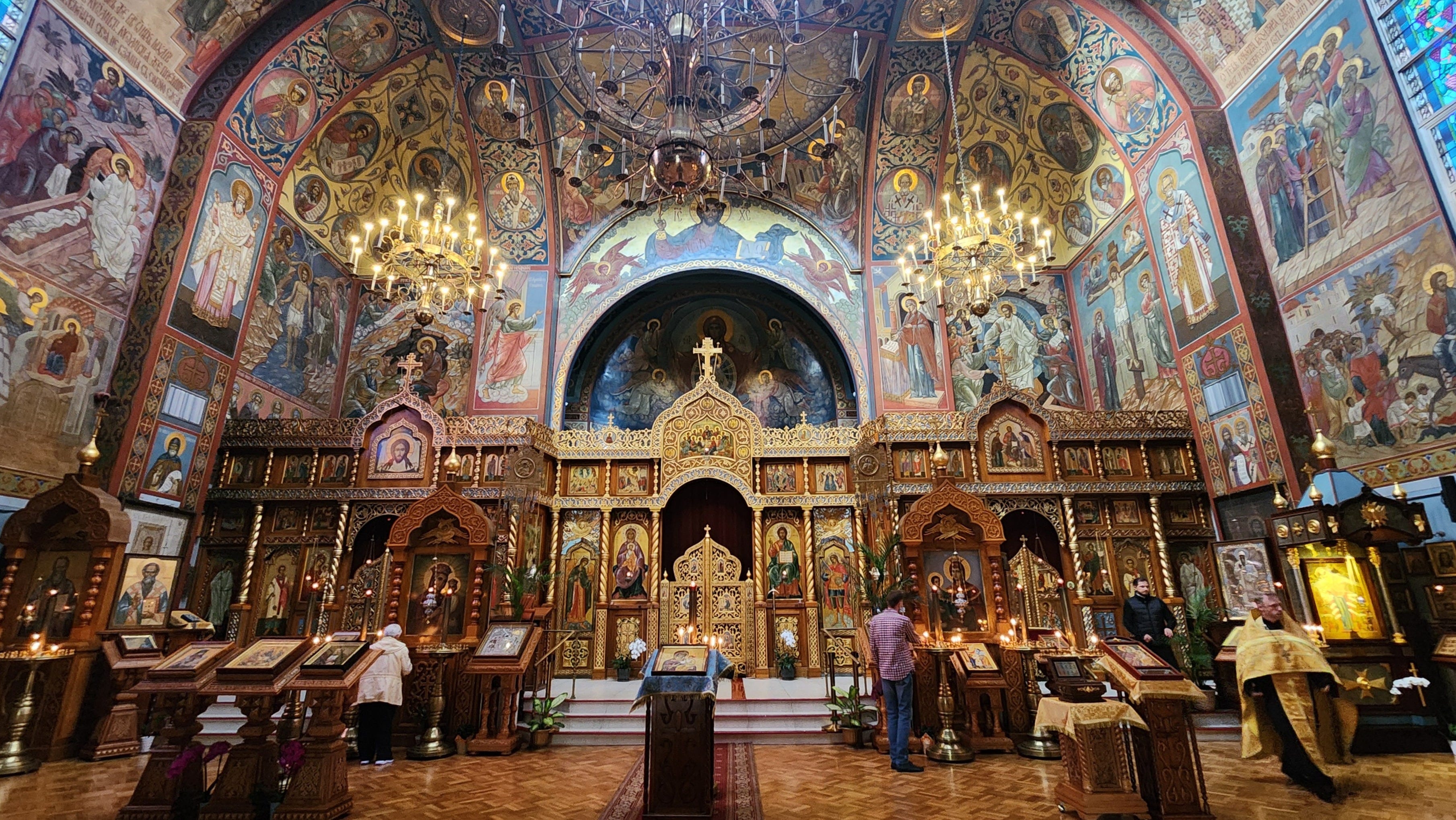
When I visited the cathedral, the icon spoke to me; I photographed it. The buried half was doing all the work. I didn’t know the saint’s name or his story, but I could read it before I could explain it. Months later, I attended my first Eastern Orthodox men’s fellowship, which has for its patron St. Seraphim of Sarov.
He is a Russian monk who went into the forest and stayed there. For years. He didn’t have an audience, a platform, and he wrote no great correspondence. Tradition holds that for a thousand days and a thousand nights he prayed on a stone in the forest.
A man on a rock, becoming one. Here is the photo I took of the icon before I knew this story:
Then people started walking out to find him. Thousands of them eventually, peasants, nobles, and bishops, over narrow trails, to a man who had nothing to offer them but himself. He greeted each one the same way, whoever they were and whatever they had done, calling them his joy.
This is presence and consistency in a single gesture, repeated for years, to strangers.
He left a sentence which is clearly readable:
Acquire the spirit of peace, and thousands around you will be saved.
Today’s gurus will tell you to build the platform, grow the audience, and get the message out. The saint says, “Acquire the spirit of peace“, which is interior, hidden, takes decades, produces nothing you can screenshot, and the effect on the people around you takes care of itself.
I Had This Wrong
I had worked most of this out for years. The stones, the four words, the readable life. And I had drawn a conclusion from it that felt humble, mature, and deeply spiritual, which is exactly how you should know to suspect a conclusion.
After decades of building and setting up the standing stone, I came to the conclusion I needed to slow down to work on stillness. The restlessness I had carried for twenty years, the thing that built organizations, wrote books, and would not let me sit, was the enemy. A standing stone is still, and I was not still, and therefore the work in front of me was to quiet down, want less, and settle into some slower season.
I brought that to my priest, Father Samuel, expecting him to confirm it.
He took it apart.
He did not think the restlessness was the problem at all. Then he pointed me back to the Ladder we have been climbing together, and the instruction was not rest. It was climb. Understand the purpose of the restlessness.
I had confused stillness with stopping.
The stone at Rudston is still standing. It holds forty tons against four thousand years of English weather because it is anchored. Take away the anchor, and the stone does not acquire the spirit of peace. It falls over.
A man who mistakes stopping for stillness becomes a rock lying in a field, which is what every other stone is until someone sets it on its narrow side.
I was looking to kill the restlessness. Father Samuel directed me to place the restlessness in climbing the holy Ladder.
This correction is valuable because it’s what a standing stone does. It came from a man who told me, “No,” in a readable way, who has been present, consistent, and spoke it with enough stillness that I understood what I had gotten wrong.
Be a Standing Stone
Years ago, I wrote a line in a book about the Hebrew Scriptures and their habit of standing stones up to mark what God had done. I wrote that the lives of God’s children are standing stones pointing to Him.
I meant it and set out to make my life a standing stone pointing to Him. I have spent the years since being outrun by my sentence, which is a humbling way to learn that you can write true things well before you can live them.
Here is what I have learned since writing that book. Every one of those biblical stones exists within a relationship.
Jacob’s stone at Bethel is about a promise made to him.
Joshua’s twelve are aimed at children who will ask.
Samuel’s Ebenezer marks help that came from outside himself.
The stone is standing there, so a conversation will happen.
Absalom’s pillar is the only one with a man’s name on it, and it is the only one that had no one to talk to.
I have a granddaughter. She is two months old. She will never know me as a young man. Every version of me she will ever meet is the one I am building starting now, and one day, if I have been legible enough to raise the question, she is going to ask about something I did, believed, or refused, and someone will have to answer her.
We can think it is the number on a building, the title behind our names, the size of our bank account, or the dates cut on a slab of stone and read by approximately 15 people for 30 years.
Your gravestone and eulogy will say nearly nothing. The most expensive marker in that churchyard says less than a father does in one honest answer at a kitchen table.
So set the other stone up while you can:
Live rooted in stillness, consistent in character, present with others, and clearly readable.
Be legible enough that your children have to ask.
Be there when they do.
Take your restlessness and aim it up, and let a man who knows you tell you when you have aimed it wrong.
Remember, a standing stone points past itself entirely, to the God who did the thing worth remembering. It keeps pointing long after the man who set it up is dust, and his name is gone from the valley.
When everyone else is looking for the marble, a big audience, or a platform, remember this path is available to any man who wants it.
Four thousand years in a Yorkshire churchyard, and half of it underground.
Go be the half nobody sees.
Build a legacy death cannot take.
A lot of men spend years trying to look impressive and never think about whether their kids actually know what they stand for.
Very interesting!