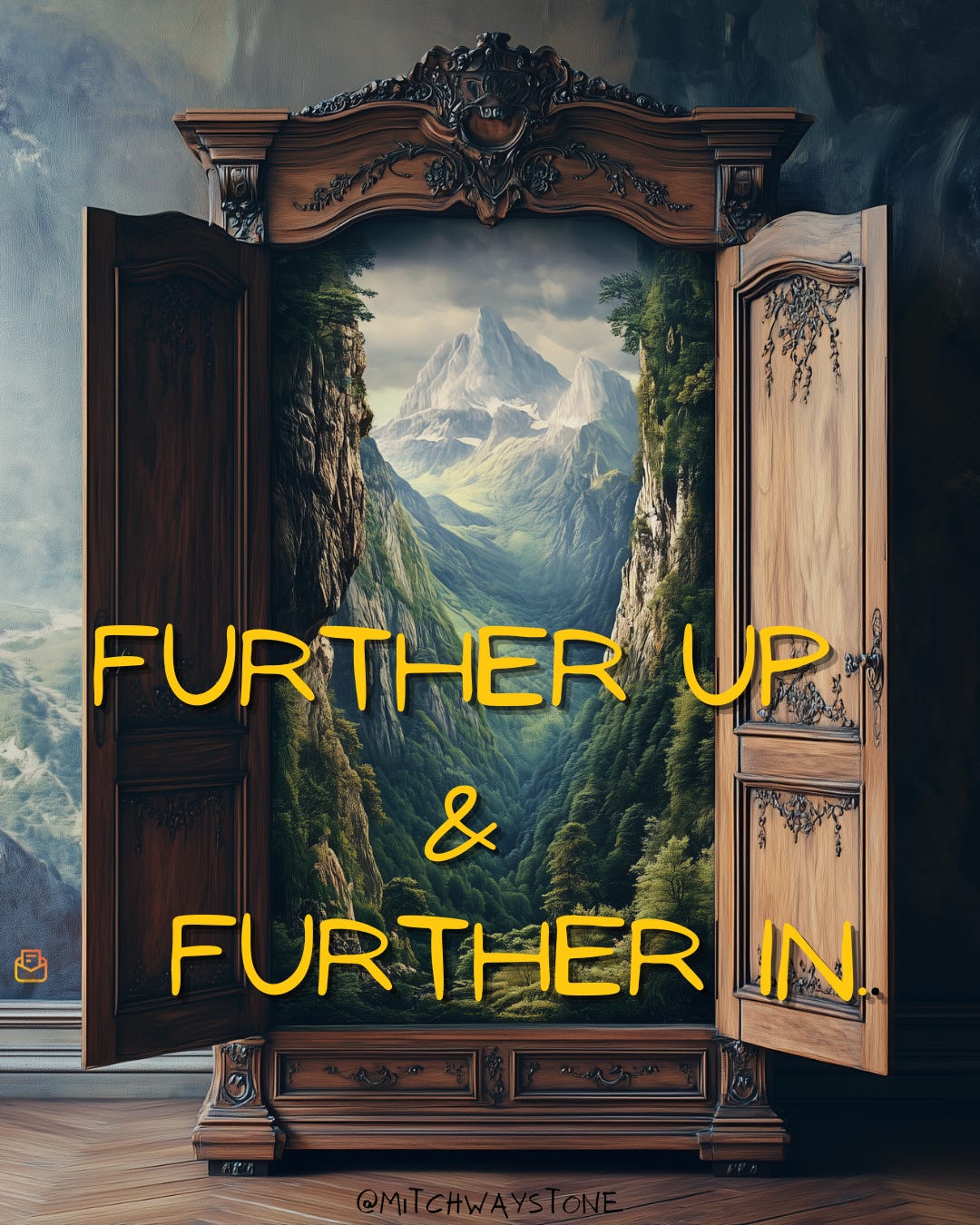
A boy stands before a golden gate.
The wall around the garden is green and high. The fruit inside is silver, and its smell makes him hungry for something he has never tasted. Back home in London, his mother is dying.
He was sent here on an errand. Take one apple. Bring it back for someone else. Do not eat it.
Then a voice speaks. A woman stands there with juice on her lips. She has already eaten. Now, She will never die, she tells him he doesn’t have to either. Or if he is too noble for that, he can carry the apple home to his mother. She would be well by morning, the woman says, and no one will ever know.
The boy’s name is Digory. The woman is a witch.
The question in front of him is the oldest question in the world:
Will you grab what is before you or will you be content to receive what is given to you?
C.S. Lewis wrote the scene for children in 1955, in The Magician’s Nephew.
On February 12th, it arrives in theaters.
A $200 Million Retelling
The film is Greta Gerwig’s, the director of Barbie. Netflix released the first look on September 16. The budget is reported at $200 million. Meryl Streep voices Aslan. Gerwig calls her vision a rock opera.
She says she fell in love with this book as a child. I have no reason to doubt it. But one can love a story and still miss what it is about.
Lewis wrote Aslan as the answer to a question: what might Christ look like if He came to a world of talking beasts? In The Magician’s Nephew, the Lion’s voice is the story.
He sings, and a world comes into being. “All things were made through Him” (John 1:3). Who gives that voice to the screen is a serious casting choice. Maybe Streep will carry it. I have concerns. We will see in February.
Here is what I do know: The Chronicles of Narnia have sold about 120 million copies in 47 languages.
This winter, millions of children will meet Narnia for the first time on a screen, and a director will decide for them what the story means.
Whoever tells your children the story first gets to tell them what it means.
Understand, we live at a time that has bad habits with old stories. Call it the cult of self: the modern lie that your life is your own. It is the culture of today, and it retells old tales the same way: the hero stops obeying and starts “discovering himself.”
Temptation becomes a test of self-trust.
A gift becomes a prize he earned.
Villains are made heroes.
Christianity is mocked.
Questions to Carry into the Theater
You don’t need a review to know what to watch for, here are three questions:
Does the Lion’s song create the world or only decorate it?
In the garden, does Digory obey, or does he discover himself?
Are the rewards at the end a gift, or a prize earned?
I’ll send a full Watch Guide for families when the film opens, stay subscribed to receive it.
Before we point at Hollywood, we need to look at ourselves.
The Problem Closer to Home
The bigger risk may not be Hollywood. It may be us.
Many Christians would miss what Lewis did even if the film got every frame right, because many of us learned the Fall as a courtroom story. It goes like this: God gave Adam a rule. Adam broke it. God’s justice demanded payment. Every one of us was born guilty of Adam’s act, as if his crime were entered on our record. Christ came and paid the fine.
I understand the appeal. My CFO career is in ledgers. A theology that balances: a debt assessed, a debt paid, the account closed makes sense to my modern mind.
Where did this story come from?
It traces back to St. Augustine, a giant of the faith, and to one verse. Romans 5:12 says death spread to all men because all sinned. The Latin Bible (Vulgate) Augustine read put the end of that verse as “in whom all sinned,” meaning in Adam. Read that way, every child is born guilty of Adam’s act.
Six centuries later, Anselm described the Cross as a debt of honor owed to God.
The Reformers sharpened it even more into a legal verdict.
Each generation moved the story further into a courtroom drama.
The courtroom gets some things right. Sin is real. We are responsible for our own. Christ gave Himself for us. None of that is in question.
What the courtroom misses is the wound. No man standing at a graveside is thinking about a ledger. A man’s debts are settled from his estate. His children don’t inherit them. Scripture says the same: “The son shall not bear the guilt of the father” (Ezekiel 18:20).
We inherited something else from Adam.
The Fall is a Grave
In the garden God said, “In the day that you eat of it you shall surely die” (Genesis 2:17).
The Wisdom of Solomon says, “God did not make death, nor does He take pleasure in the destruction of the living” (Wisdom 1:13).
Death was never part of God’s design.
The Greek Paul wrote in Romans 5:12 can be read another way: sin brought death, and now because of death, all sin. We inherit Adam’s death and death, once it is in us, breeds sin.
Hebrews 2:15 explains how this works, as Christ came to “release those who through fear of death were all their lifetime subject to bondage.”
A man afraid of dying grabs. He hoards. He climbs. He uses people. He builds a small kingdom with his own name on it, because somewhere underneath he believes this life is all he gets.
If you’ve ever taken a lifesaving course, you know how dangerous a drowning man can be. He will grab and not let go. You will drown with him if you don’t know what you are doing.
This is the cult of self at its root. It is fear of the grave wearing a mask.
Once you see the Fall as death, you cannot unsee it.
It changes what salvation means:
If the problem is a fine, you need a payment.
If the problem is death, you need Life.
Christ is Life.
He entered death and broke it from the inside, and He did not leave us to admire the victory from a distance. He gives His own life to us in His Body, the Church.
Around AD 107, St. Ignatius of Antioch, a bishop who learned the faith from the apostles, called the Eucharist “the medicine of immortality.” Christ said it first: “Whoever eats My flesh and drinks My blood has eternal life, and I will raise him up at the last day” (John 6:54).
The hope is a Body, a Table, and life given from His own hand.
Lewis knew all of this, and he put it in a children’s book.
Four Scenes You Won’t Forget
Charn: What Grabbing Does to a World
Digory and his friend Polly step into a dead city under a dying red sun.
In a hall of silent kings and queens, a golden bell hangs beside a carved dare: strike it, or go mad wondering what would have happened.
The ringing wakes Jadis, the last queen of Charn. We learn what she did to her world. Rather than lose a war to her sister, she spoke a single forbidden word, and every living thing in Charn died except her.
Charn is where one person grabbed everything, and death took the rest.
The Song: A World Made by a Word
Then comes darkness, with no world at all.
Then a Voice begins to sing. Stars answer. A sun rises. Grass runs over the hills like water. A Lion walks through a newborn world and sings it into being.
Uncle Andrew hears the same song and hates it. The longer he listens, the more he persuades himself it is only a lion roaring. Lewis tells us that what you hear depends on “what sort of person you are.” Andrew watches a world being born and wonders how to profit from it. I have sat across the table from Uncle Andrew.
The cult of self only ever hears a threat to its plans.
The Tears: God Grieves Death
Digory asks the question he has carried the whole book: can the Lion help his mother?
He expects anger, or silence. He looks up and sees great tears standing in the Lion’s eyes, bigger than his own.
Lewis does not give us a God who is indifferent to death. He gives us a God who weeps at it. This is Christ at the tomb of Lazarus, moments before He calls His friend back to life. “Jesus wept” (John 11:35).
God grieves death because He never made it.
The Garden: Grabbed or Given
Now we are back at the golden gate, where I started this article. The words on it warn that those who steal the fruit will find their heart’s desire and find despair.

Jadis climbed the wall. She got what she wanted: a life that never ends. An endless life lived in misery.
Digory refuses her. He carries the apple back and throws it into the soft ground, as he was told. He didn’t grab what wasn’t his. Then Aslan gives him an apple, to take home to his mother.
Grabbed, the fruit brings endless misery.
Received, it brings healing.
This is the Fall in two lines.
In the 2nd century, St. Theophilus of Antioch taught that the tree in Eden was good. Adam was still a child, and he was meant to grow into the gift. The sin was grabbing it before the time. God was not withholding the fruit. He was waiting to give it.
Anyone who has stepped forward to partake in Communion will recognize a gift given.
4 Readings
My father read this book to me.
Later, I read it on my own. Then I read it to my children, twice. Once when my boys were little. And again, years later, to my girls when they were old enough to understand it.
I didn’t know it as a boy, but my father was doing what Moses told fathers to do: “You shall teach them diligently…and shall talk of them when you sit in your house” (Deuteronomy 6:7). He was planting something. I read it to my children because he read it to me.
This is how a story like this should be handed down. One father. One chapter. One night at a time.
The book reads differently at every age. Your little ones will want the witch, the flying horse, and the lamp-post that grows out of the ground. Your teenagers will want to argue about Uncle Andrew. Let them. Every question is a door.
Here is the serious part. If you don’t tell your children this story, someone else will. They will inherit whatever version you hand them. Hand them nothing, and they will inherit the screens.
A Guide for the Kitchen Table
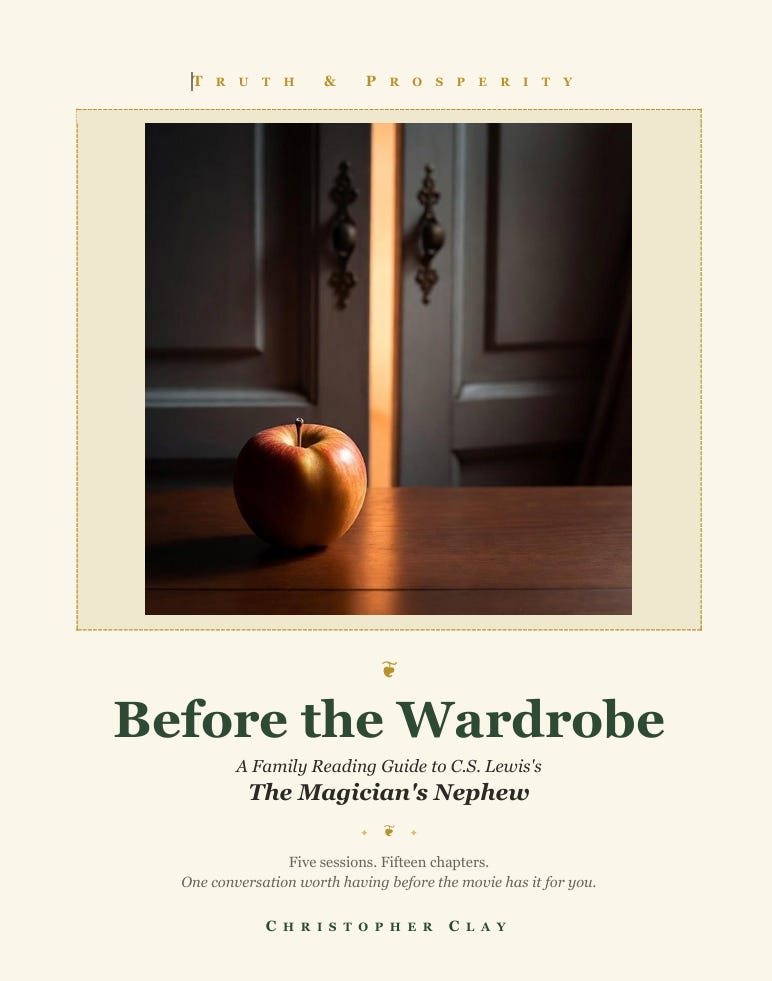
I built something to help you do this. It’s called Before the Wardrobe, a family reading guide to The Magician’s Nephew.
It walks your family through the book in five sessions of three chapters each. Every chapter has four questions, asked in order:
What happened? A recall question any child can answer.
Why? A heart question about motive and character.
Us. A turn toward your own family.
Teen Bonus. A harder question for older readers.
Every session closes with the big idea in one sentence, one anchor from Scripture or the Fathers, one question for Dad alone, and one practice for the week at home. The pages have wide margins and ruled lines. If you are reading it on your own, write your answers in pen. Writing locks in wisdom, and a book full of your handwriting is something you can hand down.
(No family? Read the book on your own and use the guide to lock in the wisdom for your own life.)
Here is a taste:
Chapter 4: Polly said no. Why did Digory grab her wrist anyway?
Chapter 12: When Digory asked about his mother, the Lion had tears in his eyes. Why do you think he cried?
For Dad alone: What am I trying to take from God that He may be waiting to give me in His time?
Picture a Friday night. The dishes are done and the phones are in a basket. You read Chapter 12 out loud. You ask why the Lion cried. Your eight-year-old says, “Because he loved her too.” And you sit there for a second, because your child just preached the Gospel at your kitchen table.
The guide is free. 30 pages. It costs you an email address, nothing more. Start this week and read 2 or 3 chapters. You will know this story long before Netflix’s February 12th release date.
Subscribe below and the guide is yours. If you’re already subscribed click the Download button.
The article ends below, keep reading.
The Tree Becomes a Door
Lewis ends the book with a small, ordinary act. Digory plants the core of his mother’s apple in the backyard of a London house. It grows into a tree. Years later a storm brings it down, and Digory, grown now, can’t bear to burn it. He has the wood made into a wardrobe.
A generation later, 4 children walk through that wardrobe into Narnia. One boy’s obedience became a door for children he would never have met.
This is what a father does.
He plants things he may never see full-grown. A habit of prayer. A table where the truth gets told. A story read aloud, one chapter at a time.
My father planted that tree for me. I planted it for mine. Now it’s your turn.
Build a legacy death cannot take.
Coming Next
This December: A Nativity series on dragons, including Eustace from The Voyage of the Dawn Treader, the boy who fell asleep on a hoard and woke up as what he was in his heart.
When the film opens in February: Stay subscribed for Before the Wardrobe: The Watch Guide, a companion for families who see it. Questions to ask afterward, so you can judge for yourselves what was kept and what was lost.
Forgiveness Sunday: Adam’s Lament. On the day Great Lent begins, the Church remembers Adam weeping outside the gate of Paradise. Few Western Christians have heard it. You will want to.
Subscribe. Get the Legacy Audit and the Reading Guide: Before the Wardrobe.
Start building a legacy death cannot take.
Not ready yet? Start with the foundational essay on the cult of self. Read one piece and decide for yourself whether this is the voice you want in your life.