

I was seeking the Kingdom with my spirit, mind, heart, and body.
As a business leader who has spent decades turning around organizations, hiring good people, and stewarding tight budgets, I do not chase feelings or slogans. I chase what works in real life. And when I looked back through Scripture and history for the faith that could anchor my marriage, raise my children, and leave a legacy worth passing down, I found clear clues.
Christ at the head. Mary honored. A Kingdom you experience here and now, not just hope for later.
In Acts, I found a shaped concreteness:
One: Eucharistic unity under a bishop/overseer in historic succession (Acts 20:28).
Holy: a community that actually calls to repentance and forms saints (Acts 2:37–47).
Catholic (according to the whole): the same faith across places and centuries, tested in council (Acts 15).
Apostolic: hands laid, a lineage you can trace, and doctrine kept in the Rule of Faith (cf. 1 Tim 4:14 echoed in Acts’ pattern).
Through travels and studies, I knew there must be tangible signs: Baptism in water; the Eucharist confessed as Christ’s Body and Blood; clergy you can name and meet; a public, ordered liturgy; instruction and discipline; visible almsgiving and service.
The apostles never preached spirit instead of body. They preached Spirit birthing baptized bodies, shared tables, councils, journeys, and martyrs. A Church you can find, join, and obey.
That is the concrete Church I was hunting.
Modern Christianity often feels fractured and thin.
There are now over 40,000+ denominations worldwide. Mainline groups that once filled cathedrals have watched membership drop by millions and attendance fall sharply in recent decades. Slogans replace substance. Communion sometimes feels like a tea party. Doctrine shifts with the mood of the age.
I feel bad for the sincere believers caught in the middle. They love the Lord. They want truth. Yet the structures around them keep splitting or softening until the fire cools into marketing.
I am just a regular father and businessman following Christ the best I know how. Nothing fancy. I have helped build a multi-million organization from the trenches, backpacked rugged trails, swung kettlebells to discipline my body as St. Paul commanded, and learned the hard way that stewardship touches every part of life.
My faith is not Sunday only. It is the compass for family, work, and legacy.
The search took me on a journey I will never forget.
My journey started where many good modern men begin, as a Methodist. John Wesley startled me. He never wanted a new church. He stayed an Anglican priest to the end. He called people back to the means of grace: Baptism, Eucharist, fasting, confession, Scripture, and works of mercy. He urged constant communion, not occasional. He read the Church Fathers and preached holiness of heart and life as real training, not vapor. In Wesley I heard Acts 2:42 again: the apostles’ teaching, fellowship, breaking of bread, and prayers.
Yet the more I read, the more I saw the fracture. Most of what flies under the Methodist name today does not match Wesley. He assumed bishops, sacraments, and ordered life. He spoke of perfection as love burning through passions. I saw therapeutic slogans instead. The fire he tended had cooled.
I stepped back further to the Church of England. Beautiful cathedrals. Prayer Book cadences. Martyrs and missionaries I still respect. Yet I could not shake the scaffolding: a crown over the altar, Parliament over council. One parish whispers Real Presence; another denies it. Articles aimed for breadth but dissolved into ambiguity. Acts 15 shows a council speaking with one voice. The Anglican chorus sounded like overlapping solos, none binding the whole. Where was the abiding, concrete unity in the bones, not just the brochures?
Then I turned to Rome. Here was fierce, unembarrassed insistence on the visible Church, a priesthood you could name, saints who bled, and a Eucharist confessed as the true Body and Blood. The martyrs’ courage and the saints’ charity humbled me. Rome kept many of the signs I had been hunting.
But the texts of Acts and the habits of the earliest centuries pressed me harder. Did Peter’s primacy in love and service become jurisdiction without limits? When did first-among-brethren become last-word-over-brethren? The Creed was received and sealed in council. Could later dogmas rest on the Church’s shared memory, or were they declared from one chair and required of the whole? I was desperate for rightly ordered authority that sounds like Pentecost and looks like the Apostles.
At each stop I learned something priceless.
Wesley’s fire. England’s beauty. Rome’s solidity. All tutored me. Christ was leading me to what Acts described: a Church you can find, join, obey, and be healed by. A people gathered around a real altar, under a real bishop, speaking with the mind of Christ, not the mood of the age.
I was close enough to feel the heat of something ancient, something you can touch, taste, smell, and see. It was not Protestant division, crown over altar, or even Roman developments. It was the ancient Church Christ founded overlooking the Gates of Hell in Caesarea Philippi.
St. Ignatius of Antioch, appointed Bishop by St. Peter, writing around the year 110, put it plainly: “Wherever the bishop shall appear, there let the multitude of the people also be, even as wherever Jesus Christ is, there is the Catholic Church.”
St. Irenaeus, battling heresies in the second century, showed how apostolic succession guards the truth: the tradition of the apostles is manifested throughout the whole world and preserved by bishops in succession from the apostles themselves. You can see it. You can trace it.
This is the Church of Acts, where the Holy Spirit makes men overseers to shepherd the flock Christ purchased with His own blood. This is the pillar and foundation of the truth. I had found the One, Holy, Catholic, and Apostolic Church. It is focused on the Right Belief, not modern inventions. In modern terms, it is known as the Eastern Orthodox Church.
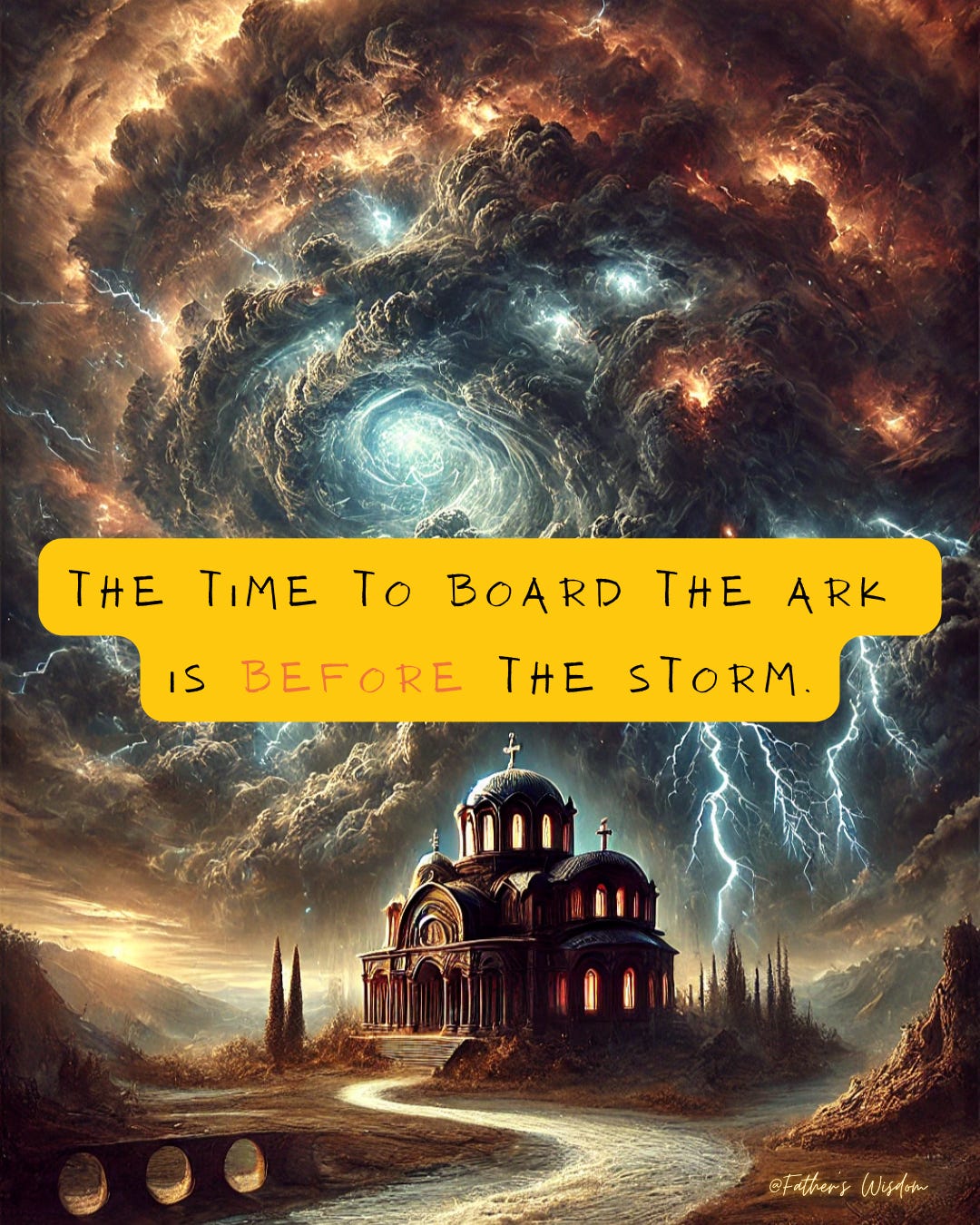
I finally boarded the ark.
Now my life looks different. Instead of chasing the next new teaching or scrolling for inspiration, I stand in the ancient liturgy with my wife and children. We guard our hearts. We raise our kids in a community that calls to repentance and forms saints. The Eucharist is not symbolic tea. It is the medicine of immortality. Confession is not optional therapy. It is healing.
As a leader in my home, I no longer wonder what foundation to build on. I steward time, money, and attention like the treasures they are. My body is disciplined. My mind is guarded. My family sees a faith that outlives trends.
Some of you may feel the same emotional pull and push.
You sense the thinness. You love your family too much to hand them fragments. You want to protect what matters most. That discomfort is the Holy Spirit at work.
Pray for those still searching. The Spirit does the heavy lifting. But do not stay on the shore. Board the ark before the storm. Find the visible Church that never had to be reinvented because it was never broken.
This is how you build something that outlives you.
A faith rooted in the Body of Christ. A family anchored in the altar. A legacy of stewardship that honors God instead of debt or distraction.
If you are ready to build with integrity, to lead your household like the patriarch God calls you to be, and to pass down tools that actually work, join me at Truth & Prosperity.
Subscribe now. Let us walk this ancient path together, one faithful step at a time. Your wiser tomorrow, and your children’s tomorrow after that, starts here.
Subscribe for free weekly wisdom on Faith, Family, Finance, Leadership, and Legacy.
The ancient Church is still standing. The question is whether you will step into it.
Beautiful as always Chris this is why Orthodox still stands to this day and only grows stronger!
Great read. Somehow reminded me of Ethiopian Orthodox church. One of the most interesting phenomenas. Have you researched them?