

I grew up in a house where Santa Claus was never real. My parents didn’t pretend, and when I had kids, I didn’t either. Santa was marketing. A costume designed to move product and keep kids compliant through December. That was the story I believed for a long time.
Then the man behind the costume found me.
In the darkness of a long December night, I read his story: His name is Nicholas of Myra and Bari. He was a bishop in the fourth century. He stood in a room full of theological cowards and refused to back down when the crowd wanted a tame, manageable version of Christ. He snuck dowry money through a window at night so young women wouldn’t be sold into shame. He guarded sailors, prisoners, and children. He gave until there was nothing left to give but himself.
Santa Claus is a cheap imitation. St. Nicholas is the real thing.
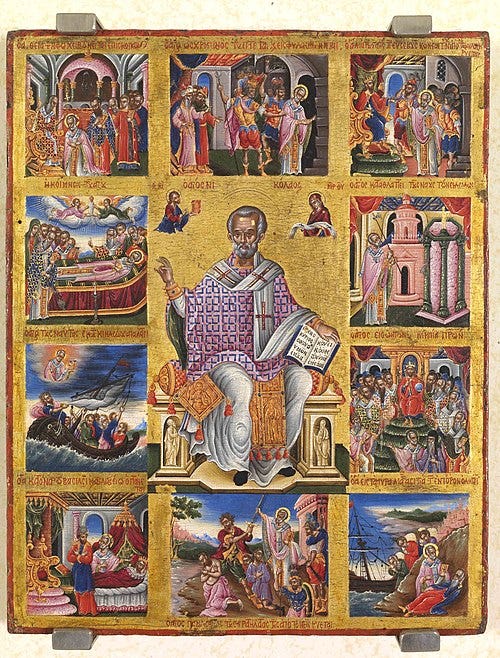
What the World Did With a Holy Man
Here is what the modern world does with anyone who actually lived for something greater than themselves. It takes their memory, strips out the sacrifice, smooths off the rough edges, slaps a trademark on it, and sells it back to you as entertainment.
Nicholas the bishop becomes Santa the brand. The man who defended the Nicene faith and gave away everything he owned becomes a jolly mascot for consumption. The confessor who suffered for Christ gets replaced with a permission slip to spend money you don’t have on things your kids will forget by February.
This is the pattern of the world.
Every true thing the culture of the world absorbs, it eventually tries to hollow out.
But here is what I have learned: you cannot fully kill a saint. Not the real ones. They keep pointing past the hollow version back to what is actually true.
The Saint the World Can’t Quite Bury
I met St. Nicholas, I studied his story, and I saw salvation wasn’t just a prayer prayed, but a life lived in holiness. Years before I walked into an Orthodox church. Years before I read the Church Fathers. He kept showing up in the margins of my life. An old bishop with a generous hand. A protector of the vulnerable. A man who loved Christ more than his own comfort.
He wasn’t a background character in someone else’s story.
St. Nicholas was one of the men God used to call me home.
Hebrews 12:1 calls them a great cloud of witnesses. This is beautiful theology. The saints are not dead. They are alive in Christ, and they are active in the life of the Church. Revelation 5:8 shows them offering the prayers of the faithful with incense (the prayers of the faithful) before the throne of God. The Saints (literally, Holy People) are living members of the Body.
This is the Gospel taken seriously all the way to its conclusion. “Behold I make all things new.” Christ turns sinners into saints!
The Moment the Door Had His Name on It
I will never forget the day I finally searched for the nearest Orthodox parish. I had been circling the faith. Reading. Praying. Watching from the outside. I had walked through the Fathers, the councils, the theology. I was running out of reasons to stay on the perimeter. A friend told me to contact the priest in Beckley, WV.
I typed in the search. Up came St. Nicholas Orthodox Church in Beckley, West Virginia.
I laughed out loud.
Of course it was him. After all those years of him appearing in the margins, the first door God put directly in my path had his name on it. My wife and I walked in. We heard the Psalms. We smelled the incense. We saw the icons. We watched people come forward to the Cup as beggars who had finally found bread.
She looked at me and said, “This is home.“ And I agreed.
I am a healthcare CFO. I have spent decades turning around organizations, building teams, and doing the hard math on what sustainable systems actually require. I know what solid structure looks like. I know when something is built to last and when it is built to sell.
The Orthodox Church is built to last. The saints show us why.
What the Saints Actually Do for You
People hear “honoring the saints” and think idolatry. I understand that. I thought the same thing. But listen carefully.
Worship belongs to God alone. That is not negotiable, and the Orthodox Church has never taught otherwise. Full stop.
Honor belongs to those who have become His friends and images by grace. When I venerate an icon of St. Nicholas, I am not worshiping wood and paint. I am confessing the Incarnation. This action shows that Christianity isn’t just praying a prayer, but living a life of holiness. God took a real human face. He redeemed real human bodies. We can depict what He has made holy.
The honor given to the image passes to the person. The love I show to God’s friends lands in God. This is gratitude.
Here is what the saints protect me from that I did not expect: private fantasies about holiness.
Before the saints became real to me, holiness was an abstract aspiration. Nice in theory. Impossible to locate in actual human life. The saints destroyed that excuse. They give holiness a face, a smell, a posture, and a way of dying. They pray the Psalms until their bones sing Scripture. They forgive enemies who tried to destroy them. They give away food, money, and reputation until only love is left to lose.
You want to know if the Gospel actually works? Stop asking the theory and look at the lives.
The Old Bishop Still Works When the Nights Are Longest
Here is what strikes me every December when the plastic Santa gets dragged out again.
Behind the grinning mascot, there is a real man who loved the poor with his own money. There is a real bishop who stood for the true Christ when it would have been easier and safer to compromise. There is a real pastor who is still, according to the faith I hold, alive in Christ and praying for the world he served.
The darkness has not overcome the Light, writes St. John.
Don’t put that on your bumper sticker, live it.
It is the testimony of every saint who ever lived and died in Christ.
St. Nicholas spent his life pointing beyond himself. To a light that rises in the east on a cold, dark December night. To Christmas. To the Child. To the evergreen that keeps its color when the world goes gray. To a Liturgy that has been praying the same prayers for 1,600 years!
The world dressed him up in a red suit and put him to work selling things. But the man himself keeps pointing home. He pointed me home. He is still pointing.
A Simple Challenge Before You Leave
If honoring the saints still feels strange, do not start with theology. Start with a life.
Pick one saint. Read slowly. Ask God to introduce you. Then ask for their prayers the way you would ask a faithful friend to pray for your family.
You will find that heaven is not as far as the culture wants you to believe, and that the Church is a family that reaches across death without strain.
The saints are our older brothers and sisters.
They have already walked what we are walking.
They can help.
They do help.
Ask St. Nicholas. Watch what happens.
If this stirred something in you, share it with someone who needs it. Subscribe to Truth & Prosperity for more on faith, family, and building something that outlives you.