

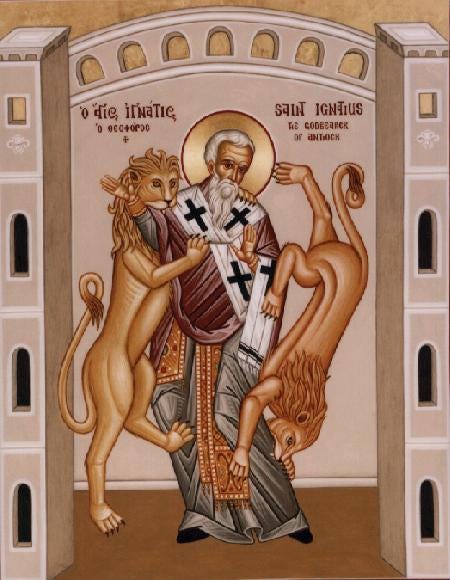
There is a man being marched across the Roman world in chains.
Ten soldiers guard him. He calls them his leopards.
He is old. He is a bishop.
He is being dragged to Rome to be torn apart by beasts in the arena for the entertainment of a crowd.
He could stop it. There are Christians in every city he passes through, and they have the money and the connections to buy his freedom. They beg to. And he writes ahead to tell them, in plain words, to leave him alone. Do not rob me of dying for Christ. Let me be ground like wheat in the teeth of the lions, so that I may become the pure bread of God.
His name is Ignatius of Antioch. He died around the year 108.
The seven letters he wrote on that death march are one of the best places a modern Christian can start reading, for a reason most modern Christians have never been told.
The story of the Bible did not end with the Bible.
A Question Every Christian Should Ask
If you are a man who reads, you have asked it: besides the Bible, what should I read?
It is a good question. It is also a question that, asked honestly, exposes a problem underneath it.
The unspoken assumption is that you have the Bible handled. You own one. You have read parts of it. You can find Romans without the table of contents. The Bible is the settled thing, and now you are looking for the supplements.
Reading is important.
A man who doesn’t read allows the loudest influences to form him.
Today, those loud influences make him stupid, anxious, and easy to be sold.
Picking up almost any serious book is better than the alternative the world hands you. Reading a serious book instead of scrolling is an upgrade. The most serious book is Holy Scripture.
Reading is the difference between feeding your soul and feeding it to an algorithm.
The Bible is important. Obviously. It is the Word of God. I have read it deeply and once walked through the entire Old Testament through several series of lectures with local and online audiences, hours of it, tracing the shape of the whole thing end to end.
Yet, you probably do not know how to read it. And neither did I for a long time.
You Received a Book and No Instructions
Here is the thing no one says from a modern pulpit.
The modern Christian believes he can pick up the Bible, open it cold, read it like a novel or a manual, and extract its meaning by himself with nothing but his own sincerity. Just him, the text, and the Holy Spirit. No church required. No history required. No frame required.
The Bible’s authors did not intend for it to be read this way.
The Bible did not fall out of the sky leather-bound with gilt edges and a concordance in the back. It emerged from the worshipping life of the Church.
The Church was reading these texts aloud in the liturgy, breaking bread, baptizing, praying, and being martyred for generations before anyone sat in a council and settled which books belonged between the covers.
The Bible came from the ancient, undivided Church, specifically out of the liturgical life. Which means the Book assumes a context no modern church has. The Bible assumes you are standing inside the ancient sacramental and liturgical life that produced it.
If you try to read the Bible apart from the Church’s liturgical life, the very soil from which it grew, it is like studying an instruction manual for a quantum computer without ever having touched the machine, observed its operations, or been trained by those who built it.
Most modern churches operate as if they can grasp the difference between bits and qubits, superposition and entanglement, simply by reading the manual in isolation, without any living reference or communal practice.
Father Alexander Schmemann wrote a small, dangerous book about this called For the Life of the World. His argument, made plain, is that the whole world is sacramental. Worship is not a religious activity you bolt onto a secular life. It is a lived reality in which everything, including Scripture, becomes legible. If you do not understand the liturgical and sacramental life of the Church, you simply will not have a framework for reading Scripture rightly. You will have words without the room in which they were spoken.
I am not saying don’t read the Bible.
I am saying know what you are holding, and know what you are missing.
A man who reads Scripture and knows he is only seeing a small part of the picture is in a far better place than the man who reads it and is sure he has the whole thing. The first man is humble before the text. The second one has made the text small enough to fit in his own hand.
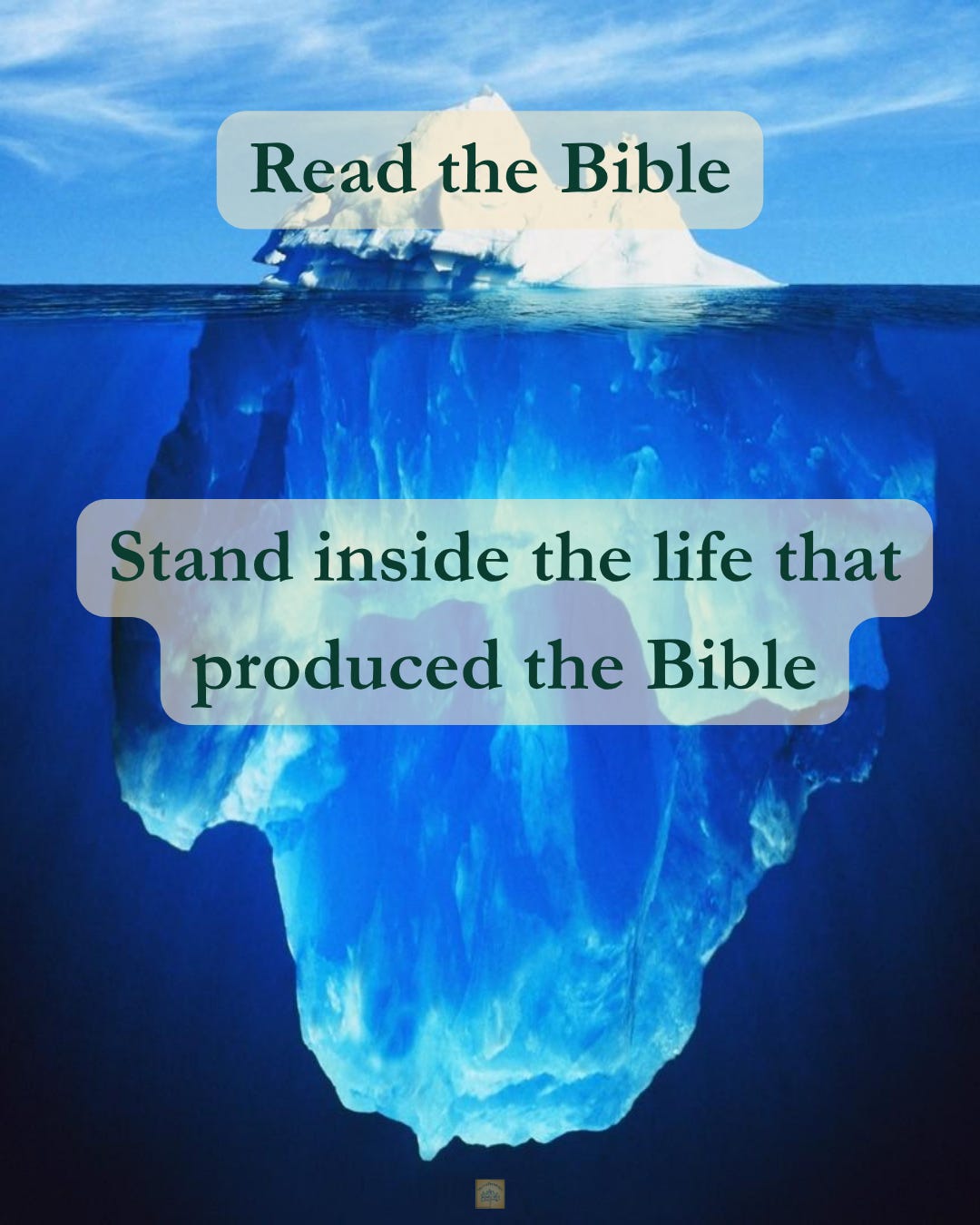
The Part They Never Told You: It’s Still Going On
Now the part that changes everything.
Most Christians read the Bible as a closed story.
The Bible starts in a garden, it ends with a vision on Patmos, the cover snaps shut, and we are living in the long afterward, waiting around for the sequel. The drama happened. We missed it. Now we keep the rules until we die or worse we wait for the big Apocalypse at the end.
The Christian picture of time differs dramatically from this modern way of minimizing scripture.
Christians are living inside the Bible.
Consider how Luke’s writing works. He wrote a Gospel (Luke), and then he wrote a second volume, the Acts of the Apostles, and he opened that second volume by referring to his “first book.” Some readers across the centuries have noticed that the Greek he uses for “first” can hint at a series still unfinished, wondering whether Luke imagined a third volume that never came. A minority reading, an inference, not a settled fact, but it should get you thinking.
Then look at how Acts ends:
Paul remained two whole years in his own hired lodging; and he received all that came in to him, preaching the kingdom of God, and teaching the things which concern the Lord Jesus Christ, with all confidence, without prohibition.
Acts 28:30-31
It does not resolve. Paul is under house arrest in Rome, preaching, and the narrative simply stops, mid-stride, doors open. No death scene. No “the end.”
It is the only book in the Bible that was never meant to be finished. The Acts of the Apostles is still being written. The chapters since the year 100 are the lives of the saints.
The ancient Church’s saints have the same drama, the same scale, and the same God operating through ordinary flesh against the prevailing powers of the age, a continuous process.
Martyrs are Acts chapter 200.
Desert fathers are Acts chapter 300.
The man whose name you carry, the saint at your baptism, is a living chapter.
The story of the Bible runs straight through the door at the end of Acts and out into history, and it has your name in it somewhere if you will let it.
Which is exactly why Ignatius matters.
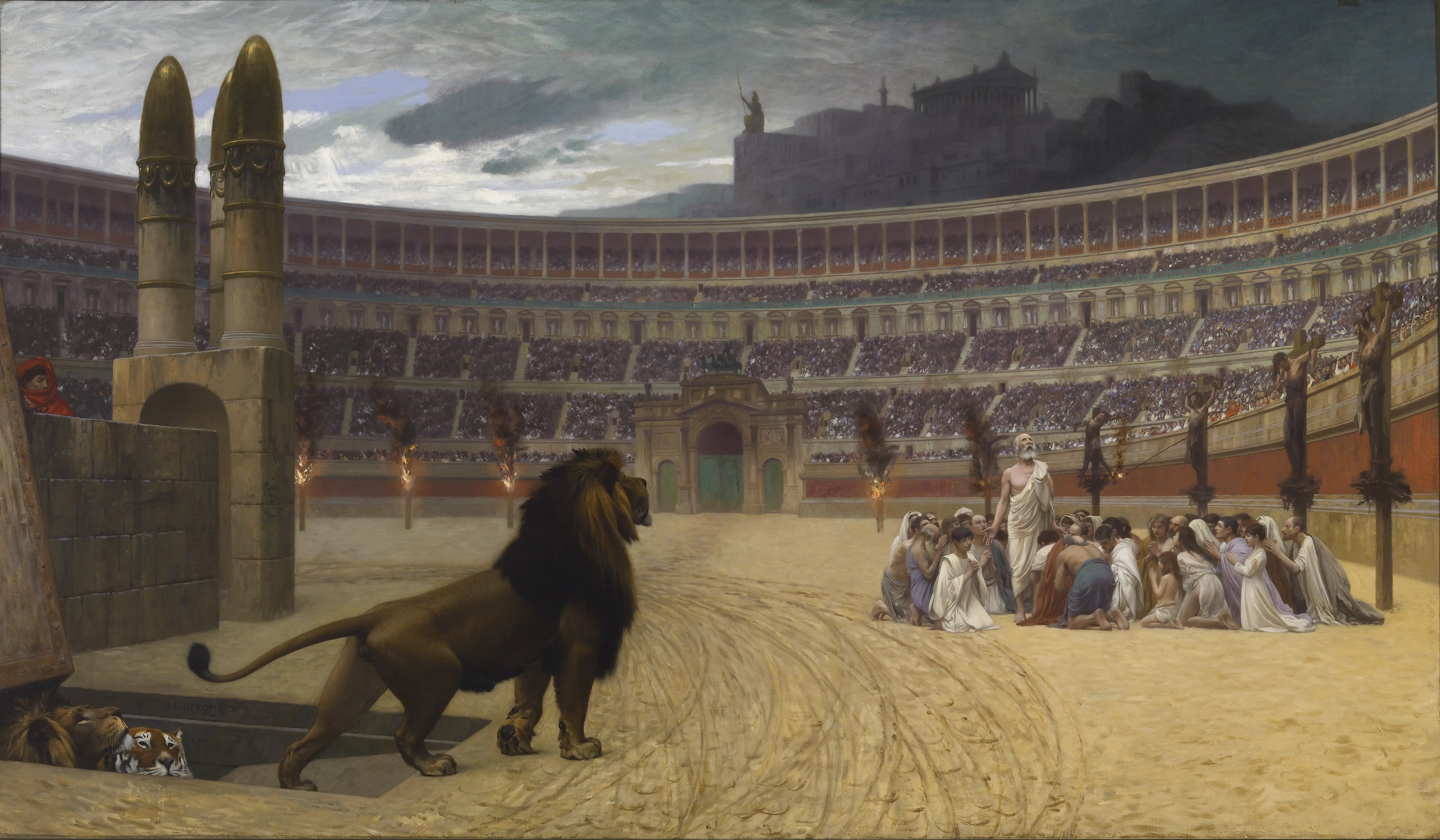
Wheat in the Teeth of the Lions
Go back to the road to Rome.
Ignatius was, by tradition, a disciple of the Apostle John.
The man who had leaned against the chest of Christ at the Last Supper had taught the man writing these letters.
He was bishop of Antioch, appointed by St. Peter, in the city where the word Christian was first used.
He is not a distant figure quoting a tradition. He is the tradition, one human link from the Lord Himself, and he is in chains.
And on that march, knowing what waits for him in the arena, he writes theology. He writes seven letters to churches along the route, and what he hammers on, again and again, with the lions practically in earshot, tells you exactly what a man believes when there is no reason to pretend.
He writes about unity. Hold together, he begs them. Do not splinter. A church scattered into a thousand private opinions is no church. The church will never divide.
He writes about the bishop. Stay close to your bishop, he says, the way the strings stay tuned to the lyre, so the entire community sings one note instead of noise. The Church for Ignatius is not a loose federation of individuals who happen to agree. It is an ordered body, visible, structured, real and in unity.
He writes about the Eucharist bluntly enough to make a modern man uncomfortable. The bread and the cup, he says, are the flesh and blood of Christ. Not a symbol of an absent Lord. The real presence of a present One. He calls it the medicine of immortality. The men who were taught by the apostles did not think they were eating a metaphor.
And under all of it runs a conviction: this faith is embodied. It is incarnational. God took on flesh, real flesh that bled, and so the Christian life is lived in flesh, in bread, in water, in oil, in the bodies of the saints. Christ is the icon of the invisible God. And the saints, transfigured by Him, become icons of Christ. So we honor them. We venerate them. We ask the ones who finished the race to pray for those still running. And we continue to record more holy chapters in the lives lived in the one, holy, apostolic, catholic life of Christ’s Body.
Today, sadly, most “churches” in your town reject all of it: the unified holy Church, bishop in apostolic succession, the Eucharist as true flesh, the honoring of the saints, the incarnational theology, and the embodied sacramental reality of it all.
Ignatius would not recognize the building down the road with the coffee bar, the fog machine, and the man in distressed jeans or a modern suit telling you that you are basically fine.
What You Are Actually Choosing
For a long time, I read like a modern man. I treated the Bible as my private possession, a book I could master with enough sincerity and a good study guide. I was sure of my own reading. Except, it was the cult of self wearing a Bible cover, the old lie that my life and my faith were my own, mine to assemble from the raw materials however seemed right to me.
The truth is older, harder, and better than that.
Stop trying to invent a faith and privately decode the Bible.
The saints handed you something two thousand years old, soaked in the blood of men like Ignatius, and your job is to enter it.
This is why I tell men to read St. Ignatius.
He is an introduction to the family you can actually belong to. When you read those seven letters from inside the ancient faith, you are listening to your own great-great-grandfather, in chains, telling you what he died certain of.
High drama.
Real stakes.
A man becoming wheat in the teeth of lions so he could become the bread of God. Don’t you want to be a part of that story? You can.
The Bible is open. The Acts of the Apostles is still being written. The only question is whether your life is a chapter in it, or a story that ends at your funeral.
One of those is a small story.
You were not made for a small story.
Build a legacy death cannot take.
Read the seven letters of St. Ignatius of Antioch for yourself here:
St Ignatius of Antioch - Orthodox Road
Or order them in a beautiful edition worth keeping on the shelf and handing to your sons:
The Letters: Ignatius of Antioch - Ancient Faith Store
Not ready to subscribe yet? Start with the foundational essay on the cult of self, the lie that your life is your own, and decide for yourself whether this is the voice you want in your life:

Well stated. Another thing we were never meant to do was to break the Bible up into thousands of individual verses to be dissected outside of the context of the text that surrounded them.
Side note: I asked ChatGPT what historical figure I most resembled based on what it knew about me, and it said.... Ignatius of Loyola. Go figure.
Ignatius did not write from a comfortable office. He wrote in chains, knowing exactly where the road was taking him. That changes how you read every word.