

The Church was built by a coward and a killer.
A fisherman who denied Christ to a servant girl while warming his hands at someone else’s fire.
And a scholar who held the coats at a stoning, then went looking for more Christians to drag out of their homes and slaughter.
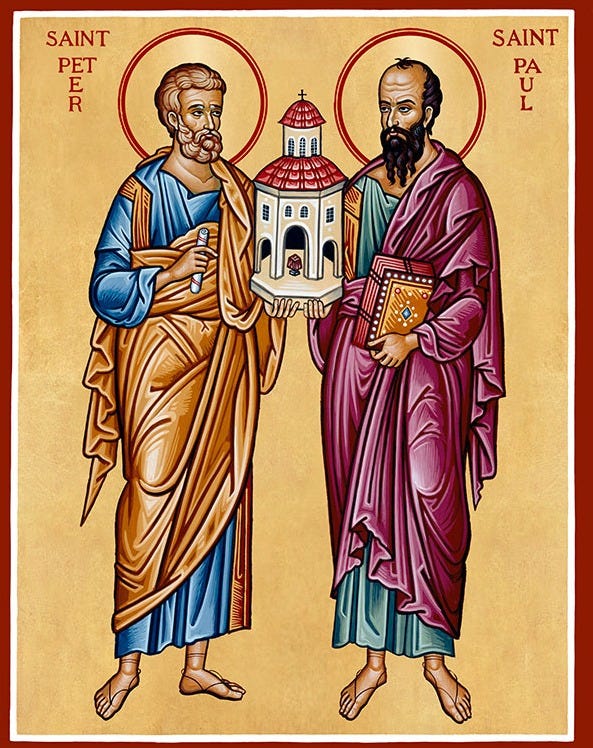
These are the two pillars. Peter and Paul. The Church puts them on the same feast day, June 29, and has for roughly seventeen hundred years.
This is intentional; it is a message. If you are a man who has been sitting on the truth, keeping your faith politely to yourself, waiting until you are more qualified to open your mouth, the message is aimed directly at you.
The Cave
Four hundred years before Christ, Plato told a story about prisoners chained in a cave. All they have ever seen are shadows thrown on a wall by a fire behind them. The shadows are their entire reality. They name them, study them, build their lives around them.
Then one prisoner is dragged out into the sunlight.
Here is the detail most people forget. The light does not enlighten him gently. It blinds him. His eyes burn. He stumbles. Everything he was certain of dissolves before he can see what is actually there.
Keep that image. Because the two men we honor on June 29 lived it. Literally.
The Most Certain Man in the Cave
Saul of Tarsus was the opposite of confused. He was the best student of his generation, trained at the feet of the great Gamaliel, zealous beyond his peers, absolutely certain he could see clearly. He was an expert in the shadows. He could name every one of them.
And he was so certain that he stood guard over the coats while a mob crushed Stephen with stones. By his own confession, “I also was standing by, and consenting unto his death” (Acts 22:20). Then he obtained letters and set out for Damascus, “breathing out murderous threats” (Acts 9:1).
On that road, the Light found him
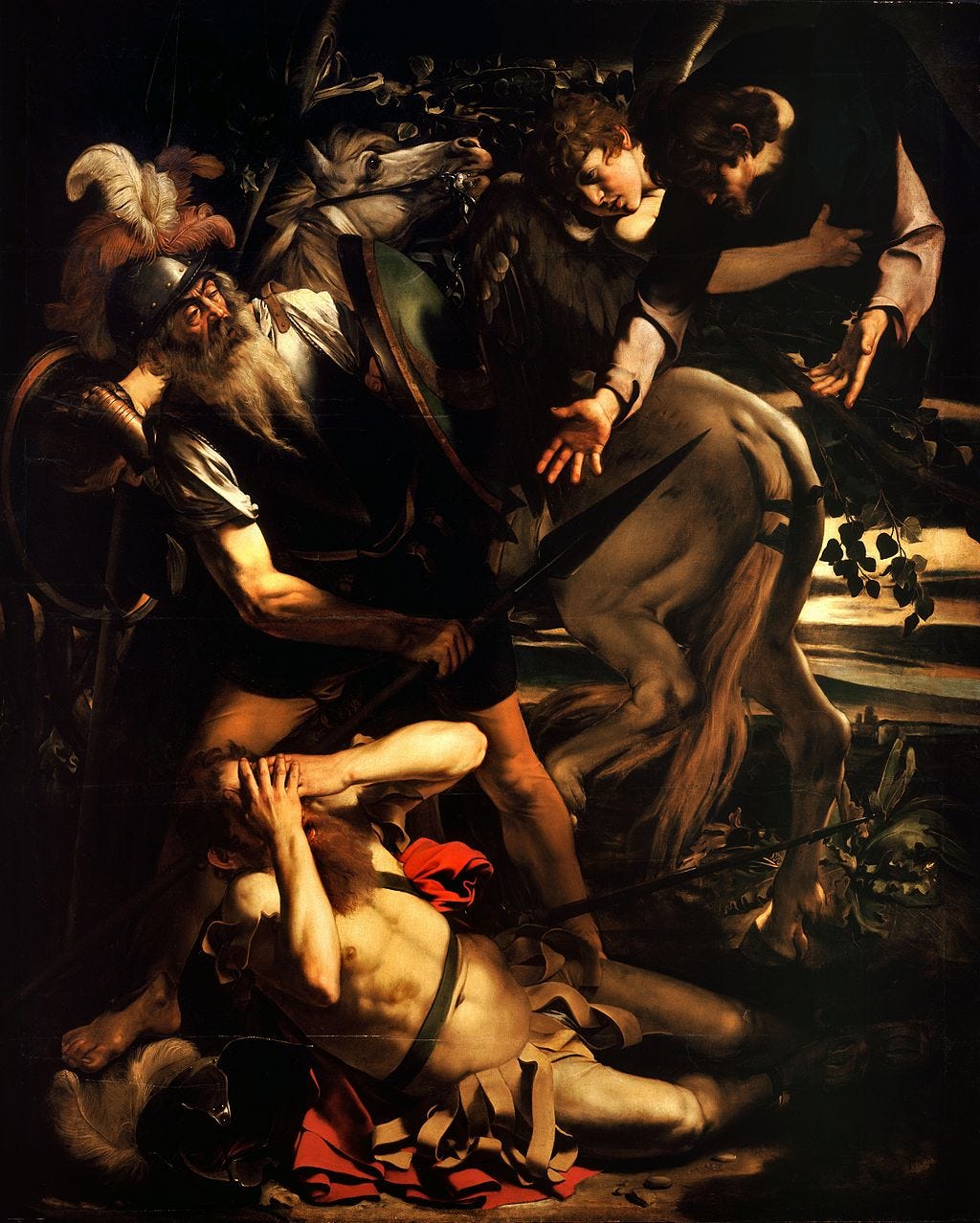
A light from heaven that knocked him to the ground and took his sight. For three days the most certain man in the cave was blind, eating nothing, learning what the prisoner in Plato’s story learned: the first thing real light does to a man who has lived in shadows is undo him.
When Ananias laid hands on him, Scripture records the strangest, most precise detail: “immediately there fell from his eyes as it had been scales” (Acts 9:18).
Scales. The residue of the cave, peeling away.
The Man the Cave Almost Took Back
Peter walked with the Light Himself for three years. He saw the lepers cleansed, and the dead raised. He confessed Christ with his own mouth.
And on the worst night in history, fear of man pulled him straight back into the dark. The Gospel of John notes exactly where he was standing when he denied his Lord: beside a charcoal fire, warming his hands among the servants of the men murdering his Friend (John 18:18).
Here is a detail: The Greek word for charcoal fire, anthrakia, appears exactly twice in the whole New Testament. Once at the fire of denial. And once on a beach after the Resurrection, where the risen Christ has built a second charcoal fire and is cooking breakfast (John 21:9).
Same smell in the nostrils. Same glow on the face. And beside that second fire, Christ asks him three times, once for each denial, “Do you love me?”
Christ did not erase Peter’s failure. He walked him back to the exact sensory scene of it and rewrote the ending.
If you have a fire you cannot stop returning to in your memory, a moment of cowardice that still warms your face with shame, understand what kind of God you are dealing with. He does not file your failures away. He builds a second fire.
Your Wall Is Made of Glass
Now look at your own cave.
The wall the shadows play on is in your pocket. It is in your hand before your feet hit the floor in the morning. The fire behind you, casting the shapes, is run by what I have named before in these pages: the cult of self, the modern lie that your life is your own, that your opinions are too costly to voice, that your job is to consume quietly and keep the peace.
The shadows are curated for you. Outrage you cannot act on. Luxuries you do not need. Versions of manhood with nothing underneath them. And the longest-running shadow of all: the suggestion that a serious man keeps his deepest convictions to himself.
It is working. A national survey by the Cato Institute found that 62 percent of Americans say the climate prevents them from saying things they actually believe (source).
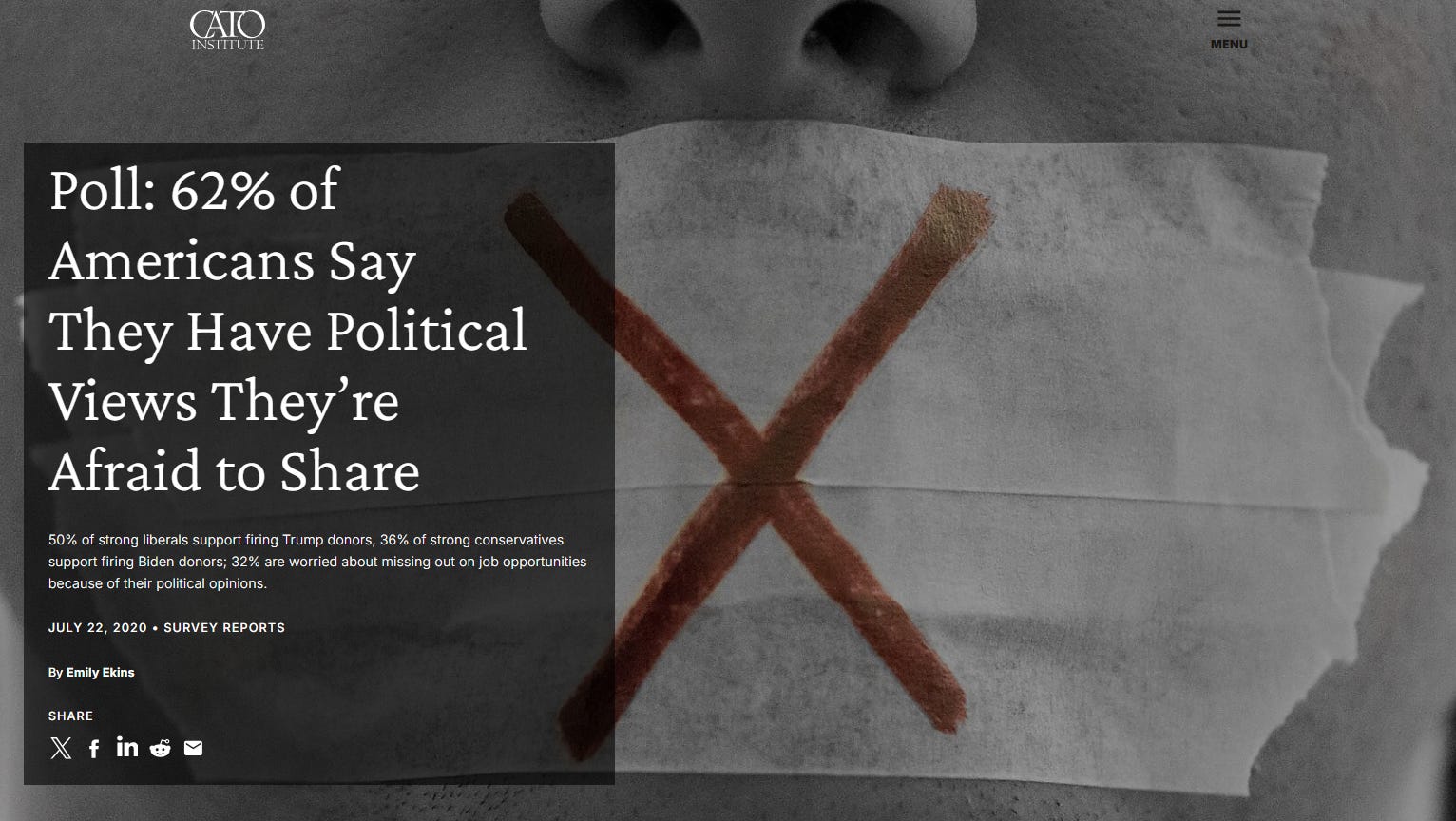
Nearly two out of three men, chained in their seats, watching the wall, holding their tongues.
No man was made for a small story. And no man was made to whisper.
The Part of the Story Where They Kill You
Plato knew how his story ended. He said that if the freed prisoner went back down into the cave to tell the others, his eyes now ruined for the dark, the prisoners would mock him. And if he insisted on dragging them toward the light, they would kill him.
Peter and Paul both walked back down.
They walked into Rome. The loudest cave on earth. The center of the empire’s noise, appetite, and power. An old tradition says Peter was fleeing the city during Nero’s persecution when he met Christ on the road, the Via Appia, walking the other way. “Where are you going, Lord?” Peter asked. To Rome, came the answer, to be crucified again. Peter turned around.
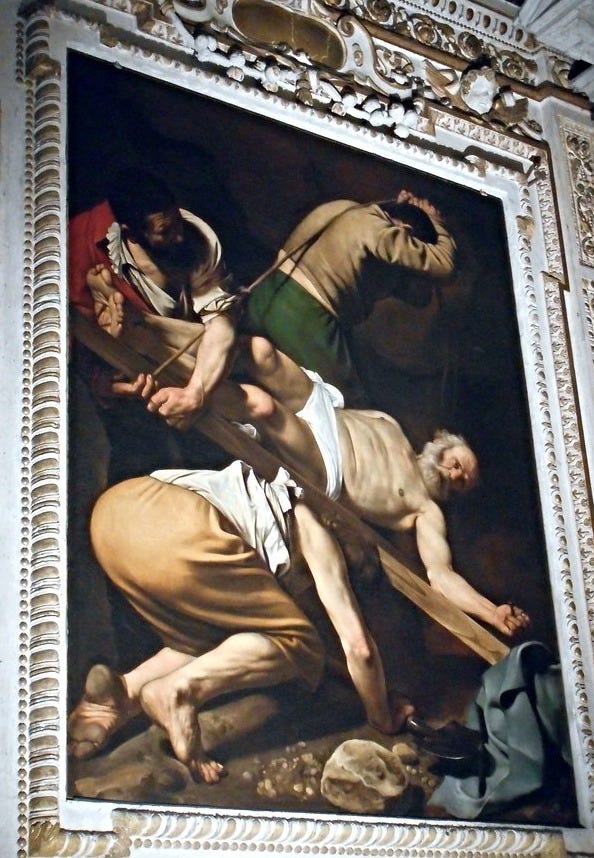
The cave did exactly what Plato predicted. Tradition holds that Peter was crucified, asking to be hung head-down because he was unworthy to die as his Lord did, and that Paul, a Roman citizen, was beheaded on the road out of the city. Same city. Same persecution. Honored on the same day ever since.
St. Augustine preached that though they suffered on different days, the two were as one, and St. John Chrysostom said he loved Rome above all its splendor for one reason: it held the bodies of Peter and Paul.
A coward and a killer. Dragged into the light, blinded, restored, and sent back down the tunnel. Neither one freed himself. Neither one stayed safe. And the Church stands on them still.
Why This Publication Exists
Now the confession.
One year ago (2025), the feast of Saints Peter and Paul fell on a Sunday. I was standing in the nave of my parish when my priest, Fr. Samuel, gave a homily about speaking up. I do not remember every word. I remember the weight. I remember knowing, the way you know when something is aimed at you, that I had been warming my hands at a comfortable fire for a long time, and that the prompt was simple: stand up, speak up, and be counted.
I went home and started writing the posts you find in this publication that day. It took me many months to work up the nerve to hit publish. But everything you have read in these pages exists because two martyrs had a feast day, and a priest took it seriously, and one man in the congregation stopped pretending he had nothing to say.
This publication is my walk back down the tunnel. I am writing to you a few steps ahead in the dark, holding a candle, telling you the sun is real because it burned me too.
The Council Is Waiting
After Pentecost, Peter and John were arrested and hauled before the council, the same council that had condemned Christ. The rulers looked at these two fishermen and Scripture says they “perceived that they were unlearned and ignorant men” and marveled, because one thing was undeniable: “they had been with Jesus” (Acts 4:13).
The council ordered them to be silent. Peter, the coward of the charcoal fire, answered for both of them: “we cannot but speak the things which we have seen and heard” (Acts 4:20).
The world looks for credentials, eloquence, impressive men with finished character arcs. Notice what qualified these “unlearned and ignorant men,” Peter and John. Proximity to the Light. That is the entire qualification, and you can have it too.
Your council is probably not a tribunal out for your murder. Glory to God. Mostly likely, it is a dinner table where your children have never heard you pray out loud. A break room where everyone assumes you think what the shadows think. A feed where you repost what is safe and bury what is true. A friend who is dying quietly in the dark, waiting for one man he respects to say the unfashionable thing.
Stay silent, and here is what it costs. The question that has been haunting you in the quiet, whether any of this will matter when you are gone, will be answered. And the answer will be no.
Speak, build, and bear witness, and the answer changes. You will leave behind something death cannot take. Two men in Rome proved that the grave cannot hold a story like that. We are still saying their names two thousand years later, on the same day, every year.
June 29
The Church does not walk into this feast casually. For weeks before it, the Apostles’ Fast strips things away, quieting the noise so the message can land.
So here is the challenge:
On June 29, find the place where you have been silent and say the true thing. Pray out loud at your table. Tell one man what Christ has actually done for you. Put your name on what you believe. Do it badly if you must. Peter preached with a denial in his past and Paul preached with blood on his hands, and the Light was strong enough to carry both.
You were made for more than a small story.
The coward became the rock.
The killer became the apostle.
The cave is still full of men you know.
Walk back down.
Build a legacy death cannot take.
Christopher Clay is the author of Five Principles and the voice behind Truth & Prosperity. He writes on Faith, Family, Finance, and Legacy from his home in West Virginia.
If this resonated, subscribe free. You will get the Legacy Audit, twelve questions for the man who wants his life to mean something, and one letter each week. No fluff. No noise. Just the walk back down the tunnel, together.
So much truth here.
Excellent, Chris! I loved this one. I am so guilty but will try to change.