

Givers earn 14% less on average than takers. They are judged 22% less powerful and bring in 2.5x times less revenue on average in sales because they don’t get as aggressive.
The cult of self will tell you:
Promote yourself, get aggressive.
Build your personal brand.
Know your worth.
Negotiate hard.
Before you buy into the next hustle pitch or online guru read this article, because the headline data goes deeper.
All of this is costing you money, and I’m going to prove it from the same data set from above.
The Part the Gurus Cannot See
Taking, giving, and matching are financial and accounting functions people pay top dollar to understand. Two types of people can perform the same functions while serving different masters. This is a large reason this publication exists.
Once you understand the lie behind what the cult of self is selling, you will be better equipped for real success. This knowledge applies to your finances, but it also applies to your faith, your family, and the legacy you are building.
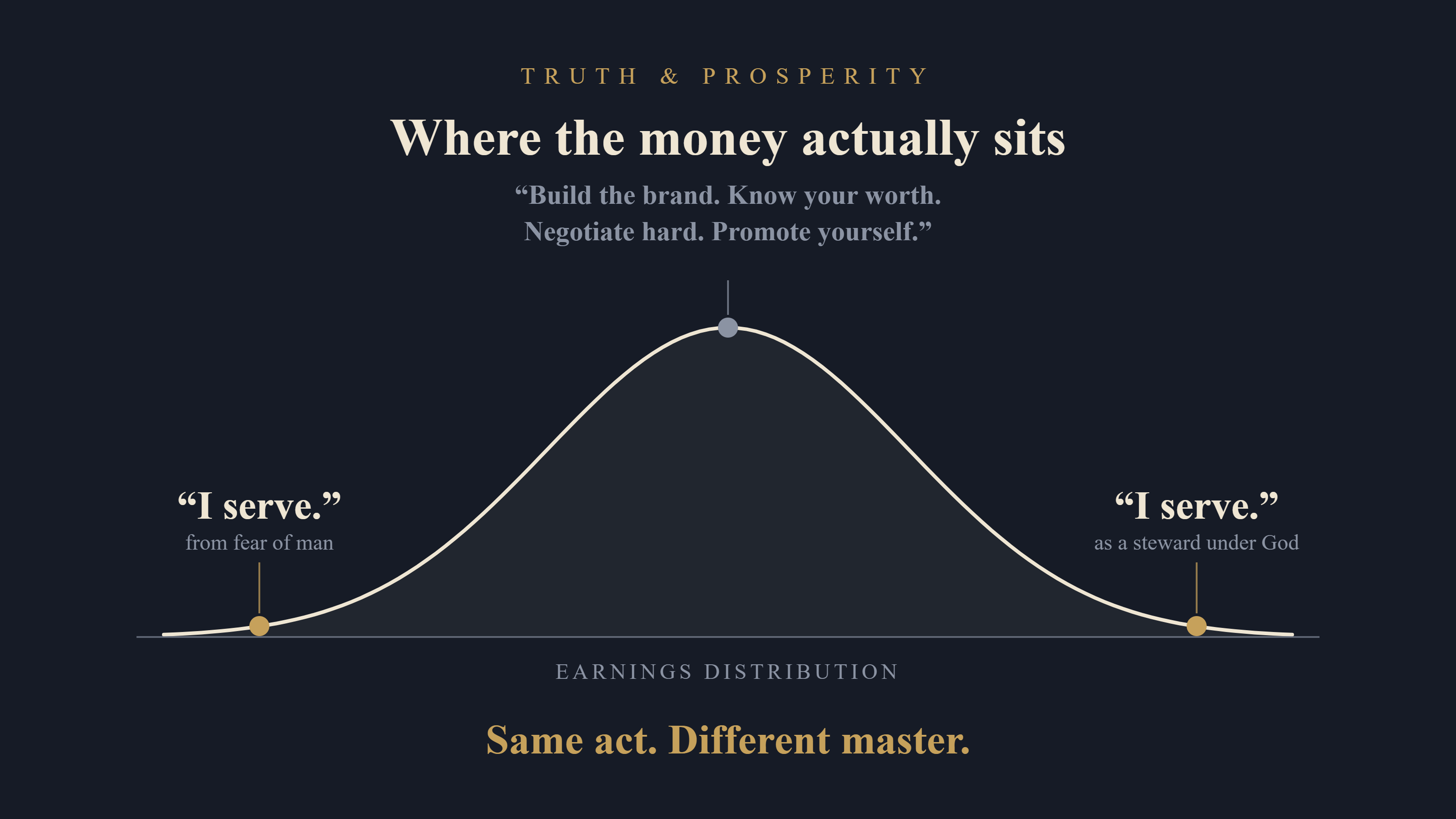
The shape of the data is powerful. Givers crowd the bottom and the average lies because the bottom is crowded. The cult of self-hustlers sits stuck in the middle. But here’s the twist: the givers at the bottom are often stuck in the cult of self, too. They serve out of fear of man, a hunger to be liked, a dread of conflict. Same cult, different program.
The whole question of your financial life is whether you can even see that a right side exists. This is the insight we’re about to unpack.
The Braggart in the Coat
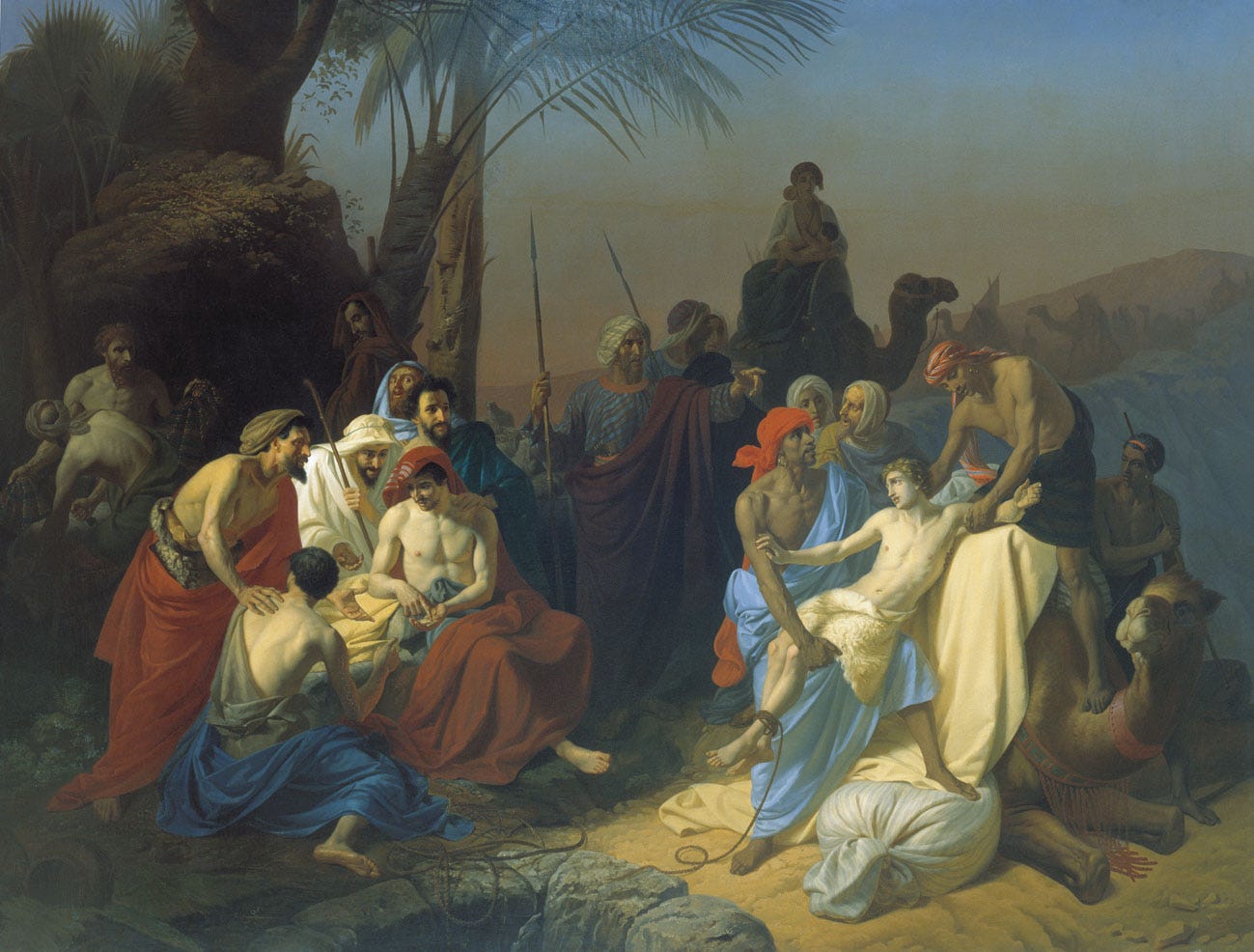
At 17, Joseph had privilege. A coat of many colors, favored by his father, and given dreams of glory by God. Honest and insufferable. My sheaf rose. You bowed to me. His bragging earned him a pit and a slave caravan.
Three thousand years later, the pattern holds in the lab. Researchers publishing in Psychological Science found that self-promoters consistently overestimate how much their audience enjoys the pitch. The listeners rated them less likable and no more competent. The brag doesn’t even buy what it costs.
The fact is most of us are Josephs. You’re reading this article online, after all. You have power for your device, a safe place to read, enough free time to read, and a list of other privileges most of the world throughout history could not fathom.
Like Joseph, and like me, in all our comfort we give in easily to the cult of self. Pride. You compare yourself to your brothers. You brag about your stress and your income. Or you sit at the bottom serving out of fear, desperate to be liked, desperate to avoid conflict. Both run the same cult of self program. One wears virtue-signaling humility. The other wears hustle culture.
A Generation Selling Itself
You work 80 hours and your company doesn’t respect you. So you humblebrag about the hours and the stress in the Monday meeting, wearing exhaustion like a medal. Research out of the University of Georgia found that stress-bragging coworkers get rated less competent, less likable, and less worth helping when they’re overloaded. The medal reads as a warning label.
You watch the influencer teach a course on getting your vacation paid for with a GoPro and the right funnel, half off if you click before midnight.
You practice the highlight reel in the elevator. You polish the LinkedIn post about being “humbled and honored.” You draft the salary case built entirely on the word I.
The pattern goes all the way to the corner office. Landmark research on narcissistic CEOs found they don’t actually improve company performance. They increase its volatility. Big swings, big bets, big drama, and shareholders riding the roller coaster so one man can feel large.
These are the facts. The cult of self has been normalized, and a generation has been coached to sell itself to people who are repelled by the pitch. Study after study shows the audience pulling away: less liking, less trust, less willingness to help, even less generosity toward the one doing the bragging. The market hears the self-promoter the way the brothers heard Joseph. And the pit is always closer than the braggart thinks.
How normal this has become.
Stuck in the Middle
You’ve updated the resume. Practiced the pitch about how you drove results. You’ve built your brand and researched your value. Negotiated hard and got the bump. Then 18 months later you get passed over for the big promotion.
You followed the cult of self’s playbook out of the bottom, into the middle, and now you find yourself stuck.
You’ve curled around the extra pay. You’ve claimed it for yourself. Yet the little extra money doesn’t answer the real problems.
The weight of a life that isn’t adding up is taking its toll.
The Man Who Rose From the Pit
The braggart in Joseph died in the pit and became a slave.
What rose out of the pit was a man who made other men’s houses prosper.
Potiphar’s estate. The prison. Egypt itself. Joseph gets promoted again and again. Society would say use the rough life to humblebrag, to demand your due, to guard your personal brand. Joseph serves. He doesn’t take his due. Even in prison, he interprets dreams and asks for nothing but to be remembered, and he’s forgotten for two more years.
Service compounds on God’s schedule.
This is where the lesson turns. Because the cult of self sits at the bottom and in the middle. Something else sits at the top, and the data points to it, too.
On average, takers outperform givers. But at the top, above the average, it’s givers who fill the column. In the research we’re discussing, the performers at the top, above the average, were givers, and they earned 50 percent more revenue than the takers and matchers.
Why Servants Sit at the Top
The market pays servants the most because true service is undersupplied and always in demand.
Jesus said it first: “Whoever would be great among you must be your servant” (Matthew 20:26).
Now let me share a little behind the scenes of Truth & Prosperity. This publication runs on a set of writing rules, and the first rule on every article’s storyboard is this: the reader is the hero. You. Every essay here is built to make you succeed, and that rule is the reason the publication works at all.
The doormat and the patriarch do the same work for different masters.
If you serve to be liked, you will be spent.
If you serve as a steward under God, it will compound.
The Weeping
Return to Joseph one last time. Near the end of his story, the brothers bow before him. The dream is fulfilled to the letter.
But the boy who wanted the bow is gone.
The man who received the bow flees the room to weep.
This is a result the cult of self cannot imagine: a world where you are free from needing everything the cult of self promises.
70% of family wealth gone by the second generation; 90% by the third. The money is plentiful, but the formation was broken. Be the steward whose wealth is still working in a hundred years.
I know some of you will spend Monday morning polishing the brand. Perhaps, this evening you are preparing for the stressful day tomorrow which will tell you, you matter. Break those chains.
So where does a man start? Small. This week, three baby steps.
Give something in secret. Money, time, help, it doesn’t matter. What matters is that no one can ever find out. Jesus set the terms: “Do not let your left hand know what your right hand is doing, so that your giving may be in secret. And your Father who sees in secret will reward you” (Matthew 6:3-4). One act with no audience will teach you more about which master you serve than a year of sermons.
Carry one burden silently. The next time the stress builds, and the old urge rises to broadcast it, to the meeting, the group chat, the dinner table - - don’t. Take it to prayer instead. You will fail at this. Try again anyway. A man learns what his shoulders can hold by holding, not by announcing.
Give the credit away. The next win that lands, hand it upward and outward before you touch it. To God first. Then to the staff who executed, the wife who held the house together, the mentor who taught you. Say it out loud, give God and others the glory. Watch what that does to your family, team, or community over a year. Watch what it does to you.
From Consumer to Patriarch.
Build a legacy death cannot take.
Research from: Give and Take: Why Helping Others Drives Our Success: Adam Grant