

There’s a saint who was banned by Moscow in the 18th century.
Suppressed in the West after Vatican II.
And yet, right now, his image is sitting on the dashboards of cars, trucks, and motorcycles all across the world.
This is truth refusing to die.
His name is St. Christopher. He is my patron saint. And once you hear his story, you’ll understand why he belongs to this moment, not some forgotten medieval world.
The Giant at the Edge of the World
Before he was Christopher, he was Reprobus.
A Canaanite giant. Over seven feet tall. Fearsome face. A warrior so terrifying he was captured by the Romans and conscripted into the Numerus Marmaritarum, one of their most brutal fighting units.
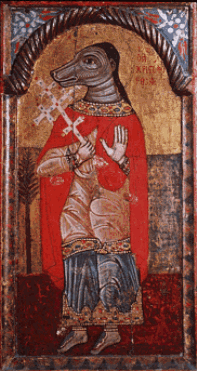
The early iconographic tradition paints him with the head of a dog.
Yes, you read that right. A dog-headed man.
Before you dismiss that, understand something: Pliny the Elder, in his 37-volume Natural History, wrote of dog-headed men, cynocephali, at the very edge of the known world. This is how ancient people described the foreign, the other, the one from beyond the boundary. The one who came from somewhere we don’t fully understand.
This is the man God chose to bear His Son across a flooded river.
Every time a rational modern mind wants to scrub St. Christopher clean of his strangeness, I think of Leviticus 23:22, “Do not reap to the very edges of your field or gather the gleanings of your harvest. Leave them for the poor and the foreigner.”
The edge belongs to God. The mysterious belongs to God. Deuteronomy 29:29 agrees, “The secret things belong to the LORD our God.”
St. Christopher was always meant to live at the edge.
The Most Powerful Master
Reprobus had one goal: serve the strongest king alive.
First he served a giant warlord, a king of his own kind. But he saw fear in that king’s eyes, so he left.
He joined the Roman legions under one of the most powerful emperors of the ancient world. But then he saw the emperor flinch.
What made the emperor flinch?
The mention of the devil’s name.
So Reprobus went looking for the devil himself. He found a band of marauders led by a man who called himself the devil. He served him. Until one day he watched his new master swerve around a roadside cross.
A cross? The devil fears a man who was crucified and still lives?
Reprobus walked away and went looking for Christ.
He applied rigorous, almost brutal, logic to his spiritual search. Reprobus would not serve second best. He followed the chain of fear all the way to the top.
That is nepsis, watchfulness, a discipline the Church Fathers praised as one of the highest practices of the Christian life. It is courageous.
Carrying What He Cannot Carry
A Christian hermit found Reprobus and gave him the Gospel. But Reprobus could not pray. Could not fast. The weight of the evil he had done in service to lesser kings was too great. It crushed him when he knelt.
So the hermit gave him a different instruction.
“You are large and strong. Go serve others by carrying them across the dangerous river.”
Not glamorous. Not theological debate. Simple service. Show up, put your body between the weak and the danger, and get them to the other side.
He did it. Day after day.
Then a small child asked to cross.
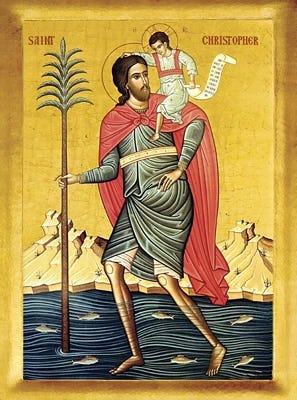
Reprobus lifted the child onto his shoulders and stepped into the water. The river swelled. The child grew heavier with every step. Heavier than a grown man. Heavier than an army. Heavier than the world. The water rose above Reprobus’ head, again and again.
He nearly drowned.
But he made it to the other side. Gasping he spoke to the small child and said, “You felt as heavy as the whole world!”
The child answered, “You had on your shoulders not only the whole world but Him who made it. I am Christ your king, whom you are serving by this work.”
The name Christopher is Greek. Christóforos. Christ-bearer.
He was baptized in that crossing by full immersion, held under by the weight of the King of Kings.
And he came up on the other side a new man.
This Story Is Older Than You Think
If this story feels familiar in your bones, it should.
It echoes through the whole of Scripture.
Noah crosses the water with wild beasts and the remnant of creation. The Hebrews cross the Red Sea alongside foreigners and wanderers into a wilderness full of giants. Then Joshua, Yeshua in Hebrew, the same name as Jesus, leads God’s people across the Jordan River into the Promised Land.
And who stands beside Joshua?
Caleb.
Caleb, whose name literally means dog. A Kenizzite. A foreigner. The one who received the edge of the land, the margins, as his inheritance.
Joshua and the dog-man cross the water and inherit the Kingdom.
“Am I a dog,” Goliath, the giant man, sneers at David, “that you come at me with sticks?”
“Even the dogs,” the foreign woman tells Jesus, “eat the crumbs that fall off the edge of the table.”
The pattern runs deep.
The foreign. The edge. The dog. The water crossing. The King.
Scripture is showing us the shape of the Church itself. A Kingdom built from foreigners, from the ones the world discards, from the ones who carry Christ through the flood.
What 666 Has to Do With It
St. Christopher is an end-times saint.
Bear with me here, because this goes somewhere concrete.
On the sixth day, God created man. Six is the number of man. Seven is the number of completion, the day God rested. Three in Scripture represents fullness: Holy, Holy, Holy. The Trinity.
So 666 is not simply a spooky number. It is man, triply complete in himself. Man perfected by man. Man reaching for the throne of God without God. That is the spirit of every age that forgets it has a Creator. This age. Modernity explaining away mystery, miracles, and faith; man perfected by man without the need of marginal space.
St. Christopher was suppressed precisely because institutional powers do not love a saint who lives at the edge of their control, who belongs to the foreigner, the traveler, the one not quite inside the borders yet.
Churches placed his image at their exits, not their entrances. Medieval towns put him on bridges. People put him in their cars.
Travel is liminal space. Between here and there. Between who you were and who you’re becoming. Between Egypt and the Promised Land. Between man and God.
In an age that worships the idol of human sufficiency, that wants to account for every margin and scrub away every mystery, St. Christopher stands at the exit and says: the road ahead belongs to God, not you.
The Man We’re All Meant to Be
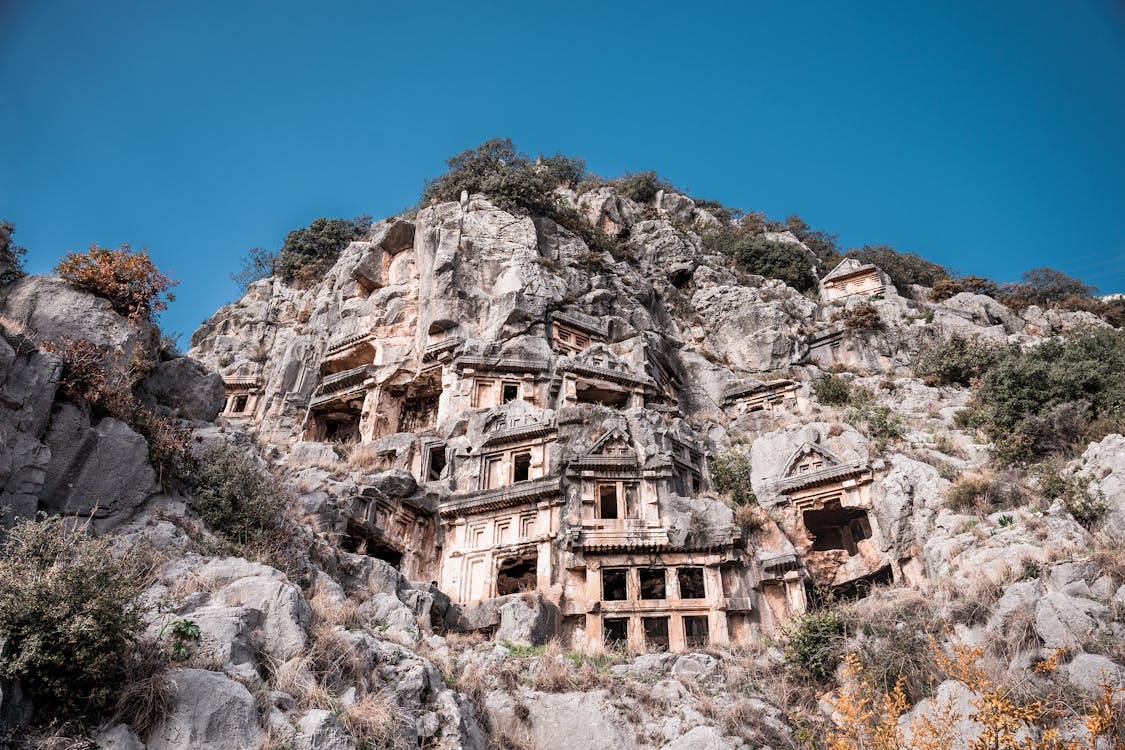
After the river crossing, Christopher traveled to Lycia.
He comforted persecuted Christians. He converted thousands. When the Roman ruler had him arrested and sent beautiful women to seduce him, he converted them instead.
When they tried to kill him by fire, by arrows, the attempts failed.
Finally, he was beheaded.
The Kontakion of the Church sings it plainly:
“Thou who wast terrifying both in strength and in countenance, for thy Creator’s sake thou didst surrender thyself willingly... Wherefore, we have gained thee as our protector, O great Christopher.”
The most terrifying warrior freely surrendered.
That is the picture of Christian manhood that has been slowly erased from public life. Replaced by passive, soft, virtue signaling, weak men leading us to ruin.
But St. Christopher points in a different direction, he points to terrifying strength, freely surrendered to Christ.
Paul wrote it in 1 Corinthians 1:27, “God chose the foolish things of the world to shame the wise.”
The dog-headed giant, carrying God across the flood.
The foreign woman, eating crumbs from the edge of the table.
This is us. This is the Church militant.
What I’m Actually Saying
When I was given St. Christopher as my patron saint, it was to learn I am Reprobus before I am Christopher.
A man who served lesser kings. A man carrying weight that should have drowned me. A man who needed someone to tell him: serve others and there you will find Christ.
Choosing a patron saint is choosing accountability in love. It is admitting you need a companion who has already run this road, who is part of the great cloud of witnesses, and whose intercession steadies your feet when the water rises.
Compared to Christ, we are all dog-headed foreigners from the edge of His map.
This is the ground of our salvation, humility before the throne.
We were not chosen because we were already clean, already inside the borders, already finished. We were chosen to bear Him through the flood to the other side.
May 9th is the feast of St. Christopher.
On that day, wherever you are, remember that the road ahead is not yours to control, but Christ’s to sanctify.
Bear Christ. Cross the river. Serve others.
That is how you build something that outlives you.
WONDERFUL
Fantastic article. It doesn’t just give interesting information; it contains practical spiritual application.
I knew a bit of St. Christopher’s story in the context of art history, but I didn’t know some of the additional details you give, so I appreciate this deep dive. Great writing! 🙏