

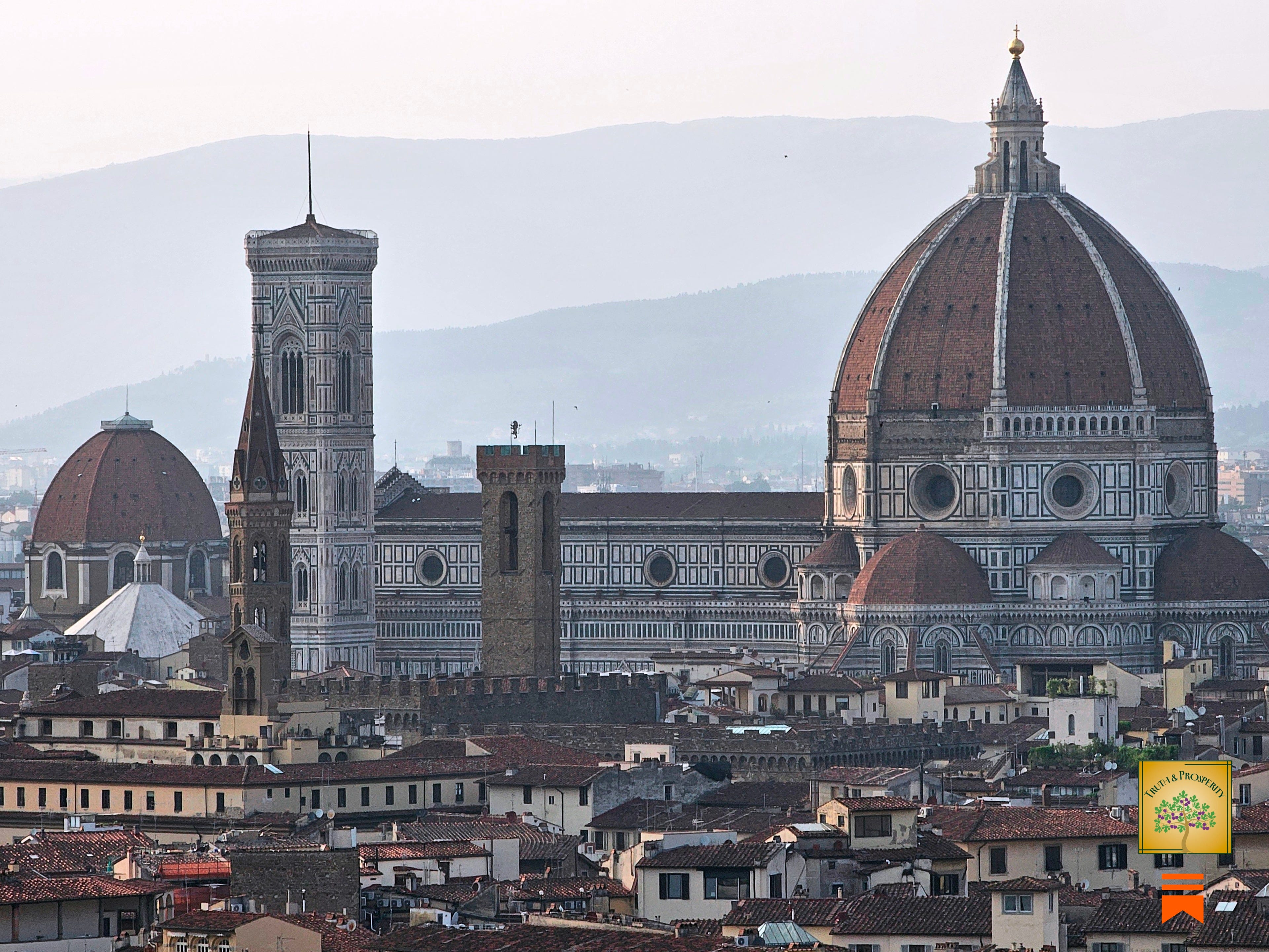
Florence is the most photographed city on earth and the most misunderstood.
The crowds line up for the Gates of Paradise. They tilt their phones at Brunelleschi’s dome. They argue about whether Michelangelo or Donatello carved the better David. They eat gelato in the shadow of Santa Maria del Fiore and believe they have seen something holy.
They have not.
The holy thing in Florence is in the dirt. It is under their feet. It is a girl.
The Tourist Sees What He is Told to See
I have climbed to the top of the great dome, looked out over Florence, and attended Mass under it.
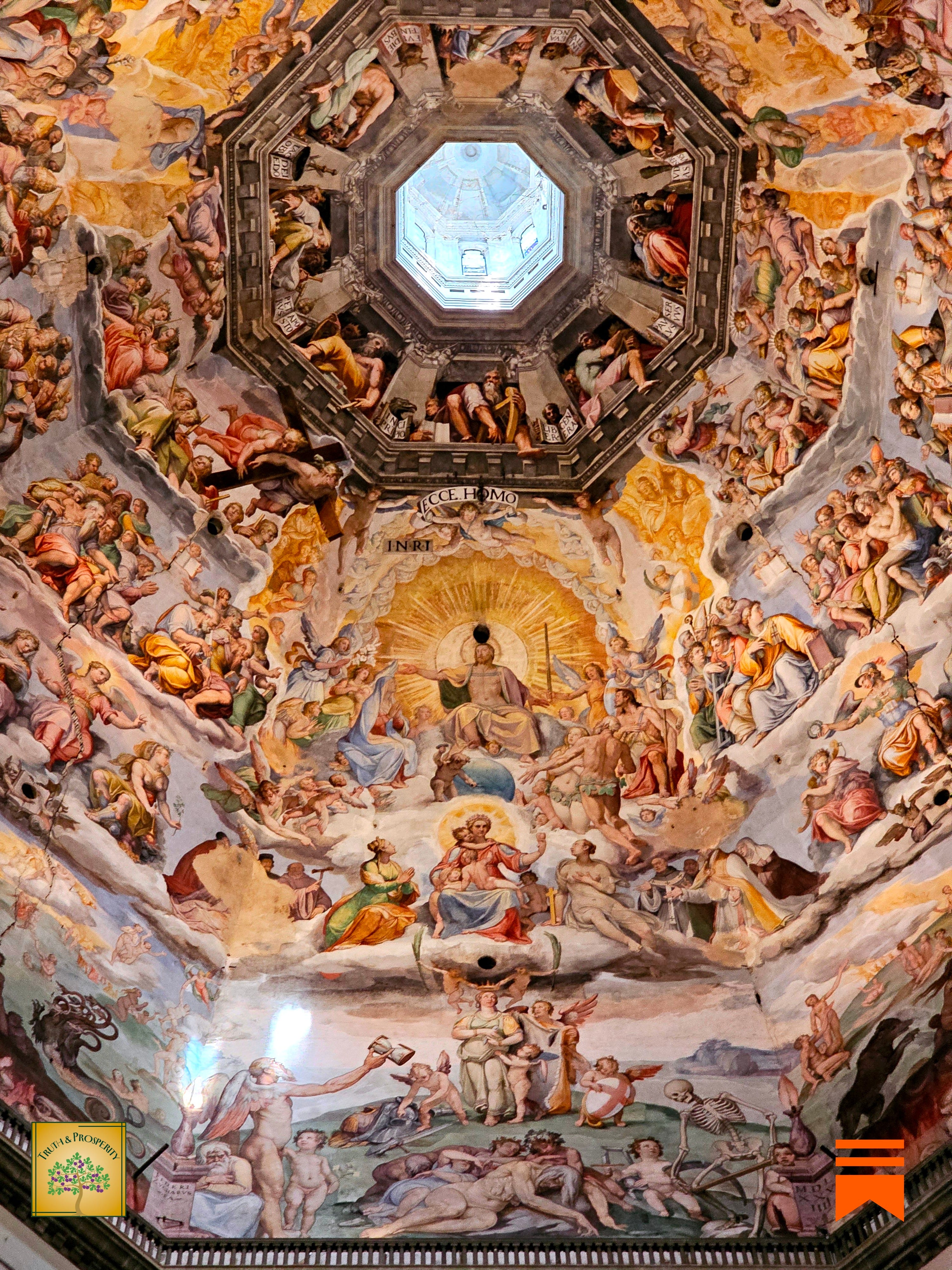
Standing in the piazza and then under the dome, I was genuinely staggered by the architecture.
Brunelleschi solved a problem no one in Europe could solve for a hundred and forty years, and his dome (completed before the discovery of America) is proof that a single disciplined man can outwork an entire age.
The bronze panels of Ghiberti’s east doors are so beautiful that Michelangelo himself called them the Gates of Paradise and the name stuck.
Florence is the city of uomo universale, the universal man, the city that put the human person back at the center of the painting, the building, and the great poem by Dante.
This is what the tourist is sold.
This is what every guidebook frames.
This is what the city wants you to walk away with: Florence as the triumph of human achievement.
And it is a lie of omission.
Because before the dome, before the marble, before the Medici and the Renaissance and the long centuries of Italian glory, there was a small basilica on that same ground with a different name. Santa Reparata. It stood for nearly a thousand years. It was the cathedral of Florence from the late fourth century until 1296, when the city tore it down to build something bigger.
The new cathedral was so much larger that it swallowed the old one whole, like a nesting box. For seventy years they built the new walls around the old basilica. The Mass was celebrated inside Reparata’s church while the dome of her replacement rose above her. Then in 1379 they pulled her down for good and paved over her with marble.
She mostly vanished from the city’s memory.
In 1965, archaeologists started digging under the floor of the Duomo and found her again. Roman foundations. Early Christian mosaics. A Latin inscription commemorating Florence’s deliverance from the Ostrogoths in 406, which the city had attributed to her intercession. Bones. Tombs. The unmarked grave of Brunelleschi himself, the man whose dome buried her.
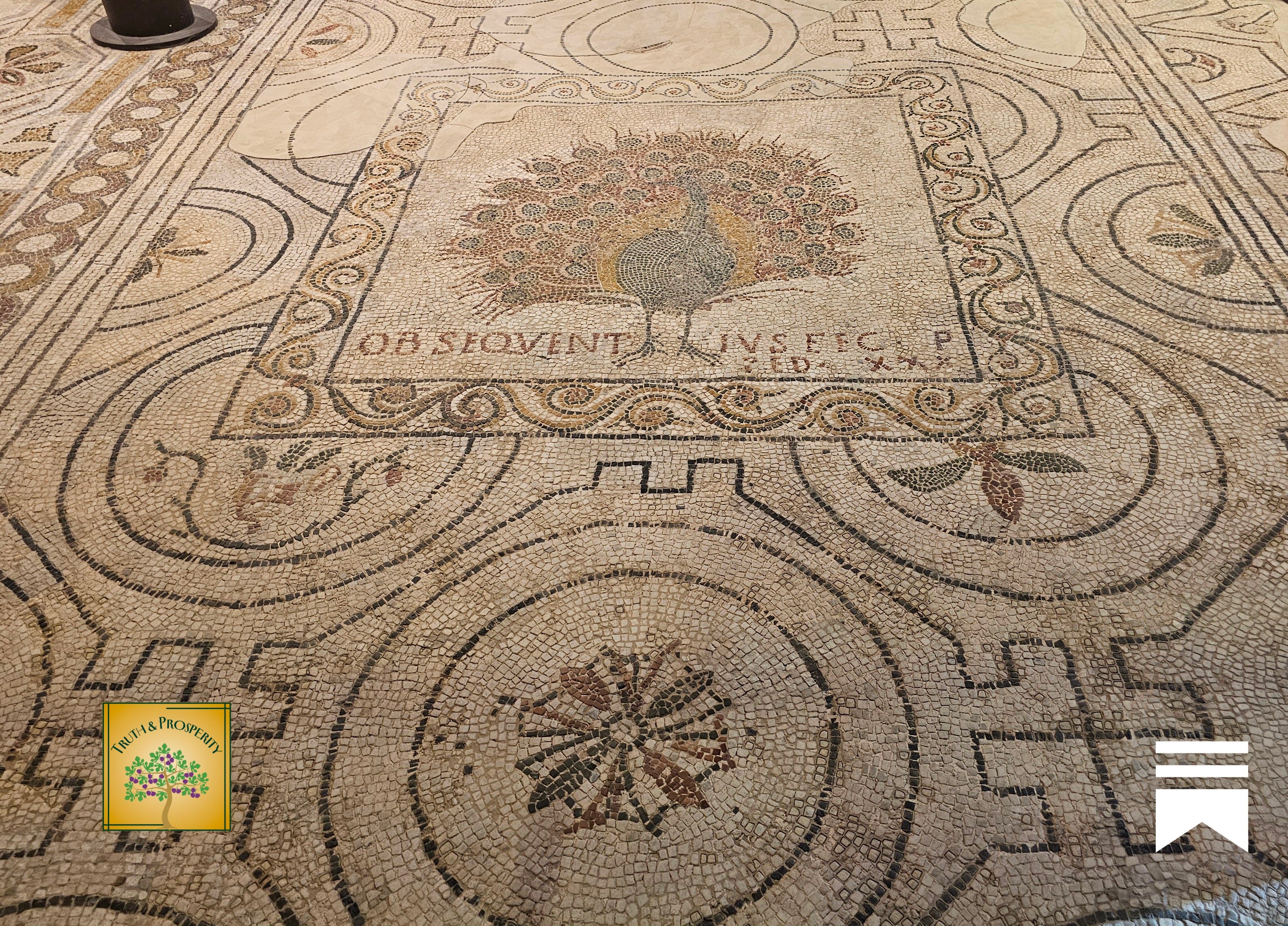
Today you can pay a small fee and descend a staircase. The noise of the piazza dies. You walk on a glass floor over fifteen hundred years of layered Christianity. Almost no one goes down there. The line for the dome above stretches around the block. The crypt below is silent.
Florence is built on a martyr’s church. The world walks over her without knowing her name.
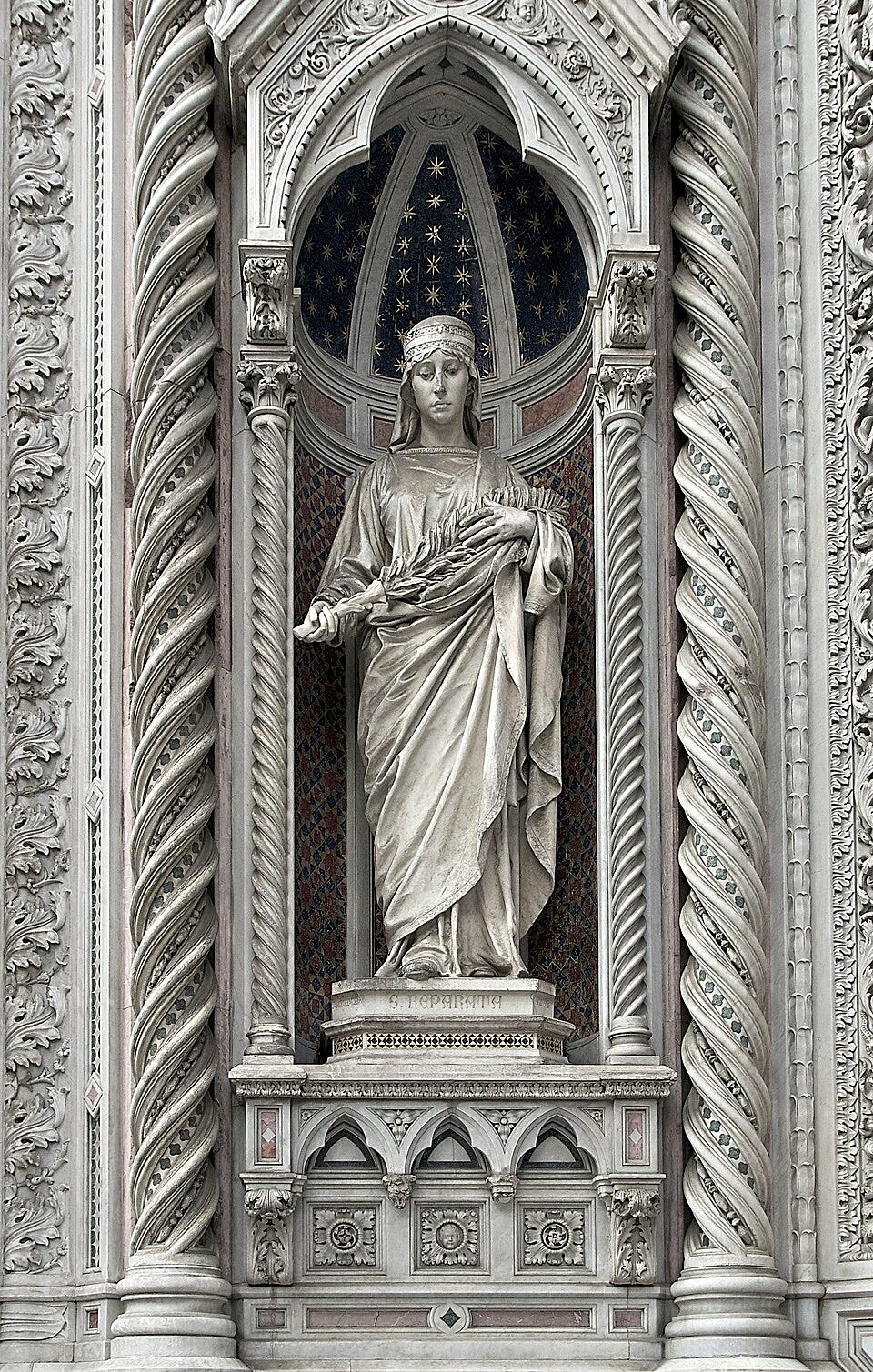
Who She Was
Her story is the kind modern Christians have learned to discount.
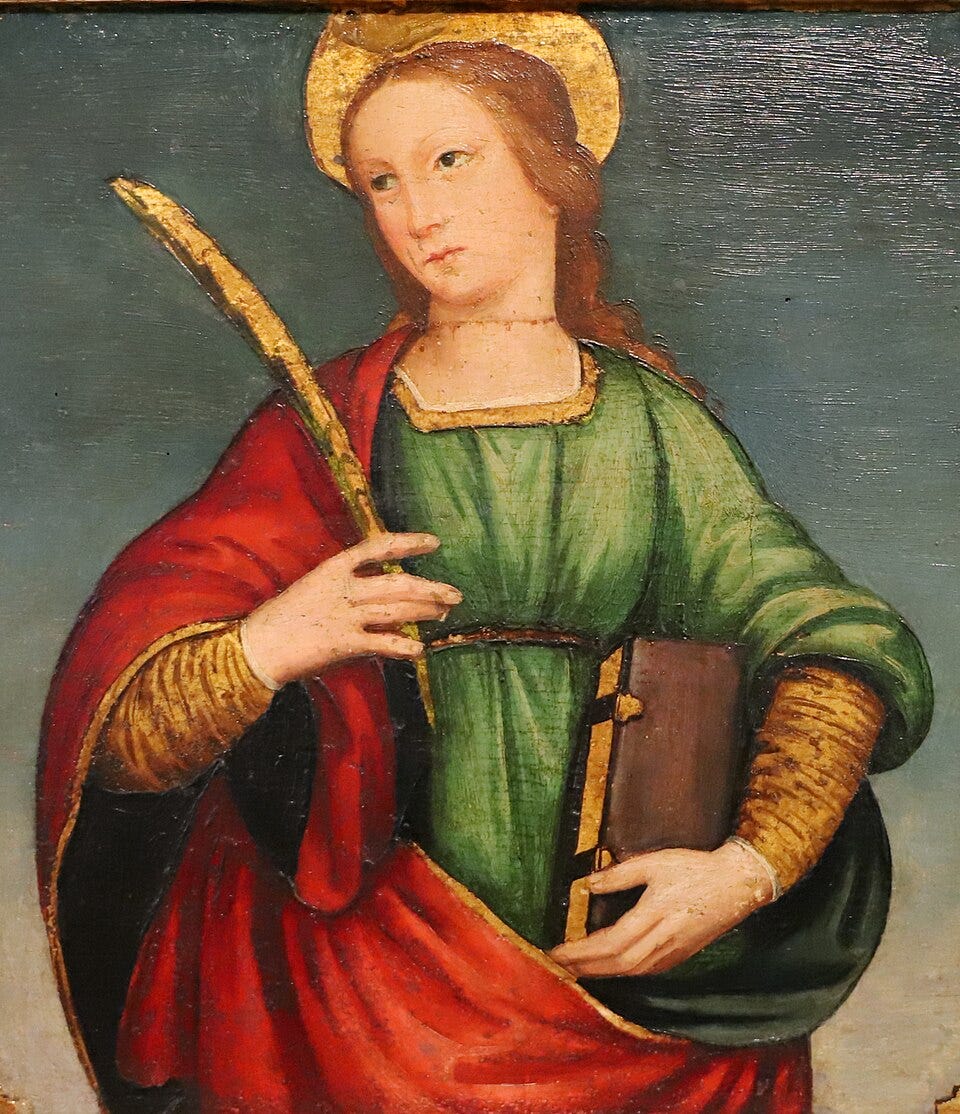
She was, the Passio (passion, the martyrdom account) tells us, somewhere between eleven and twenty years old. The cathedral in Nice that holds her relics says fifteen. The Roman Martyrology says twelve. Split the difference and call her a girl who had not yet finished becoming a woman.
She lived in Caesarea Maritima on the coast of Palestine in the middle of the third century. The emperor Decius had issued an edict in 250 AD requiring every citizen of the empire to sacrifice to the Roman gods and produce a notarized certificate proving it.
Most people complied. Some bought forged certificates. A small remnant of Christians refused, and the empire began killing them in earnest.
Reparata was arrested. She was a child. She was given every possible chance to walk free.
All she had to do was throw a pinch of incense on the altar of a pagan god and say a few words.
She would not.
So they tortured her. They tried to burn her alive in a furnace, and a sudden rain put the fire out. They made her drink boiling pitch. Yet, she still would not deny Christ. Finally, they cut off her head with a sword.
The Passio says as she died a white dove rose from her body and flew up. The legend adds that her body was placed in a small boat and angels carried it across the Mediterranean to the bay now called the Baie des Anges, the Bay of Angels, at Nice.
The skeptic will tell you that none of this is historically reliable. Eusebius of Caesarea, the great chronicler of third-century martyrdoms in Palestine, never mentions her. Her name does not appear in the written record until the Venerable Bede includes her in his martyrology in the eighth century. The Catholic Church itself classifies her Passio as “unreliable legend.”
This is the part where the modern, well-catechized Christian feels free to dismiss her.
Do not.
What the Modern Mind Cannot See
The whole machinery of the modern mind is trained to look at a girl like Reparata and see nothing.
We have been taught to ask only three questions of any claim: Can it be verified? Can it be reproduced? Can it be monetized? Reparata fails all three. There is no archaeological dig that will produce her teeth. There is no laboratory that will reproduce her courage. There is no marketing department that can sell her death.
The same Florentines who could not bear the smallness of her basilica and tore it down for something grander, the same modern tourists who walk her city without descending into her crypt, the same Christianities who have quietly traded martyrs for motivational speakers, are all running the same operating system.
Training has taught us to value what is impressive over what is true.
The ancient Christian mindset works the opposite way.
The ancient Church did not receive the Passio of a virgin martyr as a courtroom transcript. The ancient Church received it as an icon written in words. The job of the Passio is to show the reader what a Christian under pressure actually looks like, so that when the reader’s turn came, the reader would know what to do.
A Passio is a map.
And the map of Reparata says this: a child, alone, with no advocates, no political cover, no platform, can stand against the entire Roman Empire and win. Not by escape, not by might, or by being impressive, but by dying for Truth.
That is not a story modernity knows how to read; it is why Reparata is buried under marble.
What Orthodoxy Still Sees
The Eastern Orthodox Church has a different mindset.
It is the same Church that buried its first three centuries of dead under the floors of its altars and then built the liturgy on top of them, so that every Divine Liturgy is still served on a small piece of a saints relic sewn into the cloth of the altar.
The Orthodox Church literally stands on its martyrs.
When the priest kisses the antimins before he begins, he is kissing the witness of someone who died for Christ.
There is no Eucharist without the bones.
The Orthodox mindset does not view a girl like Reparata as a historical embarrassment. It views her as a window.
A window into what the Apostle Peter meant when he wrote that we have been given “exceedingly great and precious promises, that through these you may be partakers of the divine nature” (2 Peter 1:4).
A window into what Saint Athanasius meant when he wrote, “God became man, that man might become god” (On the Incarnation 54).
A window into what Saint Irenaeus meant in the late second century, just a few decades before Reparata’s death, when he wrote in Lyons:
“Gloria Dei vivens homo, vita autem hominis visio Dei.” The glory of God is a living man, and the life of man is the vision of God. (Against Heresies, Book IV, Chapter 20, Section 7)
This is a description of a martyr.
The Orthodox call this process theosis. Deification. The slow transformation of a human being into a partaker of God’s own nature, through union with Christ in the sacraments, through ascetic struggle, through suffering, through love.
Theosis is not the goal of advanced monks. It is the goal of every baptized person. And it is what we are looking at when we look at Saint Reparata.
The modern mind might think of her bravery, but brave people exist in every age and every religion.
St. Reparata is impressive because by the age of twelve, she had been so transformed by the grace of God that her created nature had begun to actually share in the uncreated nature of God. She was already, in the technical theological sense, partly divine. Not by her own essence, but by participation. The fire could not consume her because something in her was already on fire with something the empire could not touch.
The dove that rose from her body in the legend is not a literary flourish. It is the Passio author telling you what kind of creature she had become.
Modernity does not have a category for that.
The Plight of the Comfortable Christian
Look in the mirror with me.
You and I are not being asked to drink boiling pitch. We are being asked to put down our phones, fast on Wednesday, get our children to Liturgy, tell the truth at work, stay faithful to our wives, refuse to apostatize quietly under social pressure, and pray when no one is watching. None of it will get our heads cut off. Almost all of it makes us look weird.
And we still cannot do it.
Why? Because somewhere along the way the modern Christian quietly traded theosis for therapy. We stopped asking the ancient question: what does it look like for me to become fully human in Christ? We started asking the modern question: what does it look like for me to feel okay about myself?
Reparata at twelve was more human than most of us will be at sixty.
That sentence should sting.
The entire purpose of remembering the saints is to feel the gap. The saints are not on the wall of the church to make us feel inspired. They are on the wall to make us feel uncomfortable.
The diagnosis is supposed to land:
I am not as alive as that girl.
I am more impressive than her in every worldly measure and less alive than her in every eternal one.
Something has gone wrong in me.
Good. Now we can begin.
The Descent
The next time you find yourself in front of a beautiful building, a famous painting, an impressive cultural artifact, a city celebrated for its art and its history, ask yourself what is under it.
Almost every great Christian site in Europe was built on top of a martyr’s bones. The cathedrals of Italy and France and Spain are literal monuments to the witness of people who let themselves be killed rather than betray Christ.
The marble is the wrapping. The bones are the gift.
Then ask yourself the harder question. What am I building on top of? What dome am I constructing in my own life to cover over the small, dangerous, demanding thing God put under my feet? What am I paving over so I don’t have to look at it?
Because here is the governing principle. The glory of God is a living man, and a living man is one who has let himself be killed in all the ways that matter. Killed in his pride. Killed in his appetites. Killed in his cowardice. Killed in his hunger for the approval of people who do not pray for him. Killed in everything that is not yet partaking of the divine nature.
This is what Reparata is. This is what the Orthodox Church preserves. This is what the tourist on the piazza will never see, and this is what is offered to you, today, free of charge, in the ancient faith.
You do not have to die in a furnace. You only have to die in the place where God has put you. The death looks small. Most of it is just refusing to bow when everyone else is bowing.
But the result is the same as Reparata’s. A dove rises. A life becomes the vision of God. A girl in a third-century province outlasts an empire.
A Call to the Reader
If you are reading this and your faith feels like museum heritage, descend.
If you are reading this and your faith feels like a brand, descend.
If you are reading this and you are tired of inspirational Christianity and you can feel in your bones that there is something deeper than the dome, descend.
The crypt is open. The Saints are waiting. The same Spirit that took an unknown twelve-year-old girl in a forgotten Roman province and turned her into the eternal patroness of one of the most beautiful cities in human history is still moving.
He is not impressed with the marble. He is looking for living men and living women. He is looking for the dove that rises when you finally stop bowing to the things that demand a pinch of incense from you.
Look under the marble. You will encounter holiness. You will behold Christ. You will know yourself.
The heroic journey is the same as it has always been. The hero is the martyr. And the martyr is anyone, of any age, in any city, in any century, who has been so transformed by grace that his small, ordinary, hidden life has actually become the glory of God.
Saint Reparata, pray for us.
Christopher Clay is the author of Five Principles and the voice behind Truth & Prosperity, a Substack exploring Faith, Family, Finance, Leadership, and Legacy. He and his wife are members of St. Nicholas Eastern Orthodox Church in West Virginia.
I really enjoyed this. Thank you!