

A man who lays down his life for his child is not a hero.
He is the standard. A father’s life is for his children.
If that first sentence stopped you, ask why.
Most men never undergo testing, and this generation learned to equate an untested life with freedom. Today, boys are taught fathers are optional. A nice addition to a household if you can get one, mostly not required. The result? Boys don’t become fathers.
This is the frame we are given these last days. The difference between us and our great-grandfathers is they never had the option of believing a father was a luxury.
The First Frightening Numbers
Decades as a chief financial officer means I read numbers for a living and I have learned to distrust a story when the numbers do not support it.
About 1 in 4 American children, roughly 19 million of them, live in a home with no father in it, biological, step, or adoptive.
The United States leads the world in missing fathers.
Once you see fatherhood as a standard instead of a heroic exception the data becomes a verdict. Every fatherless statistic stops being a sad fact about other people and becomes what it actually is: a measurement of how far a civilization has drifted from its purpose and where it is head.
The Shape Love Takes
Fatherhood is the shape love takes when it has a body and a household to defend.
A man experiences this feeling at the moment of his child’s conception. Ask any father who has watched a heartbeat flicker on an ultrasound screen. Something in him locks into place. He is suddenly, physically, a wall between a small life and everything in the world that would harm it. This instinct is God given.
The world spends the next eighteen years trying to talk a man out of the instinct.
The lies start early.
Every year, this country tosses more than a million children in the trash.
Behind a large share of those numbers is a man who was told, by the culture and often by the people closest to him, that the wall he felt himself becoming was not his to build. They say it is not a man’s decision to protect his child. A man’s natural, God-given instinct to protect becomes an imposition when his child is the most vulnerable.
The lies continue after birth.
Roughly 80% of Americans now say a single parent raising children alone is an acceptable arrangement. Instead of saying fatherhood is hard, heroic, a tragedy to be avoid, the public says fatherless homes are acceptable.
The father has been removed from the definition of a family, and most people nodded.
The lies continue into marriage.
No-fault divorce made a father’s presence in his own home contingent on someone else’s feelings. A man can do everything right, break no vow, raise no hand, and still be told his children will see him every other weekend.
The cult of self runs all three. The lie that your life is your own, applied to a father, produces a man whose protective instinct is a problem to be managed rather than the foundation of reality.
You already know this. By now, we all have watched this happen to men we know and the data runs deep.
This is Ancient.
The world will tell you a father laying down his life for his child is heroic, abnormal, or a story worth a documentary. Yet, this is what fathers have always done. The record is long.
To be clear, I am not talking about dads. Biology makes a dad. I am talking about fathers. Men.
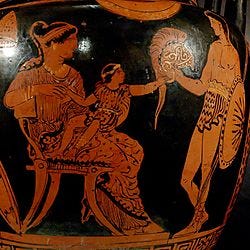
Homer knew the difference. In the sixth book of the Iliad, Hector stands on the wall of Troy with his wife and his infant son. He knows the city will fall. He knows he will die in the fight. He lifts the boy and prays:
Grant this boy, my son.. to be first in glory... let them say, ‘He is a better man than his father!’
He hands the child back to his mother, and walks out the gate. Three thousand years later, we still read it, because every father recognizes it. The prayer is for the son. The death is for the household. Hector was a father.
Aristotle writes in the Nicomachean Ethics parents love their children as part of themselves. The philosophers understood by looking at reality a man’s life is bound up in his children.
Scripture is fatherhood to the core. “Greater love hath no man than this, that a man lay down his life for his friends.” Christ says it, then does it, and the Church understood the cross as the pattern for every man.
Paul told Timothy that a man who does not provide for his own household “is worse than an infidel.” This is worse than an unbeliever. The Church takes the standard of fatherhood seriously.
The last words of the Old Testament promise a day when God will “turn the heart of the fathers to the children,” which tells you on what a whole generations and nations depend.
This is why the Church calls her shepherds father. The Good Shepherd lays down His life for the sheep. A priest who bears the name is being told, every time someone says it, what the job costs.
Two Fathers the Church Remembers
Consider St. Joseph the Betrothed.
Scripture records only one word spoken by Joseph and it is a name above his own.
Joseph is told in a dream to take the child and flee, and he gets up in the night and goes. He walks a pregnant woman to Bethlehem, guards a newborn from a king who wants Him dead, carries the family to Egypt and back, teaches a boy a trade, and dies before the public ministry begins. He never sees the Resurrection. He never sees the Church. He raised the Son of God in silence and vanished from the story before the payoff.
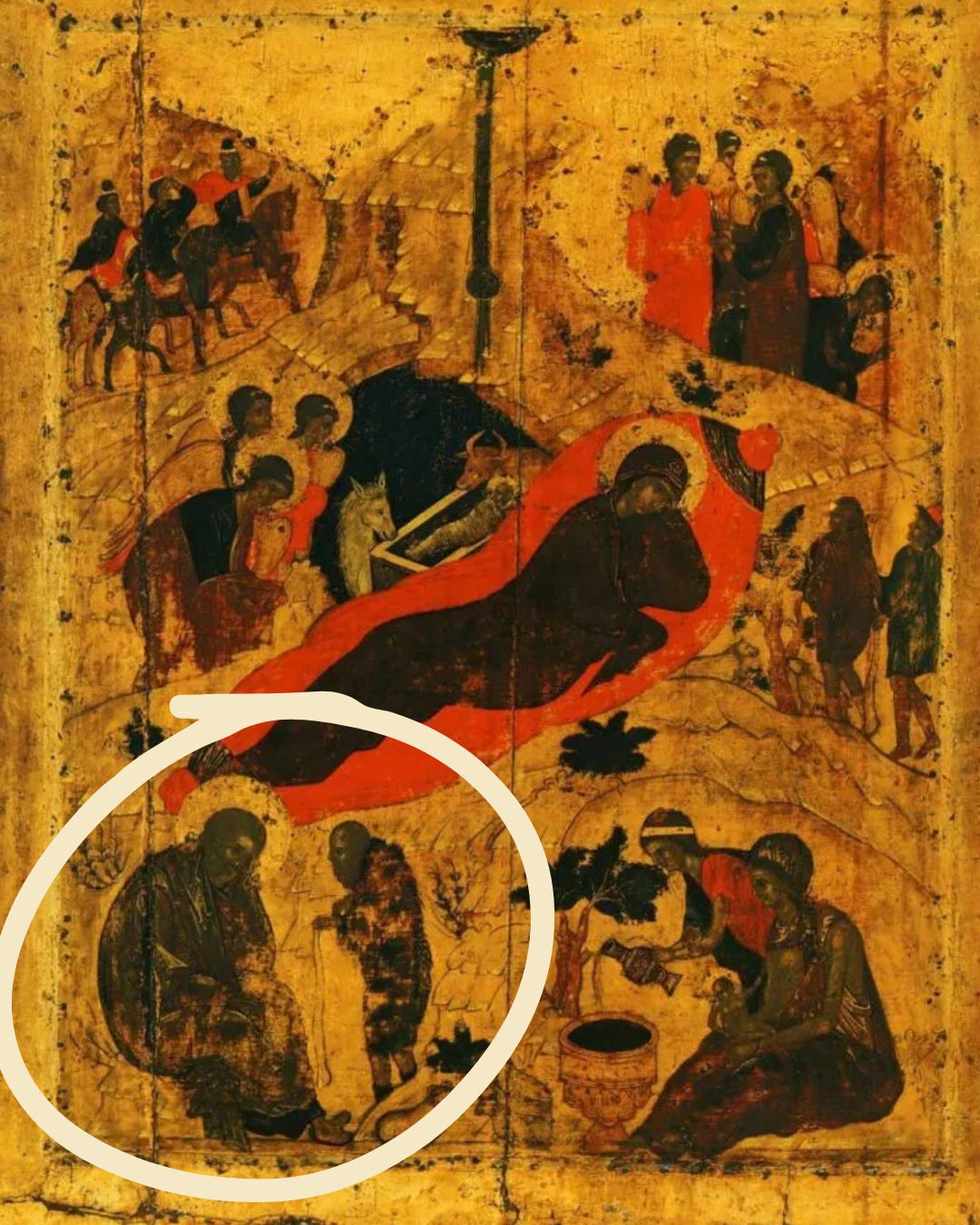
The Church made him a saint. In the Nativity Icon, when Joseph is present, he is off to the side, weathering his doubts, doing the work.
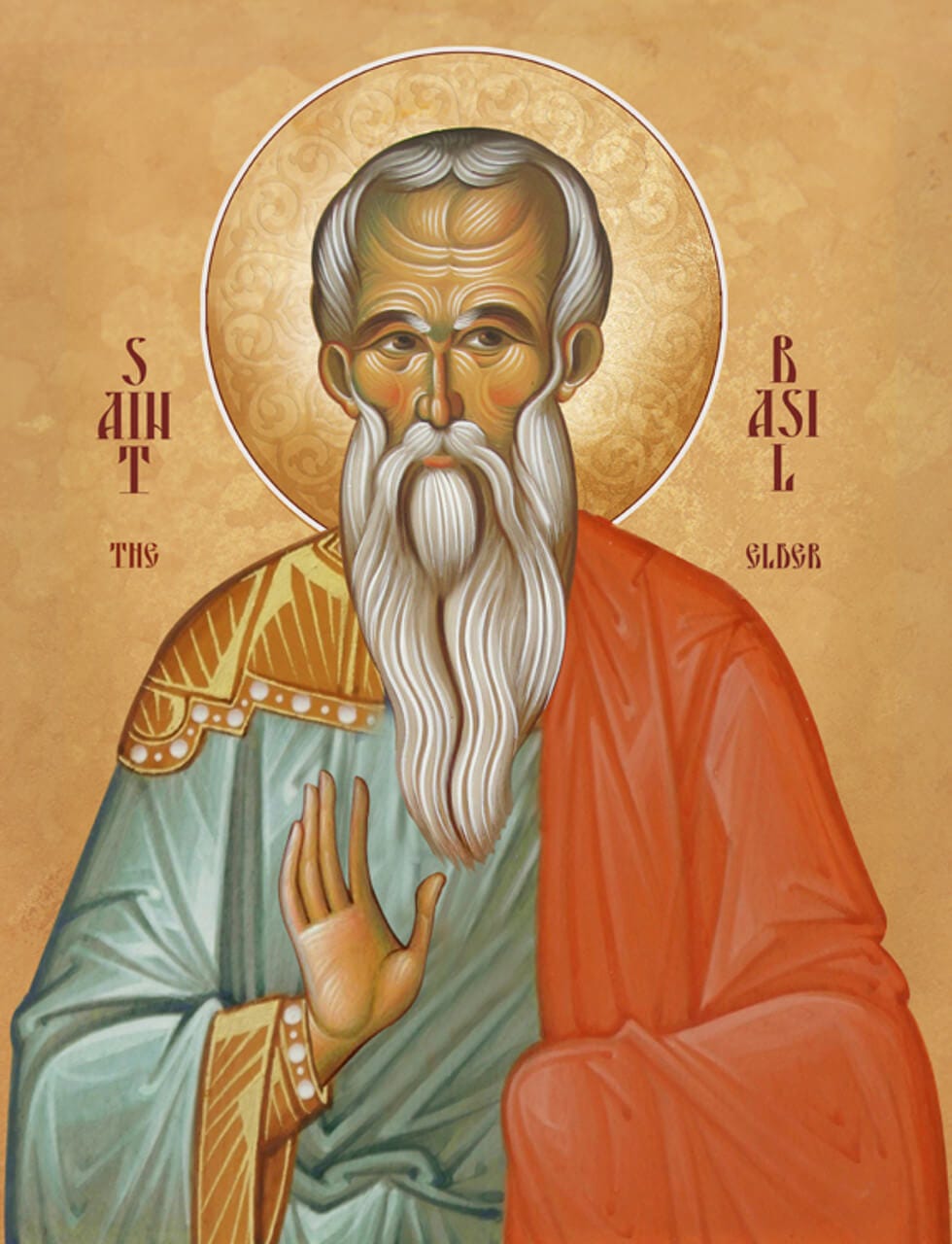
Now consider a father most men have never heard of: St. Basil the Elder.
As a young man, he lived through persecution under Emperor Galerius. His family fled into the wild mountains of Pontus and spent years there in hardship rather than deny Christ. When the persecution ended, he became a lawyer and a teacher in Caesarea, a layman known for his virtue. He married Emmelia, the daughter of a martyr, and together they raised 9 or 10 children.
5 of his children are saints.
3 became bishops.
His son, St. Basil the Great, compiled the liturgy the Orthodox Church served on the Sundays of Lent.
Another son, St. Gregory of Nyssa, helped settle the doctrine of the Trinity at the Second Ecumenical Council.
Basil the Elder saw none of it. He died in 350, decades before any of his sons became who they became. He raised his children in faith and truth, made himself small enough to be forgotten, and then is forgotten by nearly everyone.
A father of the faith, and a father of the Fathers. A truly immeasurable impact. From a kitchen table.
What a Real Father Actually Does
A real father answers the call to martyrdom.
He turns the man cave into a family room.
He skips the big game to go to the little game.
He thanks God for the food on the table, not himself for the effort he put in buying it.
Step by step, he makes himself small so he can serve his family. He gives and does not complain. He carries what his wife cannot see and what his children will not understand for forty years. In silence, he builds a future he will not live to see.
Seldom does it look like Hector on the wall. But it is the same thing.
Laying down a life in an instant is not always the hardest path. The man in the background working, building, and laying the foundation no one will see is often the bigger man. A love that works. The dramatic sacrifice is rare. The daily one is the standard which outlasts dramatic ones.
This is a secret the world doesn’t want you to know. The martyr and the man who gets up to go to a job wearing him down, who skips the man cave, and thanks God for all things is running on the truth.
A father who says that he would take a bullet for his children, but will not put down his phone for them has not understood what the bullet is.
The Weight of the Standard
Some of you feel the weight of this. Good.
The weight is the standard settling onto your shoulders where it belongs.
The world is short on men who will live for their children. It is short on fathers who understand that the daily death, the unseen sacrifice, the thanks that goes to God instead of self, is heroism. Fatherhood is the form heroism is meant to take.
You are being tested. Every morning.
Be the standard your sons will measure themselves against.
Subscribe. Get the Legacy Audit. Start building a legacy death cannot take.
Not ready yet? Start with the foundational essay on the cult of self. Read one piece and decide for yourself whether this is the voice you want in your life.
Build a legacy death cannot take.
What a great message
Another good article, Chris!