


One of the most-followed business voices on the internet (Hormozi) told millions of men how their funeral will go.
They’ll argue over your stuff. They’ll talk about the food. Somebody will read two paragraphs about you, and the room will be thinking about their to-do list as they leave. In a few weeks, you’ll be forgotten.
His conclusion, the moral of the whole sermon:
“Do what you want.”
Millions of men nodded along.
He’s right about the funeral. He’s completely wrong about the conclusion.
Over 18 centuries ago, the most powerful man on earth wrote the same thing by lamplight in an army camp on the Danube frontier:
“Soon you will have forgotten the world, and soon the world will have forgotten you.”
He looked into the same grave. He reached the opposite conclusion.
Yet, under this powerful emperor’s reign lived another philosopher. While the emperor wrote the above line to himself; the other philosopher wrote to the powerful emperor. Both men are still read today.
Hollywood made a movie about the 1st man.
It left the 2nd one out.
The 2nd man stood before the emperor’s Stoic teacher, on trial for his life, and said he knew what waited on the other side of the grave.
“How Will the World Speak My Name?”
If you’ve seen Gladiator, you remember the opening.
Germania. Mud, smoke, and fire. “Strength and honor.”
The legions win, and the old emperor watches from horseback, wrapped in purple and gold, a man who knows this is his last campaign.
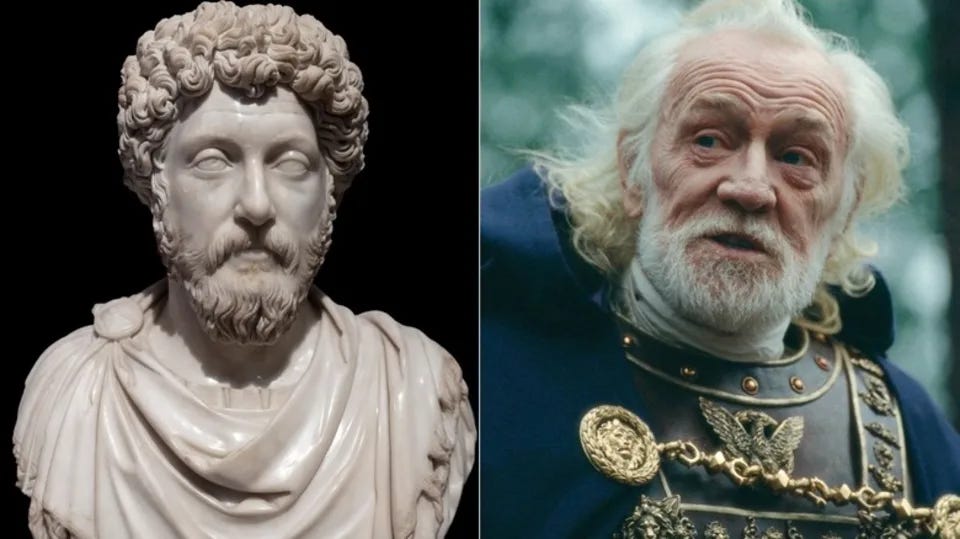
That night, in his tent, Marcus Aurelius asks his general:
“How will the world speak my name in years to come? Will I be known as the philosopher? The warrior? The tyrant?”
The most powerful man in the world is asking whether any of it mattered.
You know that question. You built the life you were told to build. The career. The marriage. The house. You still wonder, “Is any of this going to matter when I’m gone?”
The real Marcus spent much of his last decade in camps like the one depicted in the movie Gladiator. At night he kept a private journal. He never meant anyone to read it. The title in Greek means, simply, To Himself.
Τὰ εἰς ἑαυτόν (Ta eis heauton)
We call it Meditations. 18 centuries later, men still open it looking for how to live. The journal of a dying emperor has outlasted the empire he gave his life to.
It’s worth reading.
Same Grave, Opposite Conclusion
Marcus came back to death again and again. Alexander the Great and his mule driver, he wrote, both died, and the same thing happened to both.
Notice, this is the guru’s premise. Marcus got there first. His conclusion is different.
“Do not act as if you were going to live ten thousand years. Death hangs over you. While you live, while it is in your power, be good.” (Meditations 4.17)
“That which is not good for the swarm, neither is it good for the bee.” (Meditations 6.54)
The guru looks at the grave and says: you’ll be forgotten, so please yourself.
The emperor looks at the same grave and says: you’ll be forgotten, so be good while you still can. Do your duty. Serve the hive.
Same premise. Opposite conclusion. One of them is selling something.
Where I Learned to Read Marcus
About a decade ago, my wife and I went deep into the Stoics together. Epictetus. Seneca. Marcus. We read them side by side and questioned each other. One of my favorite family photos is of her holding Letters from a Stoic while I flip through Meditations.
We learned the dichotomy of control: a few things are up to you, and most things are not. We learned the three disciplines Epictetus taught: desire, action, and assent.
Assent took hold of me.
To the Stoics, assent is the moment you judge an impression true or false, before you let it move you. The impression is every thought, every ad, every person standing before you, every voice in your feed asking for your judgment, your yes or no. Every lie needs your assent to work. The discipline of assent underpins the other two disciplines of desire and action.
I believed in the power of this idea enough to name my consulting company (AssentServices.co) after it.
Here is what surprised me: when I practiced assent, testing every impression against what is actually true, it kept walking me back into Scripture. Then into the early Church Fathers. Then through the doors of the oldest Church I could find.
The Stoics taught me to ask what is true.
Hold on to that word, assent. Every voice you’re about to meet is asking for yours.
Commodus’s Other Virtues
Now the villain.
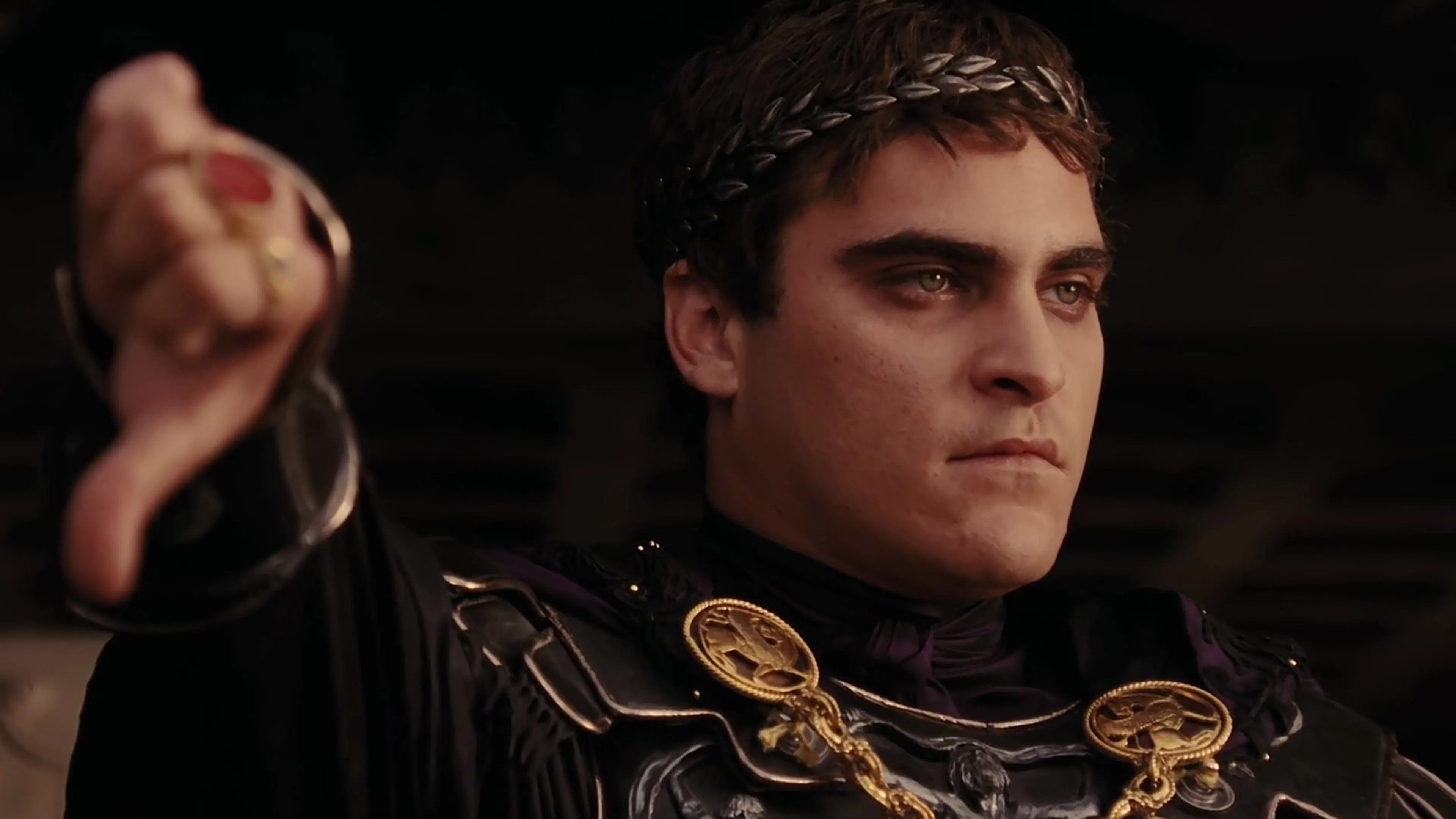
Old Marcus tells his son Commodus he will not be emperor. Commodus, eyes wet, answers:
“You wrote to me once, listing the four chief virtues: Wisdom, justice, fortitude and temperance. As I read the list, I knew I had none of them. But I have other virtues, father.”
He names them. Ambition. Resourcefulness. Courage, “perhaps not on the battlefield.” Devotion, to his family and to his father.
Every one of those words sounds good, but underneath they are all about himself.
The Enemy Has a Name
There is a philosophy running underneath this world. It’s nearly in the water we drink and the air we breathe. It’s surely the frame which every ad, every algorithm, and every career ladder operates inside.
Its name is the cult of self. The modern lie that your life is your own.
Like Commodus, it never recruits with vices. It recruits with its own list of virtues:
Ambition becomes self-improvement. The endless project of optimizing you. It never finishes, because a finished man stops buying.
Resourcefulness becomes self-creation. You are the raw material and the sculptor. No story you didn’t author can bind you.
“Many forms of courage” becomes live your truth. You answer to nothing above your own judgment.
Devotion becomes love on your terms. Protect your peace. Vows, parents, children, parish: all of it renegotiable the moment it costs you comfort.
Then comes the line that gives the whole thing away.
Commodus, kneeling beside his father:
“I would butcher the whole world if you would only love me.”
He kills his father in an embrace.
This is how the cult of self works on a man. It holds him close and takes his breath.
What Really Happened to Commodus
The real Commodus dressed as Hercules, in a lion skin with a club. He fought as a gladiator, and of course he won every bout. In 190 he renamed all twelve months of the year after his own titles. Then he renamed Rome itself: Colonia Lucia Annia Commodiana. The city of Commodus.
He put his name on the calendar and on the capital of the world.
On the last day of 192, he was strangled in his bath by his wrestling partner.
The wrestler’s name was Narcissus.
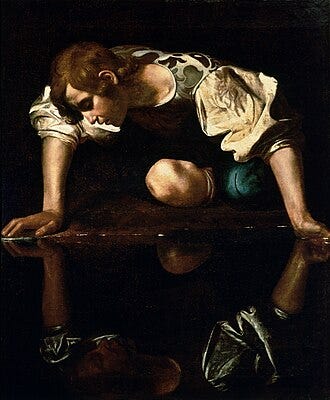
You can’t make that up!
Every cult of self ends in the same room. A man staring into his own reflection and Narcissus (the myth from which we get the word narcissist) waiting with his hands out to draw you in and squeeze the breath out of you.
The Oldest Sermon Ever Preached
Commodus wasn’t original. Neither is the guru.
The first sermon of the cult of self was preached in a garden, and it was five words long:
“You will be like God.” (Genesis 3:5)
Self-sovereignty, self-creation, self-actualization. The whole creed in one sentence from a serpent. Everything since has been a remix.
You’ve heard the remixes your whole life. They were set to jingles.
Have it your way.
Obey your thirst.
Because I’m worth it.
Just do it.

4 of the most successful slogans in the history of advertising, and every one of them is a paraphrase of Eden.
No one had to argue you into the cult of self. It was sold to you between innings, a few seconds at a time, until it sounded like common sense.
Saint Paul saw where it ends:
“In the last days perilous times shall come. For men shall be lovers of their own selves.” (2 Timothy 3:1–2)
Paul said men would keep “a form of godliness” while “denying the power thereof” (3:5). The cross stays on the wall. The self takes the throne. The new modern religion of atheism was only a minor speed bump of things to come.
This is why the cult of self is so hard to see. It simply moves in and redecorates our spiritual nature to turn it inward to self.
You were born behind enemy lines.
This is the fight and it’s doubtful you were told.
A Father’s Failure
There’s a line in the film which is heartbreaking. Marcus, gently, to the son who is about to kill him:
“Your faults as a son is my failure as a father.”
The movie invents a plan where Marcus passes over Commodus.
History is harder.
The real Marcus made Commodus his co-emperor at 17. The wisest man of his age could not form his own son.
The historian Cassius Dio, who lived through what came next, wrote the epitaph, “Rome descended...from a kingdom of gold to one of iron and rust.”
Marcus left his son an empire, but hadn’t formed his sons heart to carry it.
Wealth advisers have a grim rule of thumb: roughly 70% of wealthy families lose their wealth by the 2nd generation, and 90% by the 3rd. The money can be as great as an empire, but if the formation of the son doesn’t match it won’t matter.
Here’s the hard truth for fathers. Your sons will not become the man you tell them to be. They will become the man you are. If what they see is a man devoted to himself, that is the inheritance.
Philosophy could not save Commodus. Neither will yours, if it stays in your head and never reaches your household.
Maximus’s Name
Now watch the hero.
When Marcus offers Maximus the power to save Rome, Maximus says what no member of the cult of self would ever say: “With all my heart, no.” He wants to go home to his wife, his son, and his wheat field.
Marcus answers, “That is why it must be you.”
Then Commodus takes everything. Maximus’s family is murdered, and he is sold into the arena.
The ancient Greeks had a word for what a fighting man was supposed to want: kleos. Glory. Your name in the mouths of men after you’re gone. Achilles chose a short life with kleos over a long one without it. The arena was a machine for manufacturing it. Win the crowd, the old trainer Proximo tells Maximus, and you will win your freedom.
Maximus wants none of it. He kills quickly, without a show, then hurls his sword toward the stands:
“Are you not entertained? Is this not why you are here?”
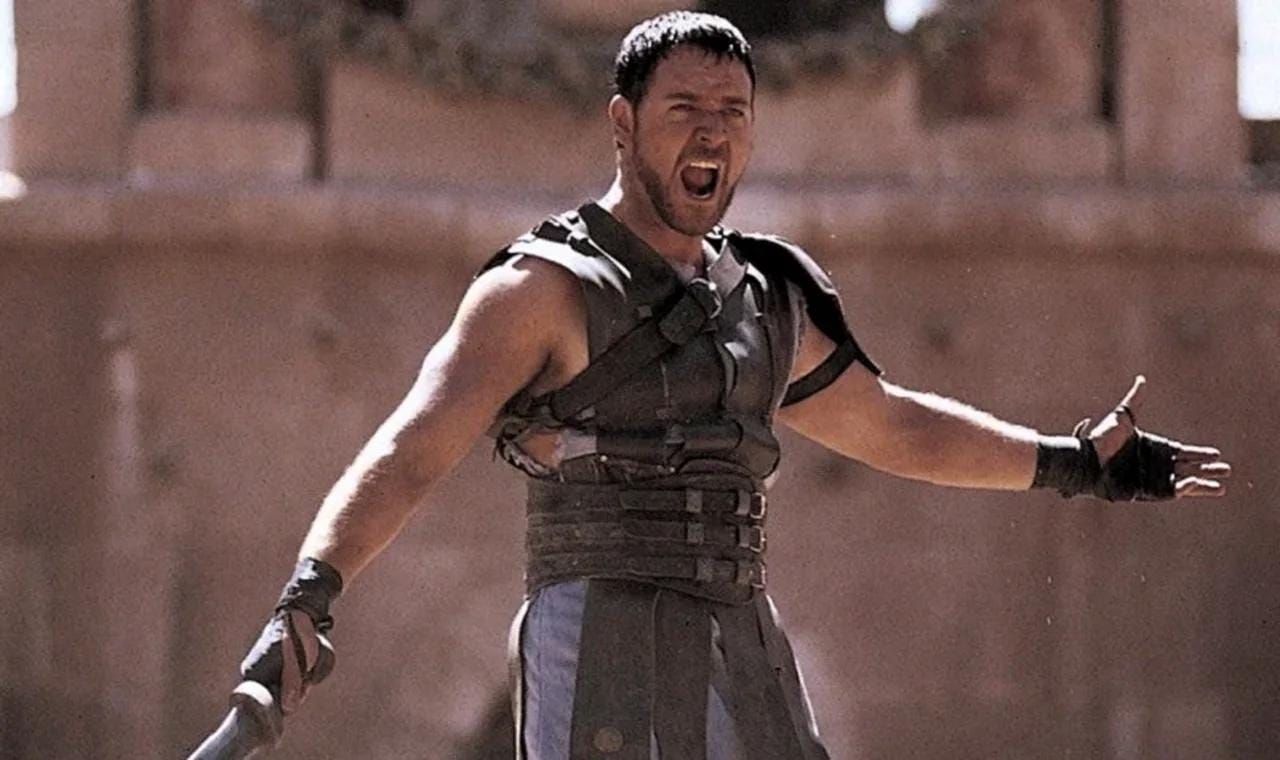
He holds up a mirror to the crowd.
We still live in that Colosseum. We carry it in our pockets, and it runs on Proximo’s deal: perform, collect the roar, make a name. Kleos, fifteen seconds at a time.
Maximus fights under the name “the Spaniard.” When Commodus finally demands to know who he is, he takes off his helmet:
“My name is Maximus Decimus Meridius, commander of the Armies of the North, General of the Felix Legions, loyal servant to the true emperor, Marcus Aurelius. Father to a murdered son. Husband to a murdered wife.”
Listen to how a real man introduces himself. Commander. Servant. Father. Husband. Every word of his name is a relationship. Every title is someone he answers to or someone he protects. (Of course Hollywood adds a vengeance line after, putting a little cult of self into a nearly flawless production, but I digress.)
Commodus wrote his own name on the months of the year. Maximus never made a name for himself. His name was made of the people he served. It’s why the movie lands, it’s a story deeper than the action, the history, it touches what man was created for.
This is the difference between a consumer and a patriarch. A patriarch worships, disciples, stewards, and builds.
Back in Germania, before the first battle, Maximus had given the line this article is titled by:
“What we do in life echoes in eternity.”
Do what you want says nothing you do will last. Maximus says everything you do will.
But Maximus is fiction. The line was written in Hollywood.
The next man was real and he proved it with his life.
The Man the Movie Left Out
His name was Justin.
He was born in Samaria to a pagan family, and he was hungry for the truth about God. So he went seeking among the philosophers.
He started with a Stoic. He stayed a long time, and in his own words he “learned nothing about God,” because the teacher “did not know himself, and said such instruction was unnecessary.” He moved through the other schools and settled with the Platonists.
Then, walking alone by the sea, he met an old man. A Christian. The old man pointed him away from the philosophers and toward the prophets, the men who had seen what the philosophers could only reason toward.
Justin wrote:
“Straightway a flame was kindled in my soul... I found this philosophy alone to be safe and profitable.”
Justin gave his assent. He judged the impression true, and he let it move him.
He kept the philosopher’s cloak and opened a school in Rome. The Stoics had spoken of the Logos, the divine reason running through all things. Justin agreed they had caught real sparks of it. Then he told them the Logos has a name and a face, and was crucified under Pontius Pilate.
“Whatever things were rightly said among all men, are the property of us Christians.”
The Letter to the Emperor
In the 150s, Justin wrote a defense of the Christians and addressed it to the emperor Antoninus Pius, “and to his son Verissimus the Philosopher.”
Verissimus. Most truthful. It was a boyhood nickname that stuck.
You know him as Roman Emperor Marcus Aurelius.
One philosopher wrote a journal to himself. The other wrote a letter to him. And in it, Justin told the emperors where the power really sat:
“You can kill, but not hurt us.”
To be fair to Marcus, he and Epictetus both honored the divine. Meditations is full of Providence and the Logos. He was reaching upward with everything he had.
But he never took the time to understand the upstart faith in his own empire. One line in Meditations, possibly his, dismisses Christians who go to their deaths as “mere obstinacy.” Christians died under his reign, in Rome and in Gaul.
Marcus was a man who walked as far as human reason can walk, and stopped at the river.
The Judge
Around the year 165, Justin and 6 of his students were arrested in Rome and brought before the prefect of the city, Junius Rusticus.
If you’ve read Meditations, you’ve met him. In Book 1, Marcus thanks Rusticus for showing him that his character needed discipline, and for introducing him to Epictetus.
The Stoic teacher who formed Marcus Aurelius was the judge who sentenced Justin to die.
The court record survives. Rusticus asks:
“If you are scourged and beheaded, do you believe you will ascend into heaven?”
Justin hopes so. Rusticus presses: do you suppose you’ll go up to heaven to receive some reward?
Justin answers:
“I know and am fully persuaded of it.”
They refused to sacrifice to the gods. They were scourged and beheaded.
The Church calls him Justin Martyr. Every Christian tradition that remembers the ancient Church remembers him.
Stoicism carried the best men of the ancient world to the edge of the river.
Justin crossed it.
3 Funerals
Go back to the funeral where we started. There are 3 ways to look into that grave.
The guru: You’ll be forgotten in weeks. So do what you want.
The emperor: You’ll be forgotten soon enough. So be good while you can.
The martyr: You will never be forgotten. So you can afford to lose everything.
The guru’s advice is the advice of a dead man to dying men.
Marcus’s advice is noble, and I still read him. But duty with no one at the other end of it is a heavy load to carry to the grave. Marcus kept writing to himself because there was no one else he was sure was listening.
Justin had met Someone who changed what death was. One who says, “I will not forget thee. Behold, I have graven thee upon the palms of my hands” (Isaiah 49:15–16). Hands that still carry the nail prints.
A man remembered by God can afford to be forgotten by Rome.
The cult of self is hiding the truth from you. You were made for more than being a good man who is forgotten slowly. The early Christians had a word for what a human life is actually for: theosis, becoming, by grace, what God is by nature. Being joined to Christ so completely that His life becomes yours, and death loses its claim on you.
You were made for more than a small story.
What echoes in eternity? A legacy in Christ. It will outlive emperors who can’t understand and teachers who condemn.
The Way Out: Three Steps the Earliest Christians Already Gave Us
You don’t need a new program. The Christians of Justin’s century left one behind. Milk before meat (Hebrews 5:12). Each step asks something of your body and your calendar. They’re supposed to cost you.
1. Worship the Way Justin Described It
In the same defense he addressed to Marcus, Justin described Sunday. The apostles and prophets were read “as long as time permits.” The one presiding preached. They stood and prayed together in unity. The bread and wine were brought with thanksgiving, and everyone answered Amen. Then they gave, and the gifts went to orphans, widows, the sick, and prisoners.
Is this what your church does? Would Justin recognize it?
The small step: this Sunday, find the worship Justin would recognize, and stand in it. Let your body learn what your mind has been unable to hear because Justin taught us true philosophy is embodied in Christ.
2. Leave the Arena
At current rates, the average American will spend more than 18 years of his adult life online -- long enough to raise a son from birth to manhood.
The small step: under 1 hour a day of secular media, total. Then 2 days a week, fast from it altogether.
Which days? The earliest Christians already chose them. The Didache, a church manual from around the end of the 1st century, told believers to fast on Wednesdays and Fridays. Let that ancient rhythm carry you, because your willpower alone won’t.
Some evenings I look down and realize I’ve been scrolling X for an hour I never agreed to give. I’ve got work to do here. What about you?
3. Pray to Someone
Marcus filled a whole book with the best thoughts a man can have, and he addressed every one of them to himself. This is the trap at the end of the road. A man walks out of the cult of self and then prays like a member: a monologue of requests and self-talk. The cult of self with its eyes closed.
The same Didache told the early Christians to use the Our Father and told them to pray it 3 times a day.
The small step: morning, noon, and night, pray the Our Father slowly. Add a Psalm before bed instead of the scroll. Words you didn’t write, addressed to Someone who is actually listening.
Received prayer is assent in its purest form. You submit to it, and the self finally comes down off the throne.
Not Yet
The movie ends in the empty arena. Maximus is dead. Lucilla stands over him: “He was a soldier of Rome. Honor him.” The men who fought beside him lift him and carry him out.
Then Juba, his friend from the training yard, kneels alone in the sand and buries two small figures of Maximus’s wife and son:
“Now we are free. I will see you again. But not yet. Not yet.”
That’s where you are. Not yet.
You’re still on this side of the funeral. The two paragraphs haven’t been written.
The cult of self will keep asking for your assent. Do what you want. Win the crowd. Protect your peace. It will sound like wisdom. Recognize the lies.
Give your assent where Justin gave his. Stand where he stood on Sunday. Fast when he fasted. Pray what he prayed. Then go home and be the man your household will one day carry out with honor.
What we do in life echoes in eternity. Justin’s has been echoing for over 18 centuries, and it reached all the way to you.
Make sure yours reaches someone.
Build a legacy death cannot take.
Subscribe. Get the Legacy Audit. Start building a legacy death cannot take. Take the twelve questions, then send this to one man who needs to hear it.
Not ready yet? Start with The Company of Heroes, the piece on Band of Brothers that hit more men than anything I’ve written. Read it and decide for yourself whether this is the voice you want in your life.