

The town I live in can be called a “bowl.”
Mountains on every side, 2 creeks run through town, and the Meadow River backs up under the railroad trestle.
When the rain comes hard, it pours off those ridges and has nowhere to go.
On Thursday, June 23, 2016, the rain came hard.
By evening, Main Street was a river. Families ran for higher ground with whatever they could carry. My wife got trapped and spent the night watching the waters rise around the nursing home she helped run with no escape and only her prayers.
4 people lost their lives. Across southern West Virginia, the flood took 23 lives.
The water took days to drain.
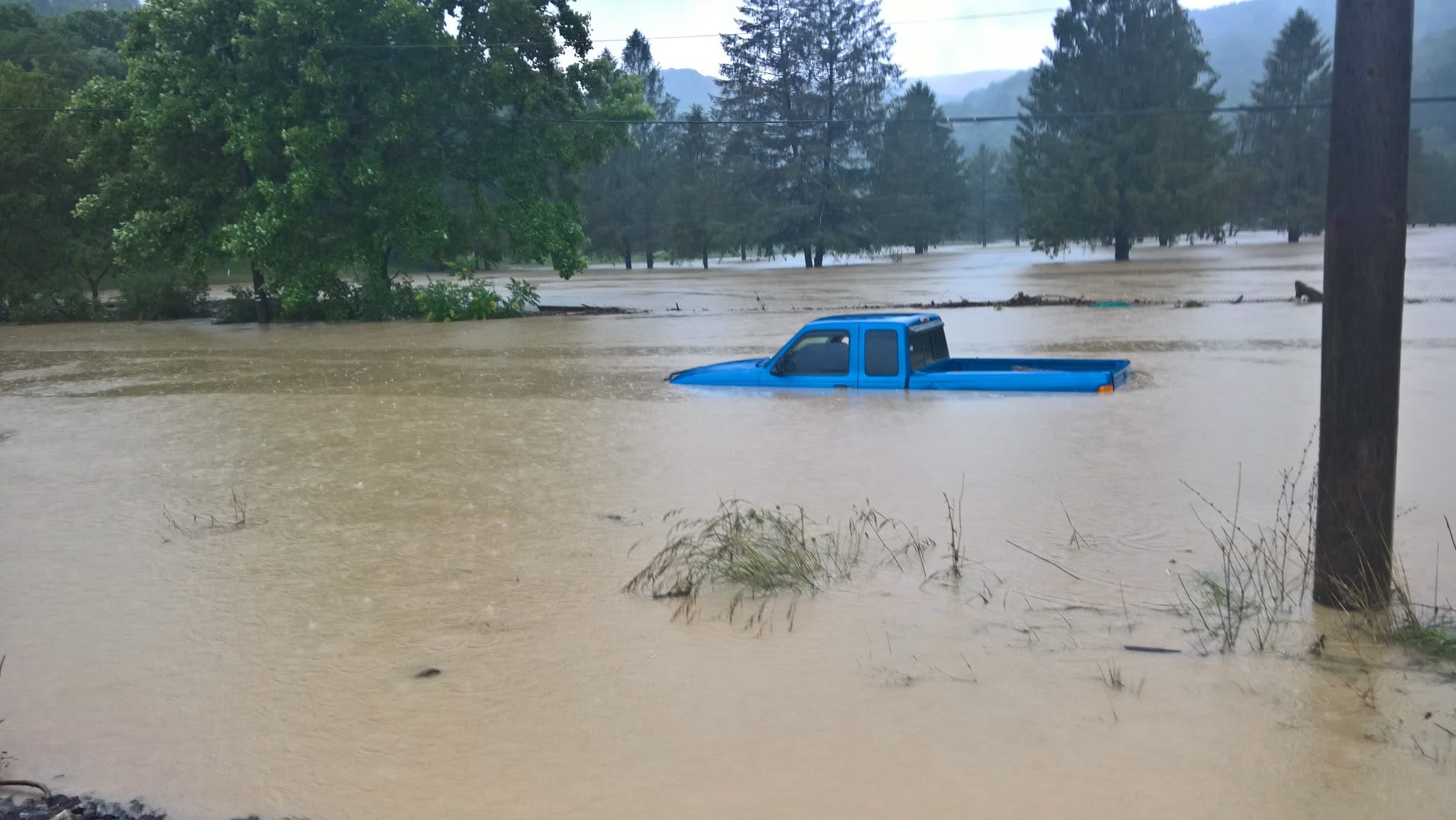
I had to wade home through knee-deep water in my suit and tie, along the train tracks mentioned above, to get to my young children. I took this photo:
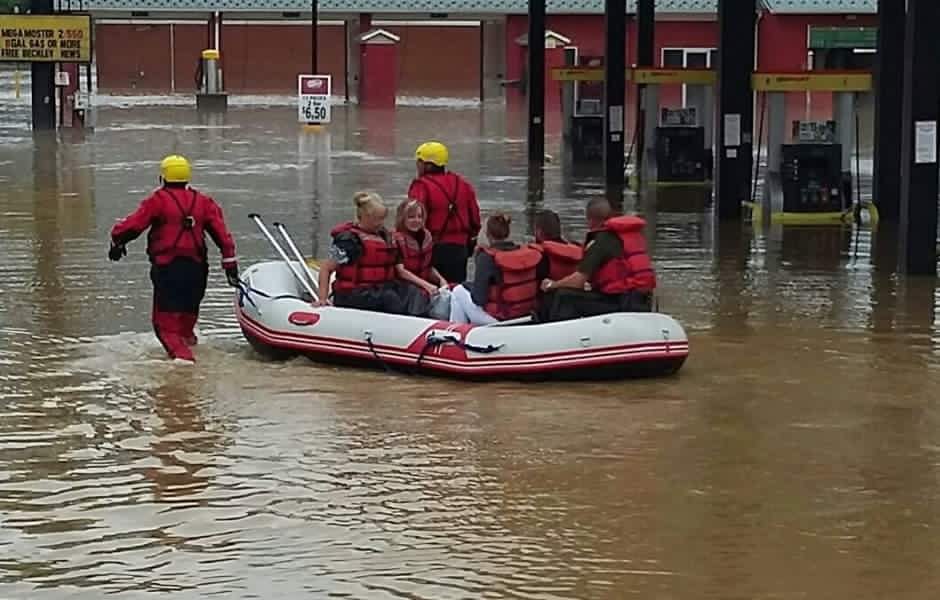
They had to send in relief staff to my wife and the exhausted crew at the nursing home by emergency rescue raft crew:
Then the sun came out.
Picture that first quiet morning after a big storm. Even if you haven’t been in a flood, you’ve stepped outside after the thunder has gone and the fog is lifting.
For me, the smell hit before anything else: mud, fuel oil, wet drywall. Then the sound. Generators. Shovels scraping concrete. Slowly, a whole town’s furniture and family possessions were stacked at the end of the driveways. As if the town was being turned inside out.
11 people who worked at our clinic lost their homes in the flood. Only 1 moved away. The rest stayed and rebuilt. I remember going home-to-home assessing damage and trying to come up with a plan to support our staff.
In all that mud, which political party a man belonged to was the least important thing about him. What mattered was whether he showed up with a shovel.
This was June. In November of that same year, the country held a presidential election that split families down the middle. The cracks had been there, but this election was different.
The water went down.
The other flood has never really gone.
After Tuesday
The polls closed this past Tuesday night, yard signs are coming down, and texts from campaigns you never gave your number to have finally stopped.
You know this kind of peace. The parking lot after a concert, when the last car pulls away, and the silence is heavier than the music. A kitchen the day after Thanksgiving, plates still stacked in the sink, but the family is all gone. The truck after a long shift, engine off, when you’re not ready to go inside.
3 moments. Same sensation. The noise stops, and what’s left is you, alone with your thoughts.
This week, the noise stopped. For some, the post-election calm feels a lot like exposure.
When the shouting ends, you can finally feel what you were leaning on to get through.
Here is what some won’t say out loud. Some nights this fall, you checked the polls before you said your prayers. Some nights, the polls were your prayers. Many could name every candidate in the races that mattered, and fewer could tell me what last Sunday’s Gospel reading was. (It was the parable of the rich man and the poor man for me.)
For a lot of good men, the thing holding them up through all the noise is politics. Faith is taking a back seat these days.
The Crutch
Sadly, ideology does the job religion used to do.
Politics hands you a ready-made tribe. A moral code. A sense of destiny. Enemies worth fighting. A promise: history will bend your way if you just stay loyal and vote right.
The difference comes down to a verb:
Theology asks you to die to yourself.
Ideology asks you to win.
This is why politics feels more urgent than faith; winning has a date on the calendar.
When something is holding us up, telling us who we are, it get’s hard to notice it. The crutch feels like a spine. This is what politics has become.
In 2020, more than a dozen scholars from 6 different fields published a review in Science on what has happened to American partisanship. When they went looking for a word for it, they used religion. They call it political sectarianism: the old machinery of sin, public shaming, and apostasy, now running on party instead of creed. In the old religious wars, politics served the faith. Now, the faith serves politics.
You can’t make this up. American partisans are changing how they describe their own religion to line up with their party politics.
Think about that carefully. Men adjusting their faith to fit their vote.
The Empty Room
Politics can’t take a throne by force. It requires an empty room.
In 2020, for the first time, in 80 years, of Gallup polling, fewer than half of Americans (47%) belonged to a church, synagogue, or mosque.
The members left the Church, but the hunger for meaning stayed.
We all desire something bigger than ourselves. We desire belonging, for meaning that costs us something and doesn’t disappear when the pews empty.
The desire migrates, and it will settle into whatever is loudest and closest. For a while, in America, this has been politics.
Both parties are happy to play church.
The Ancient Christian Faith is small and scattered in this country. Plenty of men who want real depth have never seen it up close, and they are hungry for something ancient and deep. But even then, if a man’s worship is thin, if he doesn’t sink into the sacramental and liturgic Christian life, something else will rush in to fill the space.
The pull comes from the vacuum, and the empty rooms are growing.
An Old American Habit
None of this started with cable news.
In 1861, Julia Ward Howe wrote the Battle Hymn of the Republic. One line put the cross and the battlefield side by side:
“As He died to make men holy, let us die to make men free.”
Christ’s death and the soldier’s death, rhymed into the same work.
The South had its own preachers, just as sure God was on their side. 4 years and a nation’s worth of graves later, Lincoln stood on the Capitol steps and said it plainly:
“Both read the same Bible and pray to the same God, and each invokes His aid against the other... The Almighty has His own purposes.”
The habit never left. The left got the Social Gospel: the Kingdom of God, built here through political reform. The right got the Moral Majority: faith marched into the voting booth. Sociologists even gave the whole thing a name: America’s civil religion.
Every generation of Americans has felt tempted to baptize its politics.
The water changes. The temptation stays the same.
Two Altars, One Sermon
Today, both sides wear the Christian cloak. They just cut it differently.
The left wears it as justice. The moral high ground on race and poverty. Progressive policy baptized in biblical vocabulary so it feels holy instead of merely political.
To be fair, they’re right about something. God does care about the poor, the widow, and the stranger. Amos thundered it:
“But let judgment run down as waters, and righteousness as a mighty stream.” (Amos 5:24, KJV)
The trouble starts when the Kingdom arrives by ballot. It’s the rich man’s money they are giving. The sin is in the systems or in the other party. Repentance always means the other guy repenting.
The right wears it as heritage and responsibility. America was built on Christian ground (sort of). Work hard, pay your own way, owe no one. Losing an election feels like losing the country your grandfather built.
To be fair, they’re right about something too. This country’s moral inheritance came out of the Bible, and Scripture has no patience for a man who won’t work (2 Thessalonians 3:10). But America read that Bible alone, every man his own pope. We’ve cut Scripture loose from the Church that gave it, and responsibility shrinks to every man for himself.
The self-made man takes the place of the Body of Christ. The flag and the cross get carried as one banner, and Christ becomes the mascot of a voting bloc.
It works because the hunger is real. People are reaching for it because they’re starving, and someone handed them bread that looks like the real thing. Bread that only looks real will leave you hungrier than when you started.
This offer is older than either party. The devil made it once, on a mountain:
“Again, the devil taketh him up into an exceeding high mountain, and sheweth him all the kingdoms of the world, and the glory of them; and saith unto him, ‘All these things will I give thee, if thou wilt fall down and worship me.’ Then saith Jesus unto him, ‘Get thee hence, Satan: for it is written, Thou shalt worship the Lord thy God, and him only shalt thou serve.’”
(Matthew 4:8-10, KJV)
Every kingdom on earth and all their glory.
Politics, at the scale of the entire world. The price was worship.
Christ said no. He took a cross instead of a crown.
Every political promise of salvation is the same mountain, just smaller.
Check the Fruit
When politics becomes your religion, everything turns into the end of the world. Every loss is apocalypse. Every win is salvation. You can’t hold nuance because nuance feels like betrayal.
Friendships crack over candidates. Families don’t talk at the table, and Thanksgiving is less than 3 weeks away.
Worst of all, you see people as avatars of their vote instead of souls. Your brother-in-law becomes a party. Your neighbor becomes a district.
Christ promised peace and joy. Look at what all the ideology actually grows in you: fear when you lose and gloating when you win. If the harvest is agitation, you’re tending the wrong garden, friend.
I’ve been there. In my 20s, I blogged about politics all the time. I’ve supported political campaigns of friends. And given more attention, hope, and anger at the direction of this country than I care to admit. I vote in every election, but I no longer have any faith or hope in the “princes of men.”
Strangers in Their Own Country
In the 2nd century, an unnamed Christian wrote a letter to a Roman official named Diognetus, who wanted to know what kind of people these Christians were:
“They dwell in their own countries, but simply as sojourners. As citizens, they share in all things with others, and yet endure all things as if foreigners. Every foreign land is to them as their native country, and every land of their birth as a land of strangers... They obey the prescribed laws, and at the same time surpass the laws by their lives.”
(Epistle to Diognetus)
I read this and think, “Lord, have mercy.”
Those Christians didn’t check out. Despite persecution and death, they kept the laws, paid what they owed, and lived better than the law required. They never confused the city with the Kingdom.
The Church has always asked you to love your country. She has never let you worship it.
The Ancient Church learned this on a long road. It outlived Rome’s lions, the fall of Constantinople, the Ottoman centuries, the Soviet gulags, and Islamic extremism.
The Church will outlive the current trend.
One of the fixed songs the people sing most Sundays in Church is Psalm 146:
“Put not your trust in princes, nor in the son of man, in whom there is no help. His breath goeth forth, he returneth to his earth; in that very day his thoughts perish.”
(Psalm 146:3-4, KJV)
Saving the republic isn’t your assignment. It’s not mine.
Our assignment is both smaller and harder: be faithful in the place God put you. Your parish. Family. Neighbor. Your actual work.
Let that faithfulness be the loudest thing you say.
Grab a Shovel
Here’s some post-election cycle ideas to cleanse the heart and mind:
Fast from the commentary. No political podcasts, no cable news, no political feeds. Turn the poison off. Delete the app if you have to. Then notice what you reach for when the noise is gone.
Pray for the winners and the losers, by name. Paul told Timothy to pray “for kings, and for all that are in authority; that we may lead a quiet and peaceable life in all godliness and honesty” (1 Timothy 2:2, KJV). Nero was emperor when he wrote it. If Paul could pray for Nero, you can pray for the man you voted against.
Pick up a shovel. Find one physical need on your street or in your parish this week and meet it with your hands. Rake the widow’s leaves. Fix the hinge. Carry the casserole.
Ask the mirror question. Write it down, then answer it honestly: If my side lost every race for the rest of my life, would my faith still stand? If the answer scares you, that’s where the work begins.
Drive through my town today and you’ll find a sign at Elliott Park marking how high the water came. Volunteers came from all over the country and built new houses where the old ones floated away. People who could have left, didn’t.
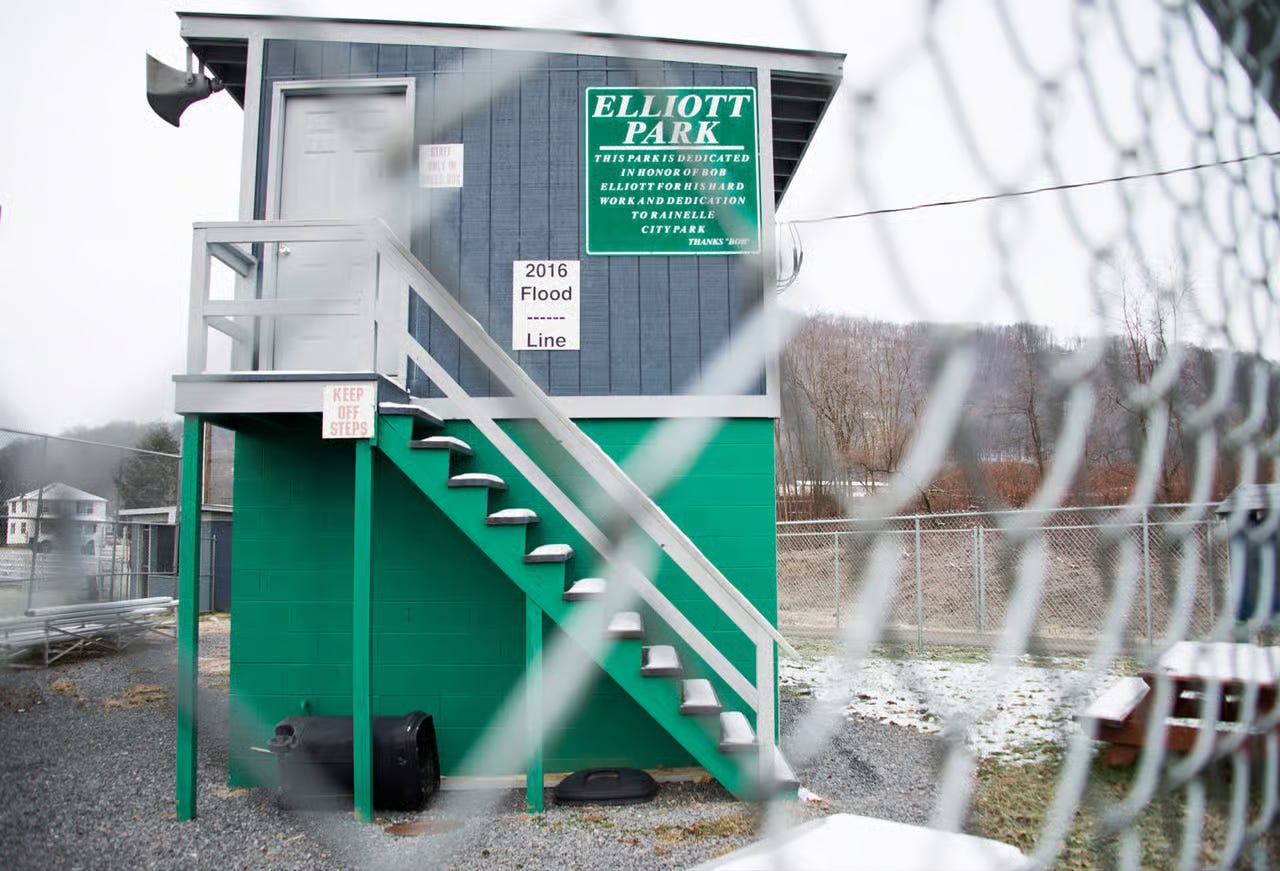
The water went down. It always does. What the town did afterward decided what it would become.
This week, the water is going down again.
The storm always passes.
What you do in the after is who you really are.
Build a legacy death cannot take.
Subscribe. Get the Legacy Audit. Start building a legacy death cannot take.
Then send this to the brother you haven’t really talked to since the last election. Call him before Thanksgiving.
Not ready yet? Start with the foundational essay on the cult of self: What Echoes in Eternity. Read one piece and decide for yourself whether this is the voice you want in your life.
Another good one!