

Everyone has icons.
We carry them on our shirts, our phones, our walls. Team logos, celebrity faces, family photos, flags. We lift them high and kiss them in our hearts.
The early Church warns about pagan icons because Christian images are holy. Long before the Church established icons as part of the councils; they had them in their caves, homes, and places of worship.
I have stood before the icons of St. John in San Francisco and in Israel where the saints prayed for centuries, asking for help.
In Rome, in West Virginia, in every temple I have entered, the same grammar holds: Christ in the center, His Mother nearby, the saints gathered. The story of salvation wrapped around the people like light.
Christians keep icons despite the risk of persecution.
And I want to tell you why. More importantly, I want to show you what you are already doing without knowing it.
The Uncomfortable Truth About Your Walls
Here is a question worth sitting with: What faces do you keep before your eyes every day?
Your phone screen. Your social feed. The celebrities, the influencers, the athletes, the politicians. The icons that greet you before you’ve had your first cup of coffee. The images that shape your mood, your desires, your sense of what is worth wanting.
You have icons. Every human being does. The word itself is just the Greek word for image.
We carry them on our shirts, our phones, our walls. We scroll past thousands of them daily. We lift the ones we love and are trained by the ones we don’t even notice.
The question is not whether you have icons. The question is whether the faces you keep before you make you more real or less.
Everyone has icons. Even the Iconoclasts.
The man who would never bow before a holy image will bow before his phone for four hours a day. The woman who calls religious pictures superstition scrolls past a thousand curated faces designed by algorithms to trigger her dopamine and shape her desires. Some people mock “religious pictures” while letting advertisers catechize our hearts with images that train us to love noise, novelty, and self.
This is a diagnosis.
After you understand it, you can’t explain it away.

Why the Church Kept Them in the Caves
The early Christians were not naïve. They lived under Rome. They knew the cost of what they believed. Persecution was not abstract. Arrest, torture, martyrdom were real possibilities.
And yet they kept icons. In their homes. In their catacombs. On the walls of their gathering places. They kept them at enormous personal risk.
Why?
Because if Christ cannot be shown, He has not truly come in the flesh. And if He has not truly come in the flesh, we remain in our sins.
This is theology with consequences. The defense of icons is a defense of the Incarnation. The defense of the Incarnation is the defense of the Gospel itself.
St. John of Damascus, writing in the eighth century, put it plainly: “I do not worship matter. I worship the God of matter, who became matter for my sake.”
The Word became flesh. He did not hide. He was heard. He was seen. Human hands touched Him. If God took a human face, we can show what has been seen. That is the simple reason icons exist, as confession.
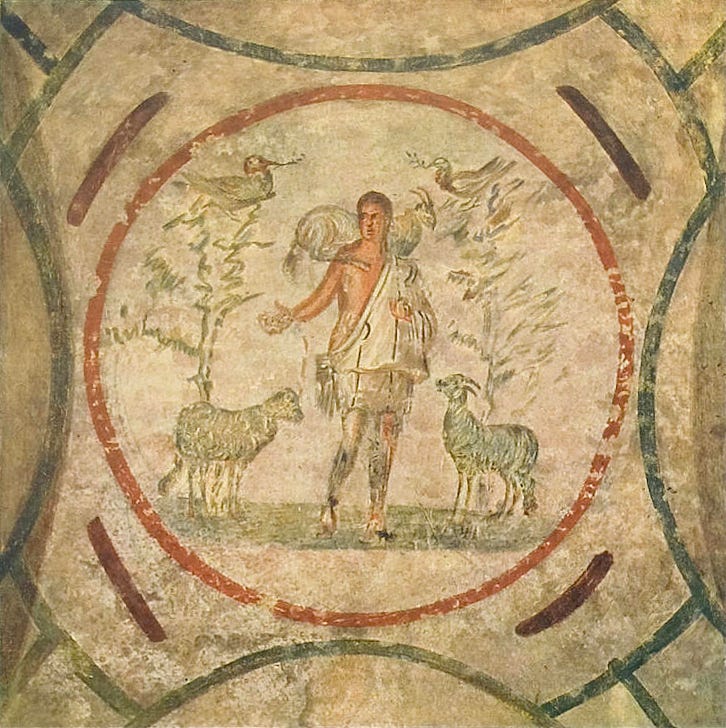
What Scripture Actually Says
People sometimes come to me with the concern that icons contradict the commandment against graven images. I understand the worry. But look at what Scripture actually does.
God commanded images of cherubim on the Ark of the Covenant, which was bowed to and venerated. Moses lifted a bronze serpent, and those who bowed to it were healed. The Temple was filled with carvings, embroidery, and representations of heavenly things. The prohibition was never against images. It was against worshipping false gods through images. When people get this wrong they watch the power of the Incarnation shrivel with their faith.
And then comes the hinge of all history: “He is the image of the invisible God.” (Colossians 1:15). The Son of God is Himself the Icon (Image, same word) of the Father. The exact imprint of His nature. (Hebrews 1:3)
When I stand before an icon of Christ, the honor does not stop at paint. It passes to the Prototype. This is what the Seventh Ecumenical Council defined in 787 AD, completing what the previous six councils had been pointing toward: The honor given to the image passes to the Prototype.
Worship belongs to God alone. Veneration is the love you show to His friends and His saving acts. The distinction matters. I am not praying to wood. I am praying before the One who looked at me first.
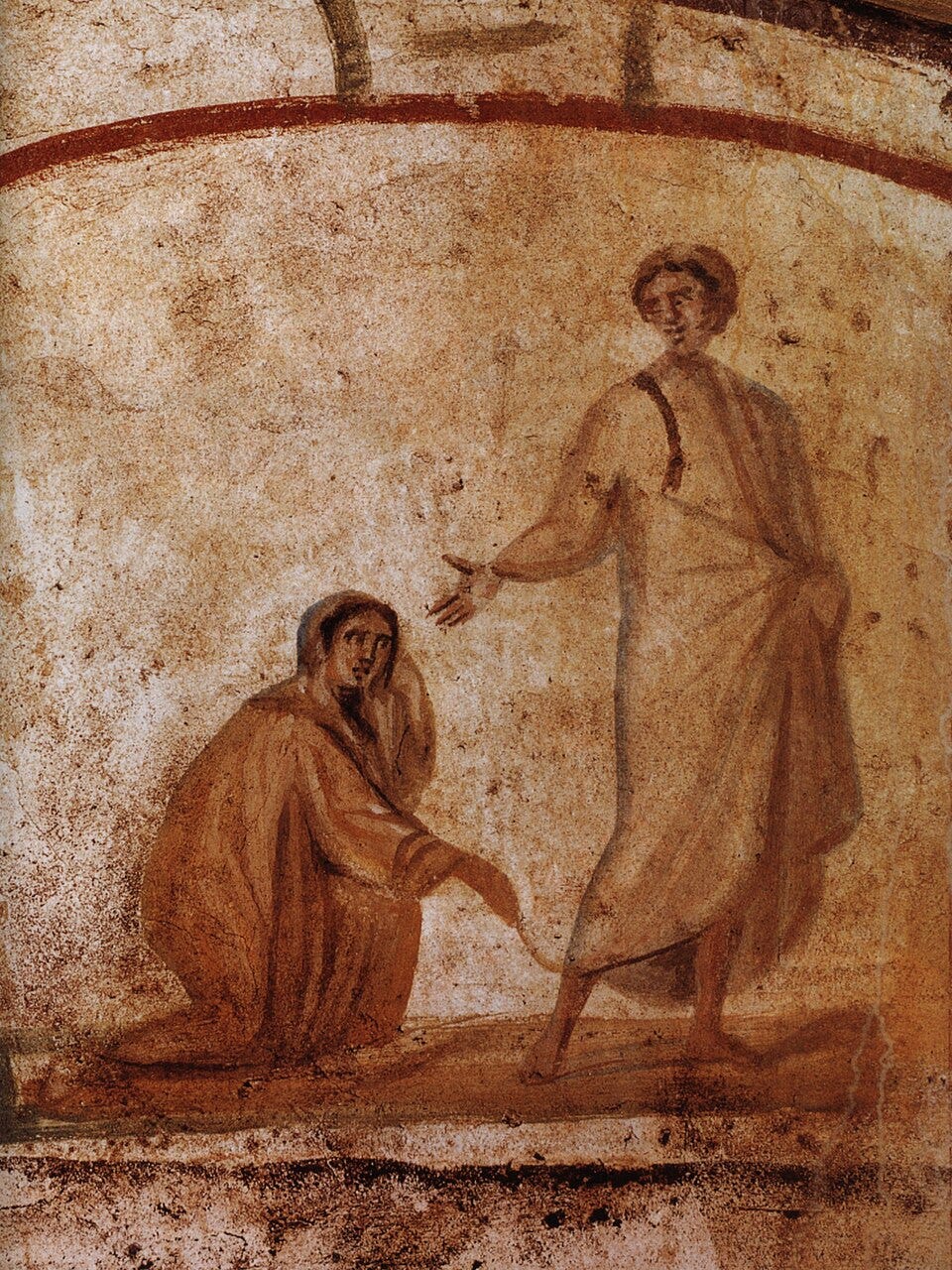
What Icons Actually Do to a Man
I have spent decades in healthcare finance. I have led organizations, managed crises, turned around struggling systems. I know what it is to carry weight.
I also know what it is to carry that weight into prayer and set it down.
Icons correct the eyes. They put Christ at the center and everything else in order around Him. They preach with color what the Gospel preaches with words.
Christ Pantocrator reminds me that the world is not leaderless. When I face a decision that feels too large for me, I need to see the face of the One who holds all things.
The Theotokos with the Child reminds me that the Incarnation is not a slogan. It is a mother holding God. Doctrine with a heartbeat.
The saints remind me that holiness has a human face and a human story. These were real people. Businessmen, soldiers, mothers, physicians, scholars. They faced what I face. They finished the race. Their faces on my wall are not nostalgia. They are a cloud of witnesses.
When I stand before the icon of the Cross or the Resurrection, I am not trying to imagine. I am standing under the fact.
The Icon Corner: Where Your Home Tells the Truth
Here is what I want for your home. A small corner. It does not need to be elaborate. It needs to be intentional.
Christ. The Theotokos. Your patron saint. A cross. A Gospel book if you have one.
This is the place where your family admits the truth. Where you give thanks and ask for mercy. Where you bless your children and pray the Psalms. Where your wife and your kids see that the head of this house orients himself toward something other than ambition and anxiety.
Read Psalm 50. Read a Gospel passage. Light a candle, because prayer should look like something. Bow, because your body should tell the truth your mouth says.
The world will try to fill your house with other faces. The television will offer you lying news anchors or celebrities whose lives are disasters. The phone will offer you an endless scroll of strangers competing for your attention. Algorithms will work hard to replace Christ at the center of your vision with whatever keeps you clicking.
Choose the faces that will make you brave and kind.
This is a decision about who leads your home and what your home is for.
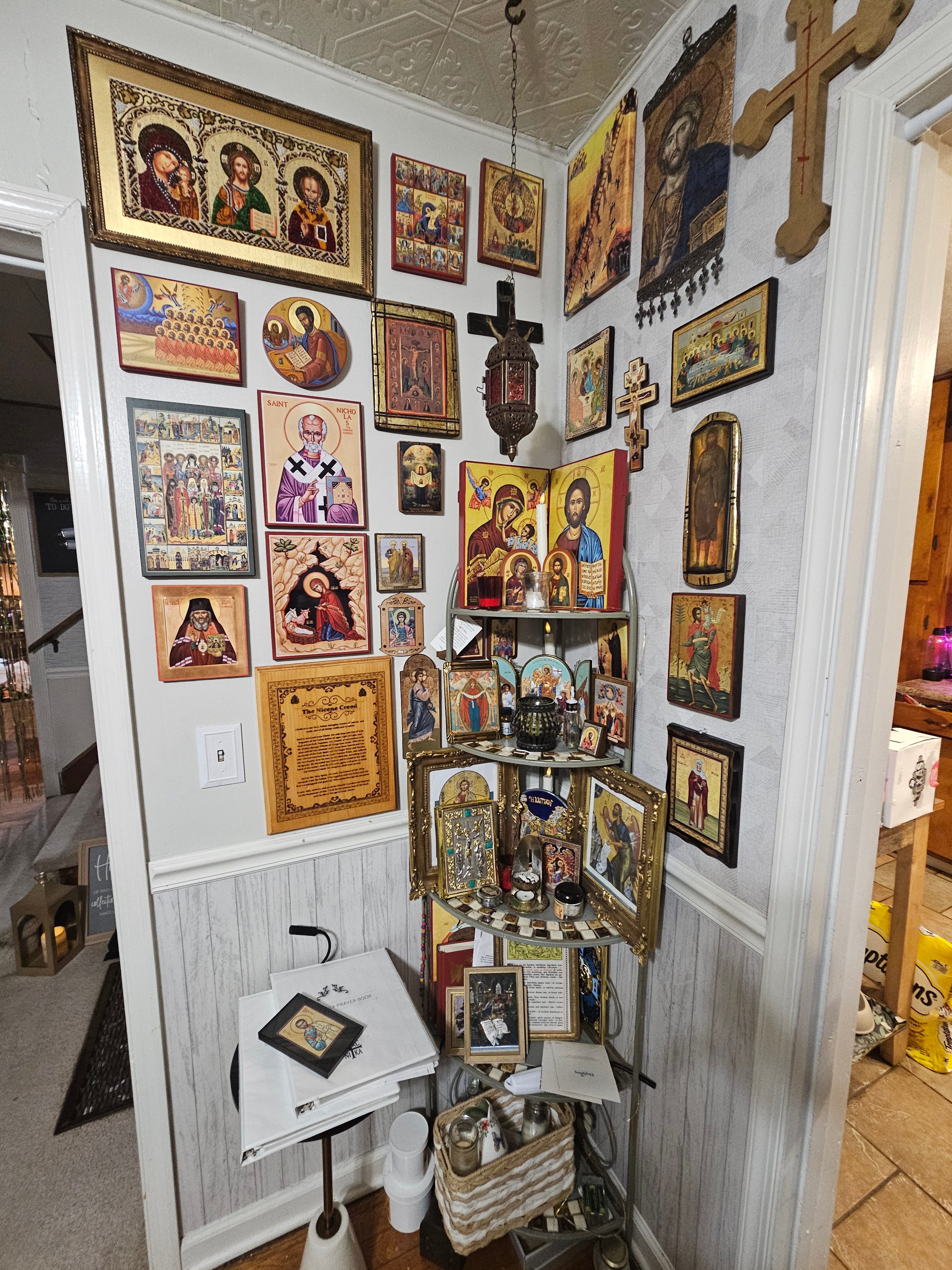
For My Orthodox Brothers Reading This
I want to turn this back on those of us who are Christian believers.
It is easy to see the secular world’s icons and feel superior. The cultural idols are obvious once you know to look. But the mirror is uncomfortable for Christians too.
Do we actually pray before our icons, or do they become furniture?
Does our prayer corner gather dust while our phone consumes our first and last moments of the day?
Do we ask the Theotokos to cover our families, or do we carry our anxiety through the whole day without ever setting it down?
Icons are for prayer. They are not decoration. They are not Orthodox aesthetic for people who like Byzantine art. They are a tool for orienting the soul toward what is true.
The true spiritual life requires that we guard the heart. The Fathers called this nepsis, watchfulness. You cannot guard what you do not see. You cannot see clearly when your eyes are trained daily on faces designed to distract you.
The icon corner is a daily practice of re-orientation. This is how you train the soul to recognize the Face that has always been turned toward you in love.
What I Have Seen
I have stood in churches where the Church has prayed for centuries without interruption and seen miracles.
I have watched what happens when icons are loved in a home.
The children grow up knowing that their home is oriented toward something.
The prayers deepen because the eyes learn to see.
The husband leads differently when he begins his morning by standing before the King of Kings instead of opening his notifications.
The blind will wrongly call this superstition. This is training.
Look at what your eyes already worship every day. Ask which images make you generous. Ask which faces make you clean-hearted. Ask which pictures steady your love for Christ.
Build the Corner. Then Watch What Happens.
Icons are a mercy because God is kind. He took a face so we would not be left chasing our projections. He gave us His Mother and His friends so we would not be alone. He gave the Church this holy way of seeing so we would learn to become what we behold.
We become what we behold. That is the truth underneath all of this.
You are already beholding something. Your eyes are being trained right now. Every face you keep before you is shaping your desires, your sense of what is worth wanting, what kind of man or woman you are becoming.
Set Christ before your eyes and do not move Him, honor His Mother, and keep company with His saints.
Then watch how your house changes. Watch how your prayers deepen. Watch how your heart learns to recognize the Face that has always been turned toward you in love.
Everyone has icons.
Let yours be holy.