

You’ve probably seen this. Maybe you’ve written it.
“The basement is finished. Perfect man cave.”
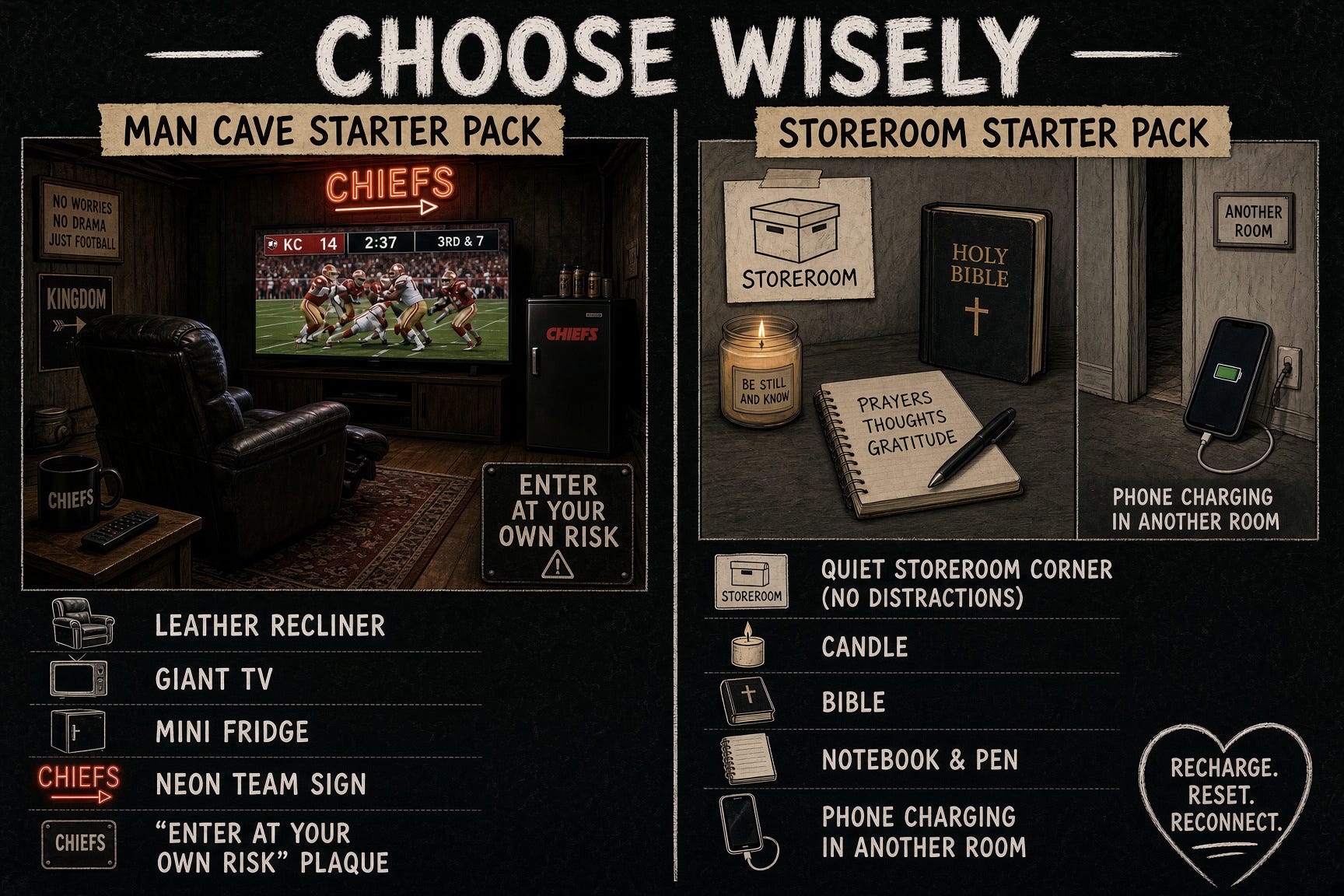
A pair of leather recliners. The biggest screen the wall will hold. A mini fridge. A neon sign in your team’s colors. And somewhere near the door, a little wooden plaque from a gift shop: MAN CAVE. ENTER AT YOUR OWN RISK.

Most men have wanted one. Plenty have built one. Your wife jokes about it with her friends. It’s the one room in the house that’s supposed to be yours. I had one.
Here’s what you probably don’t know about where it came from.
The Dragon at the Door
The phrase got its big push from a 1992 relationship book, Men Are from Mars, Women Are from Venus. It sold over 15 million copies. One idea it put forward was when a man is under stress, he withdraws into his “cave” to work it out alone.
The author’s advice to wives was to let him go. Don’t follow. Don’t ask. Wait for him to come back out. In the book, the “cave” was man’s mind, but it didn’t take long for men to build their own.
Summed up in one line:
“Never go into a man’s cave or you will be burned by the dragon!”
A cave. A dragon guarding the door. A man alone inside with his problems, distractions, or treasures.
Hold on to that picture. We’re going to need it.
To be fair, a man needs a space he can withdraw into. We’ve always known this.
But what happens in that space is important. If it’s a retreat, comfort, distraction, a place where a man can forget his problems in front of the news or the game, this leads to bigger issues. A retreat just to “feel better” isn’t a solution.
Yet, it’s what we built. A room for forgetting.
What You Carry Down the Stairs
You go down there because you’re tired in a way a nap doesn’t help.
You’re holding 3 fronts at once. A marriage that needs more of you than you have left at 7 PM. A house full of people, kids or grown kids or grandkids, watching what kind of man you are. And work that wants your best hours and usually gets them.
You can’t lead any of them off an empty tank and a scattered mind. You know that. So you go looking for a room to “refill.” You come back up as empty as you went down. Some nights emptier.
There’s a reason. A team at the University of Virginia found it in one small experiment.
In 2014, researchers sat people alone in a bare room for up to 15 minutes with nothing to do but think. No phone. No book. Beforehand, each one felt a sample of a mild electric shock, and they said they would pay money to avoid feeling it again. Then the researchers left them alone with a button that would shock them.
67% of the men pressed it. They chose pain over 15 minutes alone with their own thoughts.
Blaise Pascal saw it coming 350 years earlier:
“I have discovered that all the unhappiness of men arises from one fact, that they cannot stay quietly in their own chamber.”
The man cave takes the problem and furnishes it. Every screen in the room is a button a man can press, so he never has to sit with himself.
A man who can’t sit alone with himself has nothing steady to bring anyone else.
Go Into the Storeroom
Christ gave His own instruction about the room a man goes into alone.
“But you, when you pray, go into your room, and when you have shut your door, pray to your Father who is in the secret place; and your Father who sees in secret will reward you openly.” (Matthew 6:6)
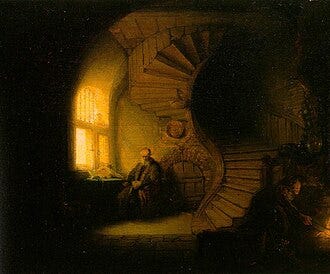
The old King James calls the room your closet. The Greek word is tameion, and in an ordinary house in Galilee it meant the storeroom. The small inner room, often the only one with a door that shut, where the household kept its grain, its oil, its provisions for the winter.
Think about where Christ sent men to pray. The hypocrites He described earlier prayed on street corners to make sure others saw them (Matthew 6:5). Christ sent His men to the pantry.
The family keeps the food in the storeroom. A man goes in, shuts the door, and comes back out carrying what his family needs.
This is the room a man needs. An inner room, where the work of re-building yourself is done. In the pain of silence, in the desperate prayers of a heart yearning for a peace only God can give.
You go into the storeroom to be reminded of who you are and what you are here to do.
The Robber Who Couldn’t Stay in His Room
The early Christians who took this most seriously went out into the Egyptian desert. They called the small room where they prayed a cell.
One of the toughest men out there was named Moses.
He started as a slave, thrown out of his master’s house for theft and worse. He was huge and violent, strong enough that a gang of robbers made him their leader. The old accounts say he killed men.
Somewhere along the way, God got hold of him. He ended up at a desert settlement called Scetis, a big, rough, scarred man trying to learn how to pray.
He couldn’t stay in his cell.
The old life came after him there, lust most of all, the way it comes after every man the moment he is alone. One day he went to his spiritual father, an old priest named Isidore, and admitted, “I can’t do it.”
Isidore took Moses up onto the roof.
“Look west.” Moses looked and saw a host of demons massing for an attack.
“Now look east.” Moses saw a countless host of angels, shining, standing ready.
Isidore told him the ones in the east were sent by God to help the men who fight. Echoing what the prophet Elisha once told his terrified servant, Isidore explained, “Those who are with us are more than those who are with them“ (2 Kings 6:16).
Moses, a man of action, comes to understand that the cell is the front line of the battlefield. This gives him courage, and Moses climbs down and goes back into his cell.
Understand, your storeroom, closet, prayer corner is you’re true man cave. The place without the screens, the neon sign, the smartphone is where you need to go. The place where you’re confronted with the silence, painful thoughts, the temptation to press a button -- this is the real fight.
Years later, the robber had become one of the great fathers of the desert. A brother came and asked him for a word to live by. Moses told him:
“Go, sit in your cell, and your cell will teach you everything.”
The cell is where the fight actually happens. Any man who has tried to sit still for 10 minutes knows it.
The Ancient Faith has a word for what a man learns in his cell: stillness. A guarded heart. A man standing watch at his own door.
A famous scriptural call to stillness comes out of a war song. Psalm 46, the Lord of Sabaoth psalm, opens with mountains shaking and nations raging. Then God speaks:
“He makes wars cease to the end of the earth; He breaks the bow and cuts the spear in two; He burns the chariot in the fire. Be still, and know that I am God.” (Psalm 46:9-10)
Be still.
Let your hands drop.
Lower the weapon you’ve been gripping.
Stillness is a command.

What the Room Has Become
Let’s be honest about what most of our rooms have become.
A screen, scroll, second job in disguise, where the laptop comes downstairs or onto the bed, “Just to check one thing.”
The cult of self has a vocabulary for that room, and you’ve heard it:
“You’ve earned this.”
“Me time.”
“Protect your peace.”
“Recharge.”
Each one sounds like rest. Then you look back at what you actually did for 3 hours, and it was a feed. Highlight reels of nonsense. Flashing lights asking for money. Pretty women stealing your attention. Outrage you can’t do anything about. Someone selling you a better version of yourself.
A man who fills his only important hour with noise gets formed by whatever is loudest.
Something is going to disciple you in the room. You choose who.
If it isn’t God, it will be the feed.
Trust me, the feed never asks what’s good for your wife, children, or community.
The Ledger
To be clear, I am writing this article for myself.
The cell terrifies me most mornings. The scroll on my phone seems like the perfect balm; and I know that’s a lie.
This past month, I completed a 21-day streak of prayer, exercise, and study before touching the phone. Something I’ve failed at reaching for months. I’d get a week or two in and then fail. Again and again. Made day 21 then on day 22 failed, again.
The lesson: Get back up, start again.
It’s always something. Eager to see election results before praying. Want to check the sportsball score from the night before. A moment’s distraction before the day gets started. We’ve all been here.
Like St. Moses the Black, we will struggle, but the front line is the storeroom, closet, or prayer corner. Not the smartphone. Not the man cave.
I’ve spent decades as a CFO, and here is something every finance man learns early. The books almost never blow up in a day. They drift.
A small entry posted to the wrong account in March. A reconciliation skipped because the month was busy. By December, there’s a hole no one can explain, and everyone swears it appeared overnight.
Good finance teams reconcile on a schedule. The discipline is boring. It’s also the only thing that catches drift while it’s still small.
A marriage drifts the same way. So does a soul.
It almost always comes down to a thousand small entries no one reconciled. A short word at breakfast or a promise to your son you let slide. A prayer you skipped because the day was full, then the next one, then the next.
The room is where you check the books every morning, while the numbers are still small enough to fix.
The small daily discipline keeps a marriage, family, faith, and a business from drifting when no one is watching.
Build the Room
Here is where to start.
Claim the room. A chair, a corner, a spare bedroom, the end of the kitchen table. A few helpful things: a cross or an icon, a candle, a Bible, a notebook, and a pen.
Be Intentional. Set your alarm earlier than normal, make the time to go into the cell with intention. Leave the phone charging in another room. If the phone comes with you, so does the button.
Light the candle and read a Psalm out loud. Start with Psalm 46. Then sit still and let your hands drop. 5 minutes, no words. You’ll want to press the button. Don’t. If you can’t take the silence pray, “Lord have mercy.”
Check the ledger. Write 3 questions by hand and answer them honestly. Where did I drift yesterday? Who did I fail? Who needs me today? Then pray for every name you wrote down.
Come back up and go first. The room exists for God to build and strengthen you for service. In stillness, don’t drift, seek forgiveness for the failures, and serve those in need.
Go back to that little sign on the basement door.
Enter at your own risk.
The man cave sold us really did come with a dragon at the door, and a man alone inside guarding his treasures and calling it rest.
St. Moses the Black had a door, too. Behind his, a robber became a father.
Your sons inherit the man who walks out of that room every morning. Someday, they’ll build rooms of their own, and they’ll build the kind they watched you come out of.
I had the man cave and mine watched me walk into it for too many years. Then, my wife bought me the greatest gift, a prayer bench, and I began kneeling before the cross instead of distracting myself with a screen.
So build the room. Then go sit in it and let God build the man.
Next Sunday, we’re going looking for the dragon.
Build a legacy death cannot take.
Subscribe. Get the Legacy Audit. Start building a legacy death cannot take. Take the twelve questions in your new room some morning this week. Send this to a man that needs the storeroom.
Not ready yet? Start with What Echoes in Eternity, the foundational essay on the cult of self. Read one piece and decide for yourself whether this is the voice you want in your life.
What Echoes in Eternity

One of the most-followed business voices on the internet (Hormozi) told millions of men how their funeral will go.
Great!