

My people crossed on the Treasurer in 1612.
They came for freedom. Room to worship without a bishop over their shoulder. Underneath this, they wanted what every man wants: a life that means something.
400 years later, I found what they were hungry for. It was older than Jamestown. Older than England’s break from Rome. Older even than England.
So why did it take 400 years to find it?
The Fastest Ship in the Atlantic
In the summer of 1612, a 130-ton ship called the Treasurer slipped out of England with 14 guns and about 60 men aboard.
Her captain, Samuel Argall, had already found the shortcut. 3 years earlier, he quit the old southern route, the long drop to the Canaries and the slow ride through the Caribbean, 12 weeks if you were lucky and 18 if you weren’t. He pointed his bow west along the 30th parallel and held it there.
This time, he beat his own record. 57 days after leaving England, the Treasurer was in Virginia. No one had made the crossing faster!
If you know the Treasurer at all, you probably know her from a cartoon. That spring, Argall used her to carry off a young Powhatan woman named Pocahontas and hold her hostage at Jamestown. Disney left that part out.
One man aboard they called John Claye.
Tradition says he was a soldier put over the musketeers Argall brought to guard a colony, which kept dying.
In January 1625, the colony counted every soul it had left. At a plantation on the south bank of the James called Jordan’s Journey, a clerk wrote it down:
John Claye, in the Treasurer, February 1613.
Ann, his wife, in the Ann, August 1623.
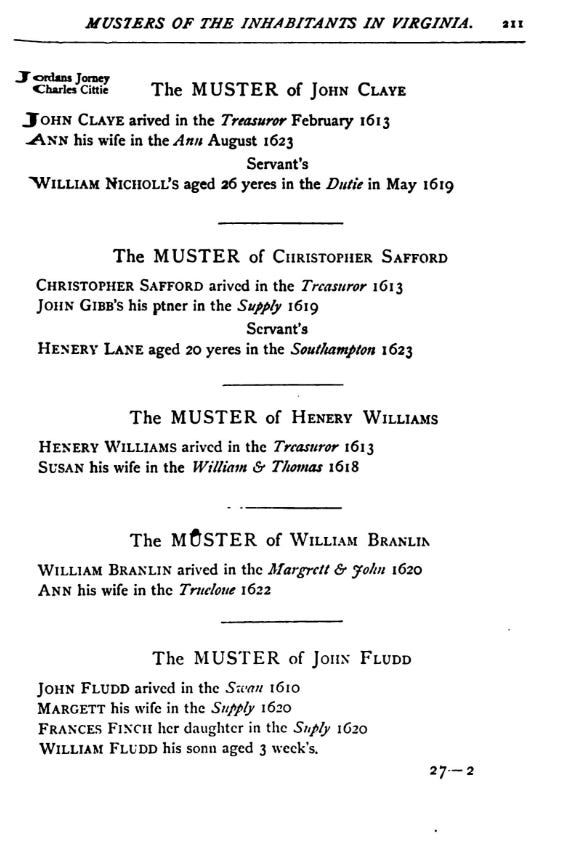
He’s off by a few months. The Treasurer was already riding at anchor in Virginia, working the Potomac. 12 years and a lot of graves later, a man can be forgiven for misremembering a date by a few months.
John Claye lived. This alone puts him in rare company. 3 winters before he landed, Jamestown had starved down to a few dozen survivors eating their horses and their dogs.
The Virginia Company had a name for the men: Ancient Planters. The title came with 100 acres.
John Claye earned his by not dying.
Genealogists argue about the relationship of John Claye to Charles Clay, born around 1638. If the history holds, John Claye is probably about my 10th great-granddad.
That’s the simple part: A name, a ship, a date, a patch of riverbank.
The hard question is why he got on the boat.
What They Hungered For
Some of them came for money. Tobacco was about to make a few men in Virginia rich, and the Company wanted its return.
If you read what they wrote something else keeps surfacing.
The charter King James signed in 1606 gives one purpose for the venture, and tobacco is nowhere in it: the “propagating of Christian Religion.” Jamestown was sold to England as a mission.
The colony ran more like a monastery with muskets. Under Dale’s Lawes Divine, Morall and Martiall, every man and woman went to church twice a day at the toll of the bell. Miss once, lose your day’s food. Miss twice, the whip. Miss 3 times, 6 months chained to the oars of a galley. Skipping the Sabbath 3 times, and the penalty was death.
No one writes a law like that about something he thinks is decoration.
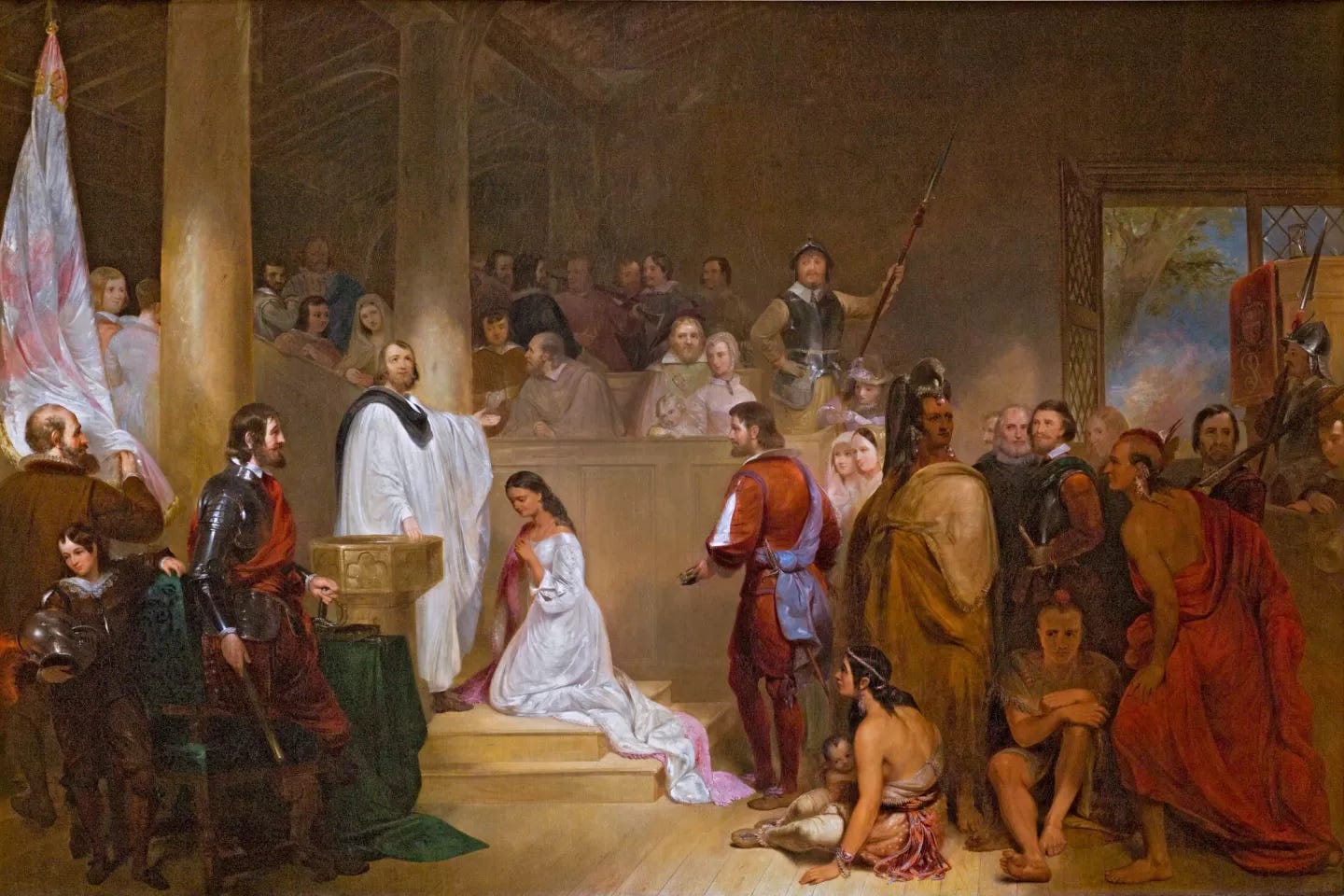
Then there’s Alexander Whitaker, the young preacher at Henrico who instructed and baptized Pocahontas. His father was one of the Puritan scholars of Cambridge. Alexander gave up a comfortable English parish to preach in a swamp, and in 1614 he wrote home wondering why the English ministers who were “so hot against the Surplis and subscription” didn’t come to Virginia, “where neither is spoken of.”
No Anglican vestments (surplice/Surplis). No bishop’s oath. Room to breathe.
This is the hunger. They felt the Church of England had gone cold, half-reformed, still wearing robes they couldn’t justify. They wanted to strip it down. Get back to something real. Start fresh on clean ground.
They weren’t wrong. Something had gone missing.
You know the feeling. Maybe the church of your childhood went cold on you. Maybe you never had one. You want something real, and every option you’re handed feels like a product.
What no one told them is where the stripping-down ends. Every reform makes the circle a little smaller. Each new church is purer than the last until the last one standing has a congregation of one.
You’ve heard the slogans that came out the other end:
“Find a church that fits you.”
“Worship your way.”
“I’m spiritual, not religious.”
Friend, this is the cult of self, the modern lie that your life is your own, wearing a Sunday shirt.
The men on the Treasurer never said this. Yet they were pointed in that direction. They were hungry for the real thing, and they were sure it lay ahead of them, on new ground, in a purer future.
It never crossed their minds that what they were seeking might lie behind them.
What They Didn’t Know They’d Lost
Go back 1,000 years before Jamestown to a winter night in Northumbria, in the year 627.
King Edwin is weighing whether to become a Christian. He calls his council into the great hall, the fire roaring in the middle, the storm howling outside.
One of his old counselors stands up and says the thing the men felt but few would say out loud. St. Bede copied it down a century later:
“The present life of man upon earth, O king, seems to me, in comparison with that time which is unknown to us, like to the swift flight of a sparrow through the house wherein you sit at supper in winter... he immediately vanishes out of your sight, passing from winter into winter again.”
Bede, Ecclesiastical History of the English People, II.13
Out of the dark. A few seconds of fire and light. Then back into the dark.
The old man finishes, “If this new teaching can tell us anything more certain, we ought to follow it.”
The English were seekers.
What they found was solid.
For over 400 years, England belonged to the one Church, the same Church from the cold islands of Northumbria to the golden domes of Constantinople. One faith. One table. One set of saints.
It produced men worth knowing.
Bede himself, the monk who wrote the first history of the English and died chanting the Gloria.
Cuthbert of Lindisfarne, who stood in the North Sea to his neck all night praying, and walked out at dawn to find otters drying his feet.
Aidan walked everywhere so that he’d meet the poor on the road.
Then the family split.
In 1054, Rome and Constantinople broke communion. 12 years later, William of Normandy sailed for England, carrying a banner blessed by the pope. After Hastings, Norman bishops replaced English ones almost to a man. In 1070, papal legates deposed the last Anglo-Saxon archbishop of Canterbury.
To be fair, the last Anglo-Saxon archbishop was no saint. Yet, the man who replaced him belonged to a different world, and England went with him.
After the conquest, thousands of English refused to live under the Normans and sailed east to Constantinople. A medieval chronicle counts 235 ships. Many joined the Varangian Guard, the emperor’s own axe-men, and the guard became so English that centuries later it still greeted the emperor at Christmas in English. Some of them, the old accounts say, planted a colony on the Black Sea and called it New England.
In Constantinople, an English exile built a church for his countrymen. They dedicated it to St. Nicholas.
Back home, the drift kept going. Rome tightened. Then in 1534, Henry VIII broke from Rome and stepped sideways, with himself at the top.
By 1612, the inheritance was a ghost. The men on the Treasurer still said the Creed. They still prayed the Psalms, kept Christmas and named their sons John and Thomas. They carried pieces of the Ancient Faith across the ocean in their pockets, like coins from a country that no longer existed.
They didn’t know they were carrying a fragment of something that was still whole.
The Room Behind the Door
For years, I wasn’t carrying anything at all. I’ve written about my this here:
My Cowardly Agnosticism

In my late teens and early twenties, I fell into the religion of agnostic atheism.
One thing which helped turn me around was a discipline. A decade ago, my wife and I went deep into the Stoics together, Epictetus, Seneca, Marcus Aurelius. The Stoics teach a discipline they call assent: don’t agree to a thing until it’s true, and when it’s true, agree all the way.
I tried to practice this, and it walked me back to Scripture. Scripture pointed to the Church.
Then came Jerusalem.
On the slope of Mount Zion stands a church called St. Peter in Gallicantu, the rooster’s crow. It sits over what tradition holds was the house of Caiaphas, the high priest. Under it is a pit cut in the rock. Prisoners were lowered into it by rope. Tradition says Christ spent the night before His crucifixion there, alone in the dark, while upstairs Peter swore he never knew Him.
Pilgrims go down into that pit and read Psalm 88:
“Thou hast laid me in the lowest pit, in darkness, in the deeps.”
Psalm 88:6 (KJV)
Walking in those lands, in the pit, the Ancient Faith became real to me. The faith no longer remained invisible or like a church in the clouds; I could now touch, join, and follow it. For Christ had come into the world so that the world might be saved.
In 2023, my family walked into St. Nicholas Orthodox Church in Beckley, West Virginia. We stood in the nave and listened. The prayers are the ones Anglo-Saxon fathers prayed. St. Cuthbert and St. Bede are remembered. The faith at St. Nicholas is the one Edwin’s old counselor reached for when he talked about the sparrow.
The name over the door is St. Nicholas. The same saint those English exiles chose in Constantinople, 900 years ago, when they’d lost everything else.
The door they built for freedom opens onto the room they left.
For me, this is the irony of America, and it’s a gift. The men on the Treasurer wanted room to worship freely. The country their great-grandchildren built gave exactly that, to everyone. This means when the ancient Church finally reached these shores in Alaska, there was nothing to stop it from coming in, setting up its icons, and waiting.
They went looking forward. The thing they were hungry for was behind them the whole time. It took the long way around.
Already Here
If you have English blood, this story belongs to you too.
46.6 million Americans claimed English ancestry in the 2020 census. More than any other ancestry in the country.
Every one of them is a grandson of Bede’s England. Every one of them has Cuthbert and Aidan in the family tree, whether anyone ever said their names at the dinner table or not.
The Church those men belonged to is here; it’s growing.
It came the other way around the world. In 1794, 181 years after John Claye, a handful of monks from a monastery on a lake in northern Russia stepped off a ship onto Kodiak Island in Alaska. One of them, a simple monk named Herman, stayed 40 years, defending the native people against the traders who abused them. He’s the first saint of North America.
The Orthodox Church in America traces its roots to that beach. Today, there are Orthodox parishes in coal towns and county seats across this country, many of them small, many of them full of converts who came home the long way.
For a man of English blood, coming back to the ancient faith is a homecoming.
You don’t have to settle 2,000 years of church history this week. You do have to stop assuming the faith of your fathers began in 1534, or 1607, or with whatever church you grew up in.
For the Americans or even the British, the faith is older than the country. The doors are still open.
The time to board the ark is before the storm.
Find Your Ship
Here are some simple steps to explore this on your own:
1. Learn one saint of your blood. Cuthbert, Aidan, Bede, Alban. Pick one and read his life before next Sunday. Find out what your people were like when they were whole.
2. Go stand in the oldest worship you can find. Find a church that prays the way Bede prayed. Go. Watch.
3. Tell your children where they came from. Skip the genealogy chart and tell the story: the ship, the sparrow, the saints. A boy who knows his people were seekers will know what to do with his own hunger.
What Will the Clerk Write?
In January 1625, a clerk at Jordan’s Journey wrote 3 things about John Claye: his name, his ship, a date.
Someday, someone will write yours. A headstone. An obituary. A line in somebody’s family tree.
The question is what you’ll be carrying when they do. A fragment you never examined? Or the whole thing, handed down to the children standing at your grave?
My people crossed on the Treasurer seeking something.
400 years later, I found the meaning they were hungry for. It had been waiting.
Build a legacy death cannot take.
Subscribe. Get the Legacy Audit. Start building a legacy death cannot take.
Send this to the man in your family who keeps the genealogy. He’s been carrying the names. Give him the faith that goes with them.
Not ready yet? Start with What Echoes in Eternity, the foundational essay on the cult of self. Read one piece and decide for yourself whether this is the voice you want in your life.