

If you’re like me, you’ve seen it more than once. I have the DVD set, so it’s lot more than once. Maybe you put it on every fall when the air turns cold.
Ten episodes in, the war ends. Then the show does the thing it held back the whole time. The old men you’ve watched at the top of every episode, the ones talking about “the boys” without ever being named, finally get their names on the screen. They’re in their seventies and eighties now. Some of them can’t finish a sentence. One stops mid-thought, looks off camera, and his chin trembles.
Something in your chest tightens.
Your wife glances over, “You okay?”
“Yeah. It’s just a good show.”
It is a good show. The show isn’t why you’re sitting there with your jaw set.
You’re Grieving Something You Never Had
Here is what you won’t say out loud.
You have coworkers, a church you attend, or used to. Maybe, you have a group text with the guys from college which comes alive for the next get-together or fantasy football season. It’s quiet the rest of the time. You have men you like.
What you don’t have are men who would run through a town full of Germans for you. If you’re honest, you can’t name one you’d run through enemy lines for either.
You aren’t alone. 15% of American men say they have no close friend, 5x the rate of a generation ago. Most of them look fine from the outside -- career, house, kids. They’re sitting in offices that look a lot like success.
When the show hits you, it’s showing you an absence.
You’re watching men who had the thing you were built for and never got, and some part of you knows it.
You ache because you’re grieving something you never had.
They Weren’t Born Brothers
Easy Company didn’t start as a band of brothers.
It started in 1942 as a pile of strangers from coal towns, farms, and city blocks, dropped at Camp Toccoa, Georgia, with a mountain behind the barracks called Currahee.
Three miles up. Three miles down. Again. And again.
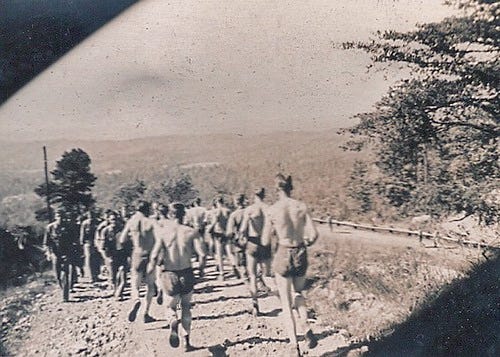
Their commander, Herbert Sobel, was petty, cruel, and by most accounts unfit to lead men in combat. He canceled weekend passes over a speck of rust. He ran them past the point of reason. The men hated him with a unity nothing else had produced.
The mountain, the petty man, and those miserable months made them one of the sharpest companies in the regiment. Years later, some men admitted Easy owed Sobel something. He had prepared them.
This is the first lesson of the show, and it’s the one modern men skip:
Brotherhood is built on shared hardship toward a shared mission.
Shared hobbies or opinions don’t produce it. Sitting next to each other at a ballgame produces acquaintances. Climbing the same mountain at 5AM with the same miserable man shouting at you, produces brothers.
Carwood Lipton, the WV native, quotes the Henry V line halfway through the shows ending interviews:
We few, we happy few, we band of brothers;
For he to-day that sheds his blood with me
Shall be my brother.
Notice the order: 1st blood, then brother.
The Men You Put in Front of Your Son
Easy Company had brothers beside them.
Every man also needs fathers above him.
Being homeschooled, I went along with my dad wherever he traveled. Courtrooms. Bank lobbies. Conference tables where I was the only one in the room who couldn’t shave. I sat with bankers, lawyers, entrepreneurs, and judges. I mostly kept my mouth shut and watched how grown men carried themselves.
Years later, my mentors at New York Life gave me words for what I’d been soaking in: the company you keep is who you become.
My grandfather put it simple, “Never use the ATM. Go inside. Meet the people.”
So I did. I’ve spent my life trying to shake the hand, get in the room, and sit near men older, smarter, and wiser than me. I wasn’t impressive, and I knew it, but I knew where impressive came from.
Scripture said it 3,000 years before New York Life did:
“He who walks with wise men will be wise, but the companion of fools will be destroyed.” (Proverbs 13:20)
My father understood something I didn’t see until much later. The men a father puts his son in front of matter. A boy becomes the company he keeps, and for the first 18 years, his father chooses that company for him.
Two questions to ask yourself: Who are the men you sit near? Who are the men you’re putting your son in front of?
Easy Company had Toccoa. I had conference tables. You have something, too.
Go First
On the morning of D-Day, Lieutenant Dick Winters found himself in command of Easy Company because his commander’s plane had gone down. Near a farm called Brécourt Manor, he took about a dozen men against a battery of German artillery shelling Utah Beach.
Vastly outnumbered, they took the guns.
This assault is still studied as a model of small-unit leadership.
7 months later, outside the Belgian town of Foy, Easy’s lieutenant froze in the open field while his men were being cut down. Winters, by then promoted out of reach, sent in Ronald Speirs.
Speirs took command on the run, and when he needed to link up with another company on the far side of town, he ran through the German lines to reach them.
Then he ran back through them. (Watch the clip.)
The men followed Winters and Speirs for the same reason. They went first.
This is leadership. You go where you’re asking other men to go. You stand between danger and the men beside you and below you.
Christ said it before anyone ever filmed a war:
“Greater love has no one than this, than to lay down one’s life for his friends.” (John 15:13)
You will never jump into Normandy, God willing. We should pray no man ever has to again.
But you have a Bastogne. A marriage under siege. A son in a foxhole you can’t see. A friend from church going under while everyone says he seems fine.
The cold is real. The waiting is real. Someone has to go first.

The Company of Heroes
Let’s return to the old men at the end of the show.
In the last episode, Winters reads from a letter written by one of his sergeants, Mike Ranney. Ranney’s grandson had asked him a question:
“Grandpa, were you a hero in the war?”
“No,” Ranney answered, “but I served in a company of heroes.”
Think about this carefully, friends.
A grandson asks his grandfather a question.
You’ve been carrying a question too. It shows up in the dull hours, late at night, or on the drive home. Is any of this going to matter when I’m gone?
It is the grandson’s question, asked from the other side of the years.
Notice how Ranney answers it? Not with his record, but with his men’s record.
Go watch those interviews! Watch what every man says, in clip after clip.
Winters spent the rest of his life refusing the word hero. They all hand the title to the man beside them. Then, fifty years later, with cameras rolling, they weep. About each other.
This runs against everything the cult of self has taught you.
The cult of self says, “Your life is your own story and you are its hero.”
“Build your brand.”
“Protect your peace.”
“Cut off anyone who doesn’t serve your goals.”
A man can follow that script perfectly and arrive at 80 with an impressive résumé and no one who can say I served with him.
Easy Company’s legacy lives in each other. When one of them fell, the others carried him. They’re still carrying each other, because we’re still telling their story, and not one of them ever told it as his own.
This is what you felt on the couch. You were watching a brotherhood and you don’t have one.
The Brotherhood Is Still Enlisting
When Christ began His work, He didn’t hand twelve men a plan and send them out. Mark records that He appointed twelve “that they might be with Him, and that He might send them out” (Mark 3:14).
Time with Him came first, 3 years of walking, eating, failing, being corrected, and getting back up. Then, near the end, He told them, “I have called you friends” (John 15:15).
The Church has always understood herself as a brotherhood and sisterhood. Christians call one another “brother” and “sister.” If you walk into a Church, you will see the walls covered with faces: Martyrs. Soldiers. Fishermen. Mothers.
Men (and Women) who were afraid and went anyway. Scripture calls them the great cloud of witnesses (Hebrews 12:1), and they’re standing there every Sunday with whoever walks through the door.
If you read their stories, not one of them would call himself a hero or a saint.
Every one of them served in a company of heroes and saints.
The great father of the Church, St. Basil the Great, pushed back on men who wanted to chase holiness alone in the desert with a single question, “Whose feet will you wash?”
A man by himself can’t be corrected, can’t serve, or be humbled by the brother who knows him too well. A man needs a brotherhood to become a saint, the same way Easy needed Toccoa.
The company is still enlisting. You can show up this Sunday and stand next to men who’ve been at it for 40 years. You can be the kid at the conference table again.
Build Your Brotherhood
Here is where to start.
Name three men. Write them down. Men you’d want beside you at Foy. If you can’t name three, that’s your answer, and your assignment.
Go inside. Skip the ATM. Shake the hand. Get in the room with men older, wiser, and further down the road than you. Bring your son.
Go first. Make the call. Send the text that isn’t about football. Ask the man at church how he’s really doing, and wait for the real answer.
Become the old man in the room. Someday a younger man will be sitting where you once sat. Make sure he finds someone worth becoming.
Someday you’ll be the old man in the chair. Maybe a grandchild asks the question. Maybe it gets asked at your funeral by the men standing in the back.
Were you a hero?
The best answer a man can give is Ranney’s. No. But I served in a company of heroes.
Build that company well, and one day those men will say the same thing about you.
Build a legacy death cannot take.
Subscribe. Get the Legacy Audit. Start building a legacy death cannot take. Take the twelve questions, then send it to one man you’d want in your company.
Not ready yet? Start with the foundational essay on the cult of self: The Enemy in Your Midst. Read one piece and decide for yourself whether this is the voice you want in your life.
That 15% is far too low. You could double it if not more. And today there is far more pathetic darker crisis in men to even find any remotely that would run through fire with you..
The real-life Dick Winters – a man among men, a man's man – chokes up just a little in relating the content of that letter.
If you've viewed each episode, and paid attention to the interview clips that precede each one, you choke up, too.
"This is what you felt on the couch. You were watching a brotherhood and you don’t have one." God-damn right, most of us don't. The modern business world, which rewards cut-throat selling out your colleague/perceived rival, is not the place to find it – a life of fellowship in Christ with other believers, is.