

The strongest man alive is standing in front of an old king, waiting to be praised.
He has earned it.
Two monsters are dead by his hand. The hall that sat dark and empty for twelve years is full of light and singing again. He is young, undefeated, famous across the northern seas, and he has laid the trophies of his victories at the foot of the throne.
The old king, Hrothgar, looks at the young hero at the absolute peak of his powers. And he gives him the strangest gift in the great poem.
A warning.
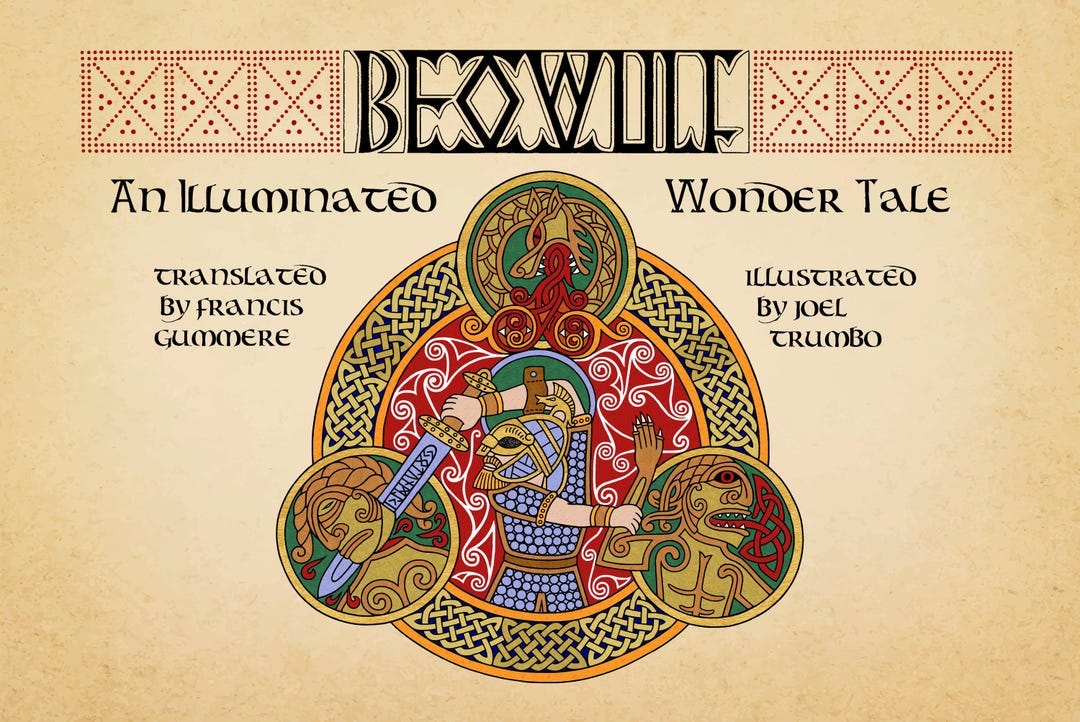
The Watchman Falls Asleep
This is known as Hrothgar’s sermon. Eighty-odd lines sitting at the center of Beowulf, and my favorite lines of the poem. Moral. Wise. True.

In my office there is a copy of this poem in a place of honor, the Old English on one page and the translation facing it, and this is the passage that is bookmarked.
Hrothgar describes a man God has favored. Health, land, power, a name. Nothing resists him. The old king says that this is when the danger begins. Because in all that comfort, something inside the man stops paying attention.
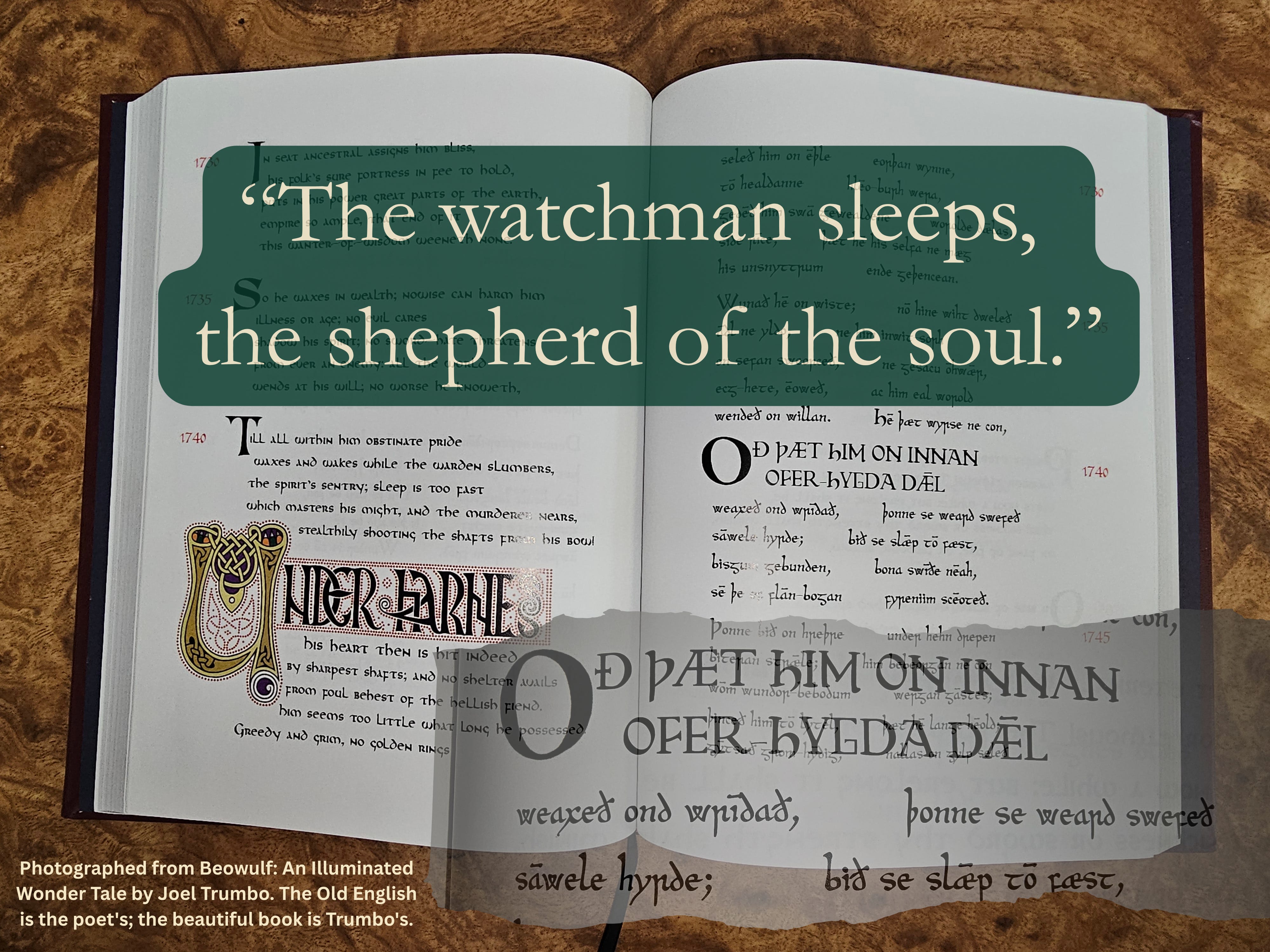
...se weard swefeð, sawele hyrde — “the watchman sleeps, the shepherd of the soul.” (line 1741)
While the watchman sleeps, a killer creeps close with a bow.
When you read this poem carefully, you notice the arrow behaves strange. It passes under the helmet and into the heart. The armor is bypassed. The strength and skill at combat are irrelevant for this type of arrow.
The arrow is whispered counsel, and every man reading this has heard it: you built all of this yourself; it is yours, the time, the money, the kingdom. Hold on to it all.
Hrothgar describes what the wound does. The man begins to covet. He grows angry-minded, distrustful. He stops giving. The whispered counsel is like poison.
The poet of Beowulf would have wanted the Anglo-Saxon kings hearing his stories to feel and understand the weight of what he was saying. For an Anglo-Saxon king had a defining virtue, to be a ring-giver (bēaggifa). Wealth existed to move through his hands to his men. A lord who stopped giving rings was already dead. Only, his burial had not yet occurred.
The poet wrote this twelve centuries before anyone coined the phrase cult of self. Yet, he described it with perfection. A man alone at the top of his own life, guarded by success on every side, brought down by a whisper no armor can stop.
Guard your heart, dear poets and warriors.
The Part About Growing Old
Hrothgar stops describing the proud man and looks straight at the young hero in front of him. Dear Beowulf, best of men, guard yourself against that evil. And then the title of this article
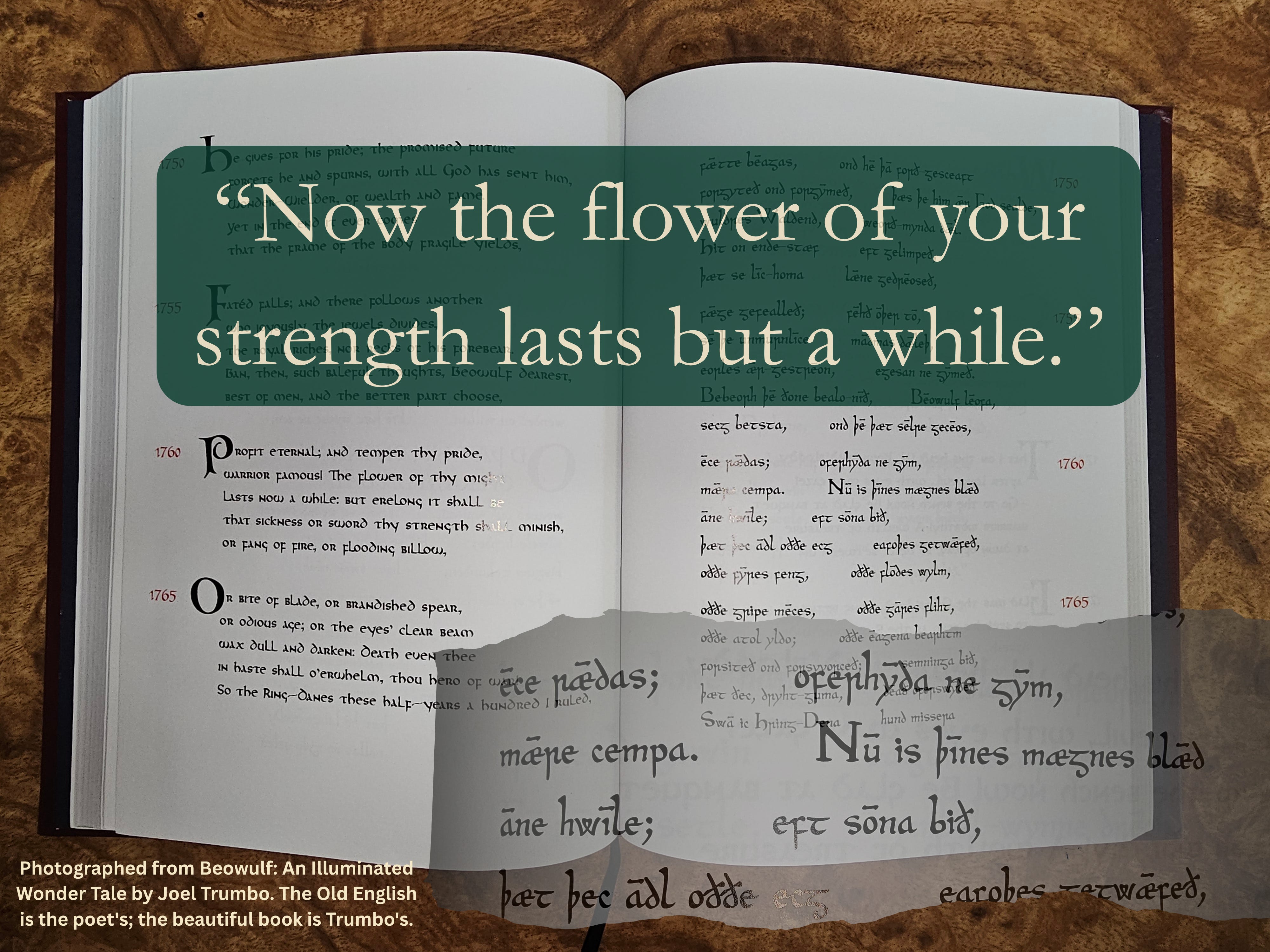
Nu is þines mægnes blæd ane hwile — “Now the flower of your strength lasts but a while.” (line 1761)
The old king counts the ways the flower of a warrior’s strength leaves. Sickness or the sword’s edge will strip your strength away. Fire’s grip. Flood’s billowing. The flight of a spear. Or terrible old age, when the brightness of the eyes dims and goes dark.
Hrothgar can say this because he has lived it. He built the greatest hall (heorot/mead-hall) on earth, ruled in glory, and then sat in that hall helpless for twelve years while a monster terrorized and emptied his hall night after night. Strength left him the way it leaves every man: death, he tells Beowulf, will overpower you too.
Hear me now, brothers!
Every one of us is on the same path. Your age will come to an end soon. You may be on the rising tide of success. Perhaps you are strong, competent, and winning. The old king is telling you the flower has a season, and a wise man builds for the day the petals fall while his hands are still full.
The Better Counsels
What does the old king actually tell the strongest man alive to do?
Two words.
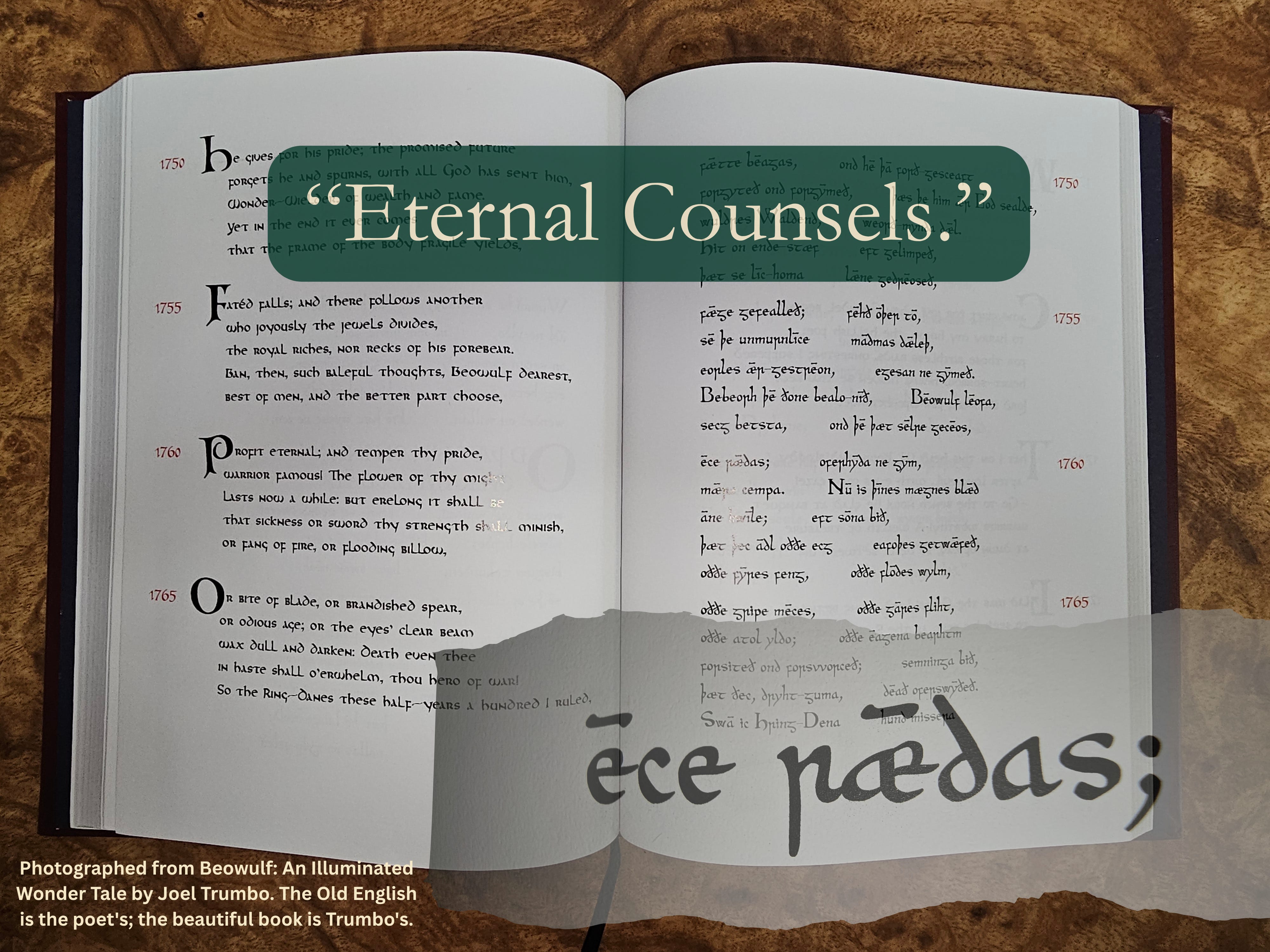
...þæt selre geceos, ece rædas — “choose the better part, the eternal counsels.” (lines 1759-1760)
Ece rædas. Eternal counsels. The things that still hold when strength is done.
The Beowulf poet was a Christian, most like a monastic, copying down scripture and ancient stories for us to receive. In doing this, he decided to tell this story. The poet is looking back with love at pagan ancestors who had courage and strength in abundance and no resurrection hope. The poet puts his whole theology into an old king’s mouth: glory is a loan; strength is a loan; the hall, the gold, and the name are loans. The only holdings to survive the funeral pyre are the eternal ones.
Beowulf listened.
He ruled well for fifty years and died, as the old king promised he would.
At the end, his men standing at the burial mound called him the mildest of men, the kindest to his people.
The gold on the pyre melted.
The witness remained.
Find Hrothgar and Beowulf
One more thing before you go.
The most important speech in the poem came from an old man to a young one, from a king who had been humbled to a warrior who had not.
This warning has to be handed down, face to face, by someone who earned the right to give it.
Two questions:
Who is your Hrothgar? Name the older man who has standing to warn you, and put yourself in front of him before the year is out.
And who is your Beowulf? Somewhere a younger man is watching you win. The day is coming when the best thing you can give him is your warning.
Beowulf’s story continues beyond the bright hall.
An older enemy waits at the end, patient, coiled around everything a nation treasures.
We will walk that road together when the Christmas Advent Season begins in a four part series, subscribe to be notified when the article releases on November 26th.
Until then, hear the old king.
The flower of your strength lasts a while. Choose the eternal counsels.
Build a legacy death cannot take.
If you’d like to hear an artistic interpretation, a rendition, of Hrothgar’s Sermon in Old English give this a listen:
“Glory is a loan” is a line worth sitting with.
Thank you for the articulate response, it's much appreciated. Time to try out a few different versions.